
From the archives: Rainbow Bookstore closing its doors
Celebrating Tone Madison’s 10th anniversary with some highlights from the past decade.
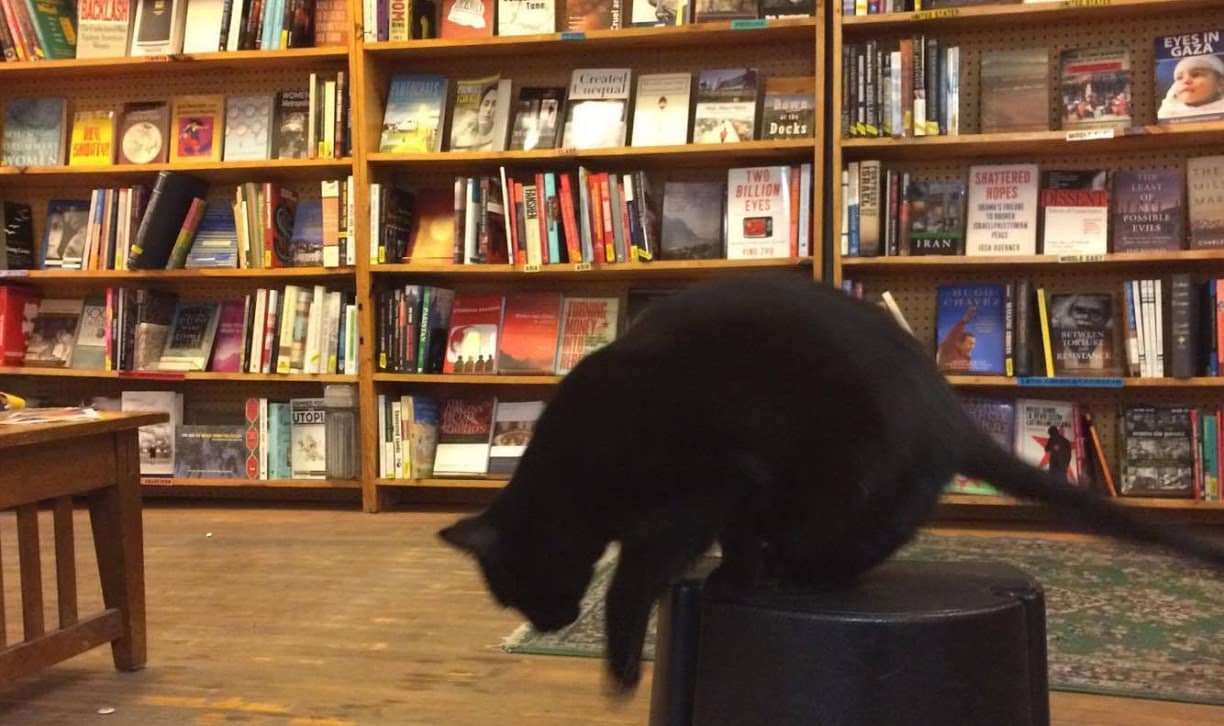
Celebrating Tone Madison‘s 10th anniversary with some highlights from the past decade.
Tone Madison turned 10 years old in 2024. To mark a decade of our fiercely independent, reader-supported coverage of culture and politics in Madison, we’re continuing to revisit some highlights from our archives. Got a favorite Tone Madison story you think we should include? Let us know by sending an email to editor@tonemadison.com.
“It is increasingly crucial and more difficult to educate the public about the importance of belonging to local cooperatives. While the public surely bemoans the loss of community institutions when they’re gone, it is extremely difficult to communicate the importance of sustained patronage to a cooperative during the rest of its lifespan.”
—Chali Pittman
At Tone Madison‘s inception, as it transitioned from the Arts Extract Podcast, it was best defined by its niche arts coverage and droll takes on local culture. Especially since 2020, though, the publication has dramatically ramped up its commitment to progressive political commentary as well as investigative and on-the-ground reporting. And I would argue that Tone is now most recognized for that.
You can see the roots of that evolution in current WORT News and Public Affairs Director Chali Pittman’s reporting on the 2016 troubles at Rainbow Bookstore Cooperative, formerly at 426 W. Gilman St., a mere three blocks from my first Madison apartment. (The shop wasn’t one I frequented, but I won’t forget the visit by Nate McDonough and Daniel McCloskey of Cyberpunk Apocalypse on Halloween 2012.)
Following the recent closure of the longstanding Paul’s Bookstore on State, just last Saturday, Pittman inspired me to revisit her work during that era with Tone, and the pair of articles about Rainbow, specifically. Her initial article in August 2016, “Where the Rainbow ends?,” examined the reasons for the store’s precarity and “decline of radical bookstores,” as Pittman wrote.
This few-months-later follow-up was written and published just one day before Rainbow closed its doors at the end of November. Pittman’s framing concisely relayed the reality of the situation, while at once retaining such a convincing point of view, which wistfully honored the connections she formed with staff and members at this physical location, a significant congregating place.
Further embedded in that reflection was her advocacy for leftist politics and the worker cooperative structure itself. It’s obvious to note, but seven years after these articles ran, Tone Madison itself became a cooperative, and joined the Madison Workers Cooperative (MadWorC)—a move that aligns with Pittman’s values and vision in her integral contributions to this publication.
—Grant Phipps, Film Editor
Rainbow Bookstore closing its doors
After months of uncertainty, the long-running cooperative is done.
Originally published November 29, 2016.
Madison’s Rainbow Bookstore Cooperative will finally close this week.
This August, we reported on the general disarray at the beloved radical cooperative, and were ourselves lost amid the potential scenarios for Rainbow’s future—a future scenario that seemed to change depending on which Rainbow volunteer one asked. There was talk of continuing the cooperative in some other form, or moving to a new location. Several volunteers hoped that the store’s three-month clearance sale might raise enough cash to temporarily solve its financial difficulties. But Rainbow’s landlord, Opitz Realty, says that the store needs to vacate its space at 426 W. Gilman St. by the end of November. That means a last push to liquidate the store and, after a 27-year run, the Rainbow will dissolve for good on November 30.
The cooperative’s uncompromising commitment to its radical roots may have been its undoing. “It’s become harder to be a cooperative in a capitalist society,” says John Peck, a Rainbow volunteer for 22 years. Debbie Rasmussen, another longtime volunteer, says that other Madison cooperatives have only managed to survive after making compromises, such as appealing to a general audience—compromises that would run counter to the whole radical spirit of Rainbow in the first place. The RBC, a specialty cooperative for (essentially) leftist activists, would lose a whole lot of its appeal and reason for existence if it became a general-interest bookstore in order to compete with bookstore chains and online vendors.
Rainbow’s cuddly black shop cat, Harvey, will be moving in soon with another longtime volunteer. Two other nonprofits that used the Rainbow space, Wisconsin Books to Prisoners and the Madison Infoshop, are now both based at the Social Justice Center, 1202 Williamson St.
Rasmussen says that Rainbow’s problems were compounded by the need for volunteers to try and solve several problems at the same time. The cooperative had to chase multiple targets, such as debt repayment and a possible relocation to the East Side, while also running the day-to-day business and help with Books to Prisoners and the Madison Infoshop. With the looming debt the cooperative owes and nowhere to relocate to, it just made the most sense, ultimately, to dissolve the RBC altogether.
Another more subtle problem Rainbow and other Madison cooperatives increasingly face is a dwindling lack of community awareness. It is increasingly crucial and more difficult to educate the public about the importance of belonging to local cooperatives. While the public surely bemoans the loss of community institutions when they’re gone, it is extremely difficult to communicate the importance of sustained patronage to a cooperative during the rest of its lifespan.
Rainbow’s problems were not unique in this regard. Another long-running downtown bookstore, A Room of One’s Own, began as a feminist collective but had to evolve into a general-interest bookstore to stay afloat. The Mifflin St. Grocery Co-op closed 10 years ago under the same pressures. And recently, Community Pharmacy has repeatedly put out calls to remind Madisonians of the importance of their patronage, with only a temporary bump to show for it.
Perhaps the Rainbow’s closing is just another sign of the times. The Rainbow did last longer than many collectives, and there were plenty of years when it was doing really well. And instead of spending energy trying to rescue a sinking ship, former Rainbow volunteers can spend that energy on other nonprofits and cooperatives in order to actualize radical politics. Collectives and cooperatives are still a part of Madison’s fiber. But if you’re like me, and can’t bring yourself to think “out with the radicals, in with creative destruction,” realize the value of Madison’s remaining cooperatives, collectives, unions, and nonprofits. Without an investment of time, money, and energy from the broader community, these institutions will vanish.
For more information on supporting the cooperatives still operating in Madison, visit the Madison Worker Cooperatives website.
Who has power in Madison,
and what are they doing with it?
Help us create fiercely independent politics coverage that tracks power and policy.
Author

Related Articles

From the archives: Take me home to the ball game
Celebrating Tone Madison’s 10th anniversary with some highlights from the past decade.

From the archives: Butter where butter shouldn’t be
As Tone Madison’s 10th anniversary approaches, we look back at some highlights from the past decade.
From the archives: Layers of art, plywood, and privilege accrue on State Street
As Tone Madison’s 10th anniversary approaches, we look back at some highlights from the past decade.