
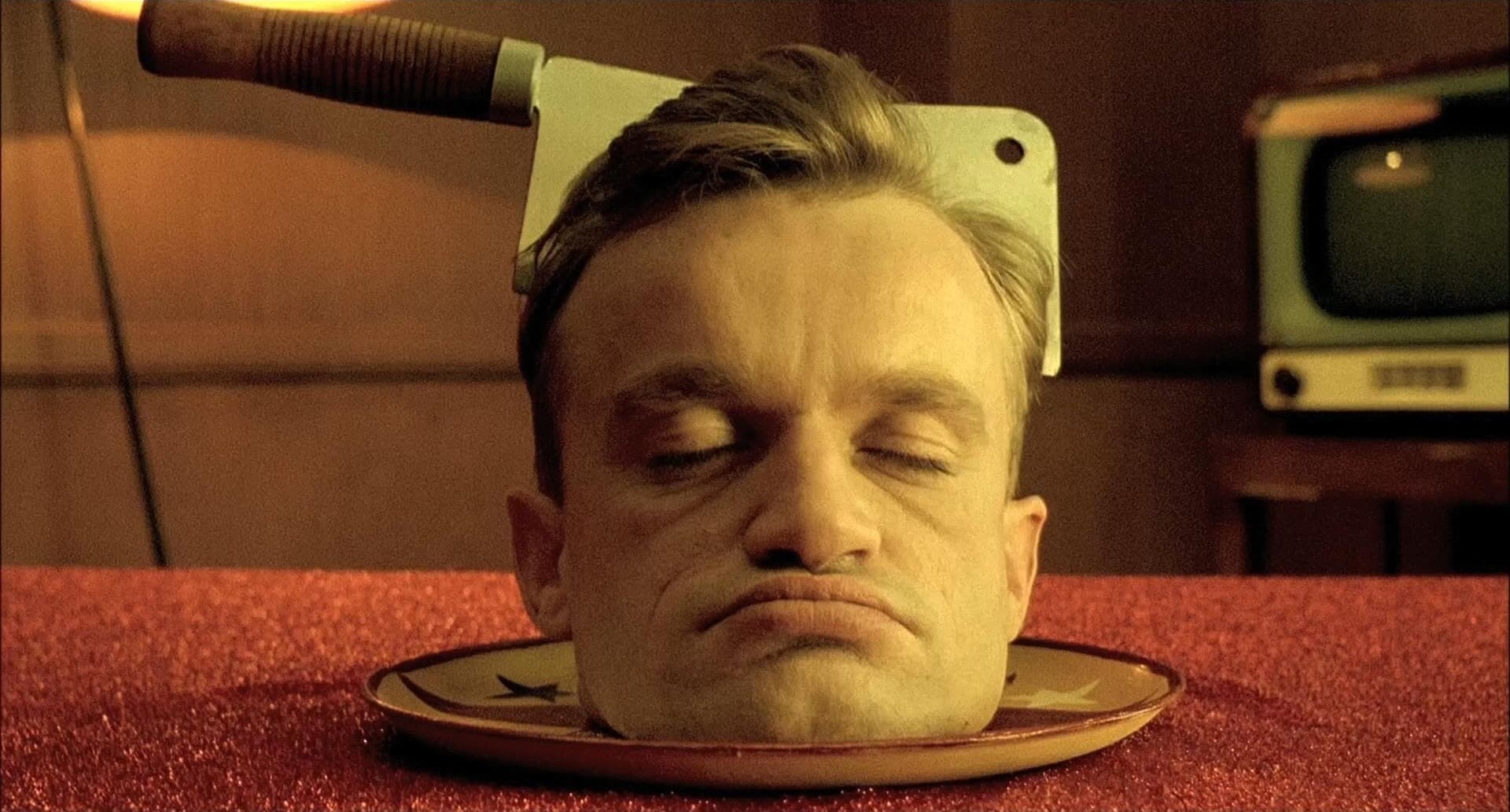
Jean-Pierre Jeunet and Marc Caro’s cutting dystopian black comedy from 1991 screens in a new restoration at UW Cinematheque on March 16.
If you’ve been following fellow Tone Madison contributor Jason Fuhrman’s advice to partake of film-themed dining before a select screening at UW Cinematheque, you might want to consider alternate plans before seeing Jean-Pierre Jeunet and Marc Caro’s Delicatessen (1991), screening there in a new restoration on Saturday, March 16, at 7 p.m. While this pungent black comedy might suggest a perfect pairing, something very different than your usual pastrami or bagel and lox is on the menu here. The film packs in tantalizing visuals galore, but you may very well leave without much of an appetite.
Set in a desolate post-apocalyptic landscape where nothing grows, the atmosphere besieged by perpetual yellow fog, the film stars Jeunet regular Dominique Pinon as Louison, an ex-circus performer who has newly arrived at a dilapidated apartment building to work as a handyman. The tenants have adjusted to the new situation in different ways: some trade grains, some eat snails, and some, like the landlord and butcher Clapet (Jean-Claude Dreyfus), have resorted to cannibalism. Though Louison is a little scrawny, Clapet has chosen him as his next victim.
Viewers who are only familiar with Jeunet from his hyperactive romantic comedy Amélie (2001) might be taken aback at first by the grimey production design of Delicatessen. The industrial decay and steampunk styling has more in common with Terry Gilliam’s Brazil (1985) than the candy-colored Paris of Jeunet’s aforementioned (and more approachable) megahit. But the two films do share a wide-eyed, even borderline naive, belief in the possibility of goodness in their worlds. Louison forms a sweet, if endangered, connection with Clapet’s daughter Julie (Marie-Laure Dougnac), and the pair bond over a love of music. The camera, too, seems infatuated with its setting. Despite much of the action being confined to the apartment building, Jeunet and Caro’s imaginations run wild even in that limited space, cruising through water pipes and swooping along stairways with abandon. Moments of harmonization in the sound design, like bed springs aligning with cello strings and the swish of a paintbrush, add to the cacophonous charm.
Such technical giddiness helps keep the innate despair of the storyline at bay, if only barely. For a film that’s over 30 years old at this point, Delicatessen is the rare dystopian vision that feels more conceivable as time goes on. While many of us are seeing even modest grocery bills balloon to unreasonable proportions, food scarcity is a real problem for a growing percentage of the globe, and one that only promises to get worse as climate change continues to wreak havoc on weather patterns and crop yields. At some point, it will touch every level of society, something that Jeunet and Caro wisely leave as subtext. There’s little that separates the carnivorous apartment dwellers from the more abstemious underground resistance group known as the “Troglodytes,” except perhaps willpower.
In the end, Delicatessen is more optimistic about humanity’s potential to be cooperative, at least on a small scale. When the world’s gone mad, sometimes all you need is a person you can make music with. Or at least someone who shares your diet.