
The dense digital palettes of “Body Prop” confront the horrific normalization of violence in America
M. Woods’ experimental collage essay film screens as part of Mills Folly Microcinema on April 23 at Arts + Literature Laboratory.
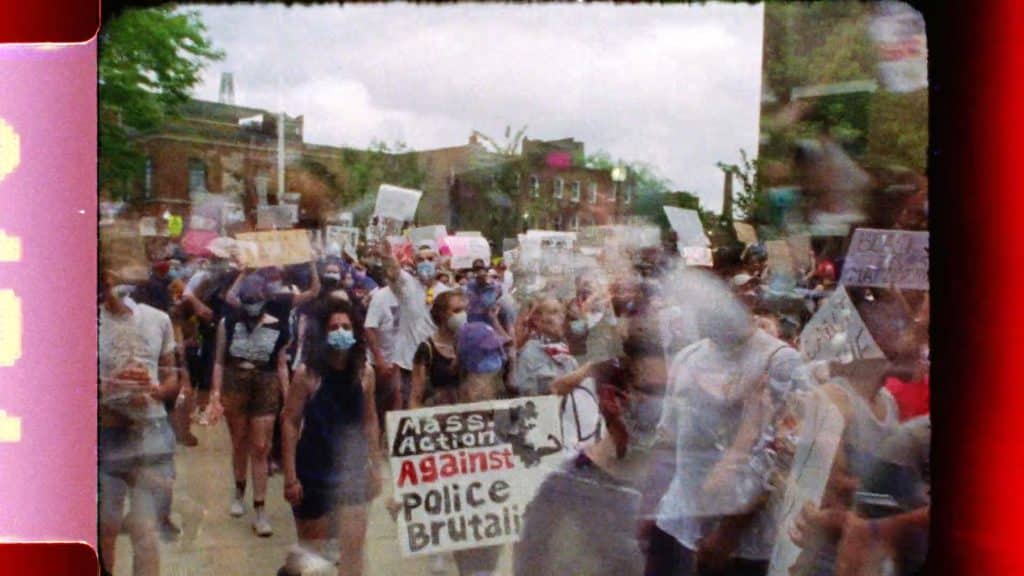
M. Woods’ experimental collage essay film screens as part of Mills Folly Microcinema on April 23 at Arts + Literature Laboratory.
In the time since the avant-garde revolutionary Situationists‘ heyday, Guy Debord’s 1967 philosophical text The Society Of The Spectacle has proven an evergreen resource for artists seeking to make meaning out of the incorporeal chaos of the attention economy. M. Woods is one such artist—their prolific output growing increasingly urgent and multimodal in its Marxist-materialist treatments of the present moment. Their recent work is in and of the pandemic and Trump’s America. Their chaotic documents for chaotic times attempt to reverse-engineer reality in a hyperreal society.
Under the banner of the “Death Spiral Tour” this spring, they will be presenting their second feature, Body Prop (2020), at Mills Folly Microcinema on Wednesday, April 23, at 7 p.m. This screening will also be accompanied by excerpts of Woods’ poetry and film photography from two collections: The Abridged Oxoniae Photographae and [Temporary] Custody, work co-authored by Woods and their young daughter Annmarie.
The experience of watching Body Prop pushes and pulls viewers between a hyper-analytic intellectual project and more polyvalent, intuitive viewing of visceral abstractions. Dense with information, the film’s nearly nonstop narration relays quotes from the likes of Baudrillard and Sartre in a computer-generated monotone or TTS. Occasionally, it overlaps with other streams-of-consciousness and samples ranging from Malcom X speeches to Mozart’s opera The Magic Flute.
The sonic and thematic soup, augmented by Woods’ own original beats and sound collage, complements the film’s similarly dense visual palette, made up of leftover Super-8 reels from past projects and bits of found footage. When legible images come through between stretches of hand-processed abstraction, the material has the quality of a travelogue. Body Prop highlights buildings and people seen in passing on the sidewalk, all layered on top of one another and color-inverted at will.
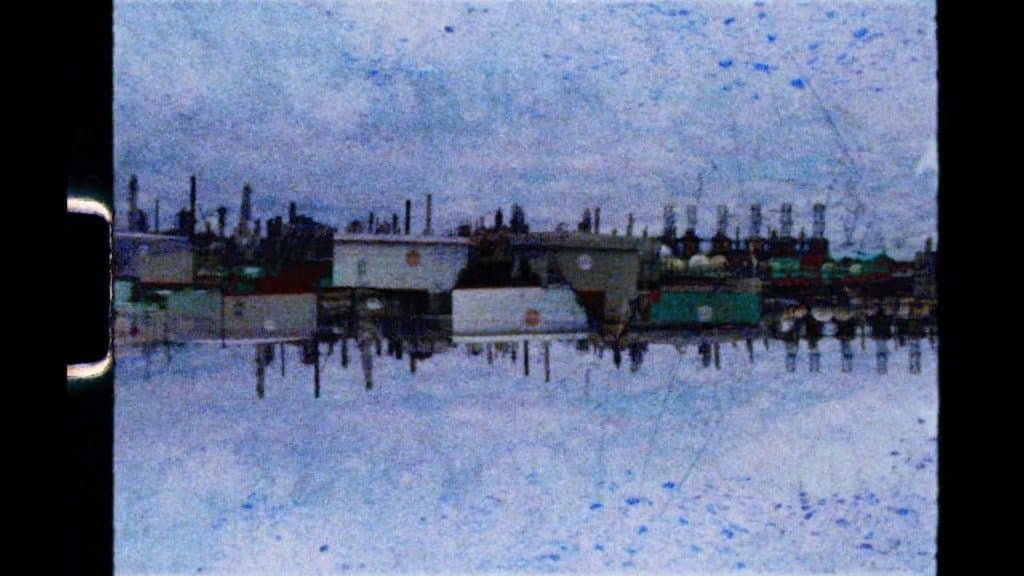
As one of Woods’ robotic stand-ins states, the 2020 social actions that the film occasionally documents have an uncertain place in contemporary society, where gestures towards radical action don’t often rise above the status of gesture. Woods is pessimistic about the path forward, as they and other radical artists in turn have to draw on increasingly insubstantial and discursive material due to the present condition where—according to Guy Debord—”everything that was directly lived has receded into a representation.”
As if to challenge this, Woods abruptly slows the film down in its fourth movement to consider Atatiana Jefferson’s murder by Fort Worth police in 2019. Cutting through the film’s otherwise heavy, frantic material, Woods wants to force a reckoning with the horrifically regular acts of violence committed by cops. Police brutality often gets captured and absorbed into an image economy along with everything else, turning people into “body props”: dehumanized subjects now defined in the public eye by victimhood, living on as a pretext for endless protests.
Frustrated, Woods’ response has been to make work that cuts through what they refer to as a “numb spiral.” As detailed in Woods’ more recent film Commodity Trading: Dies Irae (2023), they mean this as a sort of widespread cultural addiction to flattening all meaning through overstimulation, a response of complacency to the increasing and increasingly visible horrors of the world. Like the recognizable buildings that scroll the screen, Body Prop is an immovable object to be reckoned with, and makes a strong case that all revolutionary art in the present day must be.
We can publish more
“only on Tone Madison” stories —
but only with your support.
Author

Related Articles

Evaluating tenderness and depth of family dynamics in “Sentimental Value”
Grant Phipps and Lance Li argue in favor of and against the artistic framework of Joachim Trier’s latest psychological family drama.
Movie tee envy
Pondering a shirt collection, and stumbling upon Cosmic Cabin, which has the goods—at least niche ones for cinephiles.
“The Annihilation Of Fish” wholeheartedly renders the enchanting eccentricities of a senior romance
Charles Burnett’s long-lost love story from 1999 screens on 35mm at UW Cinematheque on December 5.