
Dan Walkner’s “Easy Going” balances subtle pathos with nostalgic warmth
The Americana-indebted songwriter’s latest album is an intoxicating concoction.

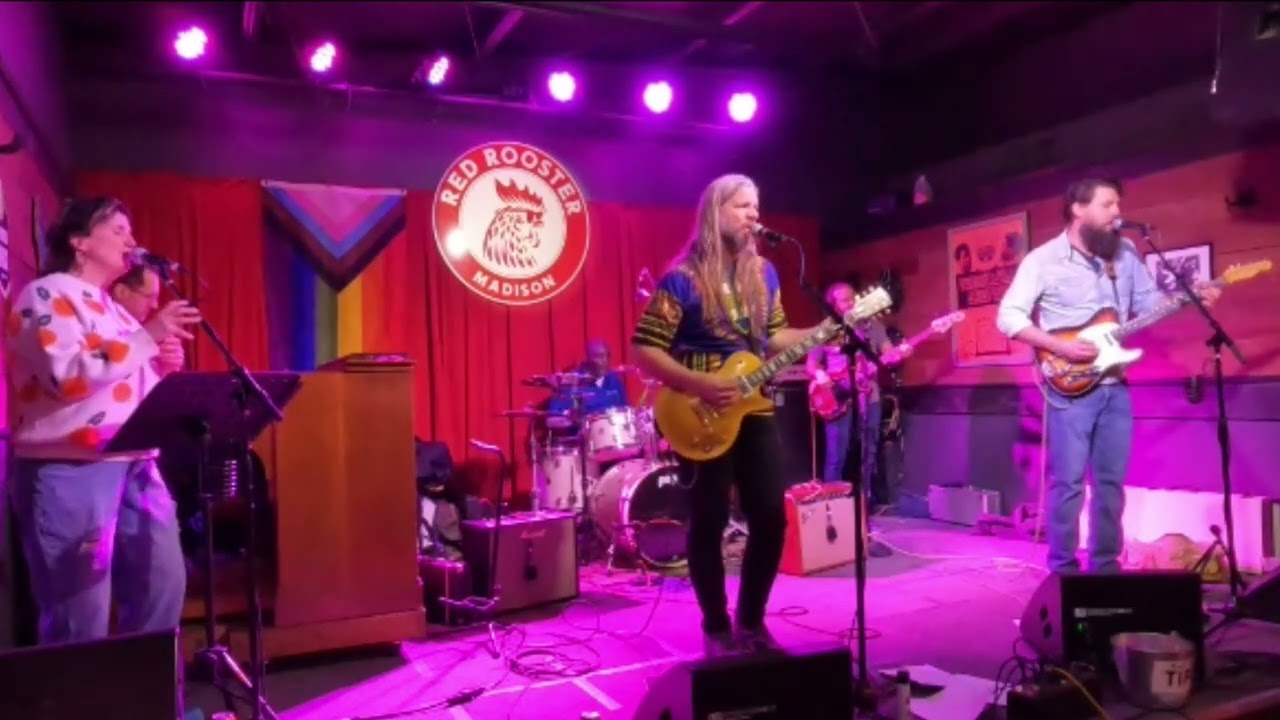
Madison is home to a number of musicians who seem to be driven by the compulsion to create art, above all else. It’s not uncommon to see these names pop up repeatedly—both here and in other local publications—as they dole out a slew of new work with consistency. Occasionally, these acts will disappear for a time, but when they come back, they come back stronger than ever. Dan Walkner‘s the latest example of that exact dynamic, and Easy Going—the Americana songwriter’s new album with the Dan Walkner Band, released physically in June and digitally several weeks later—is hard proof.
Walkner’s music has always been a bit hard to pigeonhole, as it flits between Americana, roots-rock, southern rock, alt-country, folk, gospel, and blues without ever fully settling into one particular mode. But that same resistance to formality enlivens the material, while also keeping listeners on their toes. A rustic, well-loved nostalgia reverberates through Easy Going, which cuts through as both a culmination and celebration of Walkner’s varied influences.
“Easy Going,” both the title track and the album’s opener, is a savvy thesis statement. From the Derek Trucks-esque lead guitar riff, to the blues shuffle and driving rock beat, the band Walkner’s assembled makes it abundantly clear that the ensuing album won’t be gently ambling along. In the coyly clever polarity that exists between the title and the floor-the-gas music, Walkner’s devious playfulness gets a front-and-center showcase. Within that, however, Walkner has buried a lyrical narrative that boasts kernels of incredibly thoughtful introspection.
“Mirror, mirror on the wall / Never told me / Anything I didn’t know / She’d just scold me / Well, I’m just trying to live free / I’m just trying to be me / I’m just tryin’ to be / Easy going,” sings Walkner on the title track, putting a fraught relationship between the frustrations of adulthood and the desire to let them go under the microscope. Relatable and quietly urgent, “Easy Going” sets a strong template for the album. And the ensuing material lives up to the implicit promise of music that’s as balanced as it is nuanced.
To help Walkner achieve his artistic vision, his band of intrepid players digs deep and conjures up some road-worn professionalism. Terry Galloway, Ethan Noordyk, and Jacob Miller all feature on drums at various points. Bass duties fall to the collection of Dan Plourde, Tim Powers, and Nick Brown. Josh Youngblood shows up as a guest guitarist on “That Song”—the only song on the album engineered by Paul Mitch, with the rest ably handled by Mark Whitcomb. Vince Faris tackles keys on the record, and Walkner gets strong additional backing vocal performances from Teresa Marie Hardy, Liz Stattleman-Scanlan, and Craig Baumann. Roger Lian was responsible for mastering Easy Going, and everything else listeners hear on the album was spearheaded by Walkner himself.
Walkner makes full use of his expansive cast of collaborators on the record. “I wanted to get all the best people I get to play with live and showcase what they do best on my songs so everyone gets to be a part of it,” Walkner explains via email. “As far as the songs go, they all are little bits of my life that I put down on paper then got together with the other guys and gals and breathed life into them.”
While Easy Going feels like the product of an army of seasoned veterans, it also still retains the sensibility of a Walkner’s singular vision. Nowhere is this more present than “The Light,” a festival-ready barnburner that adeptly combines nearly every genre Walkner and his band flirt with throughout the album. Gospel keys, a shuffling uptempo snare, a polka-ready bass that sneaks in a good bit of walking, and a handful of tasty fills are all commanding enough on their own. Together, they collate into a rousing, triumphant burst of feel-good catharsis that, ostensibly, stares down hardship, and, possibly, death. “There’s a light / At the end of the tunnel” croons Walkner on the steely-eyed chorus, full of the conviction that there’s a reprieve waiting for anyone who puts in the effort to push through any obstacle in their path. It’s Easy Going‘s biggest moment in both length (the song clocks in at six and a half minutes) and scope—while also leveling acute narrative intimacy—leaving one hell of an impression.
“Nashville Dirt,” which arrives a track earlier, emphasizes Walkner’s tasteful subtlety. A light reggae influence peeks through the song’s more characteristically blues structure, with the two genres combining for a gripping instrumental that feels half as short as its (roughly) three and a half minute runtime. In an email message to Tone Madison, Walkner notes that “Nashville Dirt” was a song that Walkner initially wrote as background music to a stop motion film that his brother and sister-in-law made using his son’s construction toys. The song’s final, full band version—the initial track was a synth project on GarageBand—is a tribute to the filmmaking duo. Taken in a tandem with “The Light,” the two tracks affirm Easy Going‘s well-rounded versatility. Every solid moment of lighter, grounded experimentation is counterbalanced with larger-than-life bombast. It’s an impressive tightrope act that never veers too far off Walkner’s figurative center of gravity.
By the time the mid-tempo “That Song” wraps up the album, Walkner and his band have traversed a good bit of stylistic terrain, but remain steadfast in their cohesion. As a result, the record stands as an intensively unified work, emerging fully intact after a number of well-executed turns. “You know I got my vices / Tell you what’d be nice if / If the jukebox stopped playing that song” belts Walkner in Easy Going‘s final minute, before a burst of twin lead guitars lay the entire affair to rest.
Fittingly, for an album that at least peripherally contends with the limitations of mortality, Easy Going is dedicated to the memory of the cat that appears on its cover, Don Henley. The album’s half-hidden pathos doesn’t come without warmth, extending a sense of subtle, but welcome comfort. As a cumulative whole, the overall effect is one that’s surprisingly tender and moving for a record that wields an unassuming aesthetic as a point of strength.
Walkner tells Tone Madison via email that Easy Going is the 10th record he’s released since moving to Madison in 1999—a discography that includes releases from Wrenclaw and Clovis Mann in addition to solo fare. As an enticing reminder of what heights can be achieved via an uncanny understanding of craft, Easy Going stands out as a superlative entry in that collection. Thankfully, it seems as if Walkner has more left in the tank, and isn’t likely to stop chasing a new horizon.
We can publish more
“only on Tone Madison” stories —
but only with your support.
Author

Related Articles

Achieving a broader focus through music photojournalism in 2025
The fourth installment of our live music photo essay series centers a more personal vantage point.

Tone Madison’s favorite records of 2025
A celebration of 20 local releases that defined the year.

Madison’s musical odds and ends of 2025
A meditation on the past year’s musical margins.