
Cultural assimilation and reciprocity in Nathan Deming’s “February”
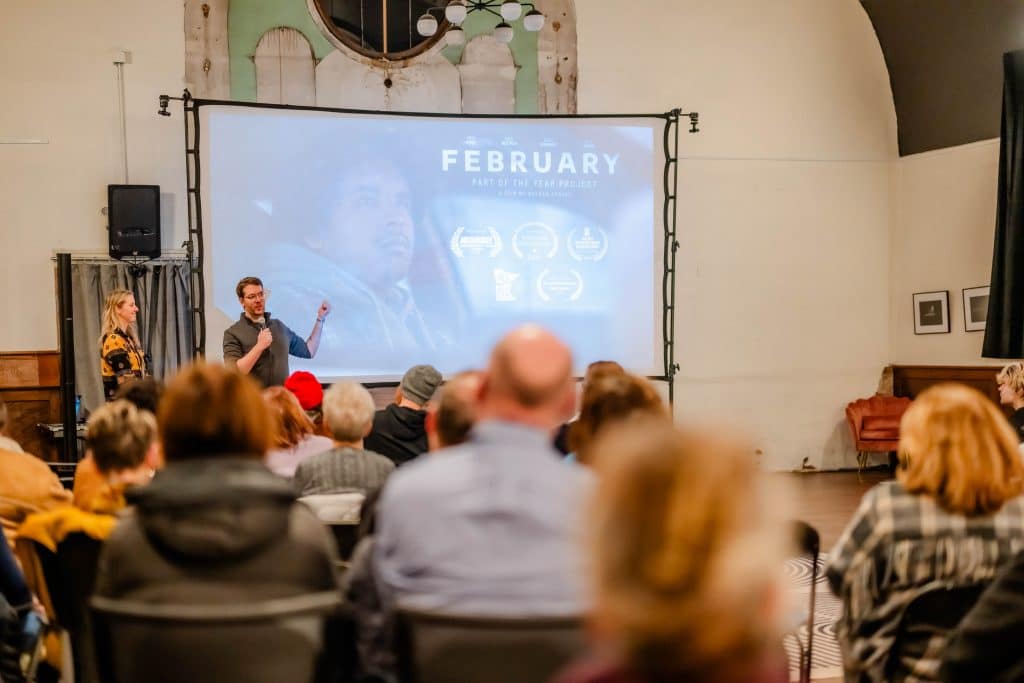
The Wisconsin native and his Golden Badger-winning film return to Madison for a special encore screening and Q&A at UW Cinematheque on March 2.
The Wisconsin native and his Golden Badger-winning film return to Madison for a special encore screening and Q&A at UW Cinematheque on March 2.
Listen to writer-director Nathan Deming speak about his work for just a minute, and you’ll grasp how he humbly wants his characters to find commonalities even in the trickiest of situations. He has positioned them in a formidable cinematic micro-universe, an undertaking partly inspired by Krzysztof Kieślowski’s Dekalog miniseries (1989). Two films into this “Year Project,” Deming intends to make 12 films in total, one for each month of the year, and tell a broad array of humanist tales in Wisconsin refracted through the methods of social realism.
In a November 2024 Shepherd Express article, Asbah Shah perceptively wrote that Deming’s work “is neither grandiose nor overstated. Instead, it captures the quiet, the mundane, and the monotony that stitch together our days.” At least for now, after the two frigid episodes of January (2022, 24 minutes) and February Or: Si Nos Dejan [If They Let Us] (2024, 48 minutes), Deming wants you to feel that. He wants to encapsulate that Midwestern experience for the screen, one that we’re currently stuck in, as we surrender to the introspective, yet placidly harsh hand of the winter season.
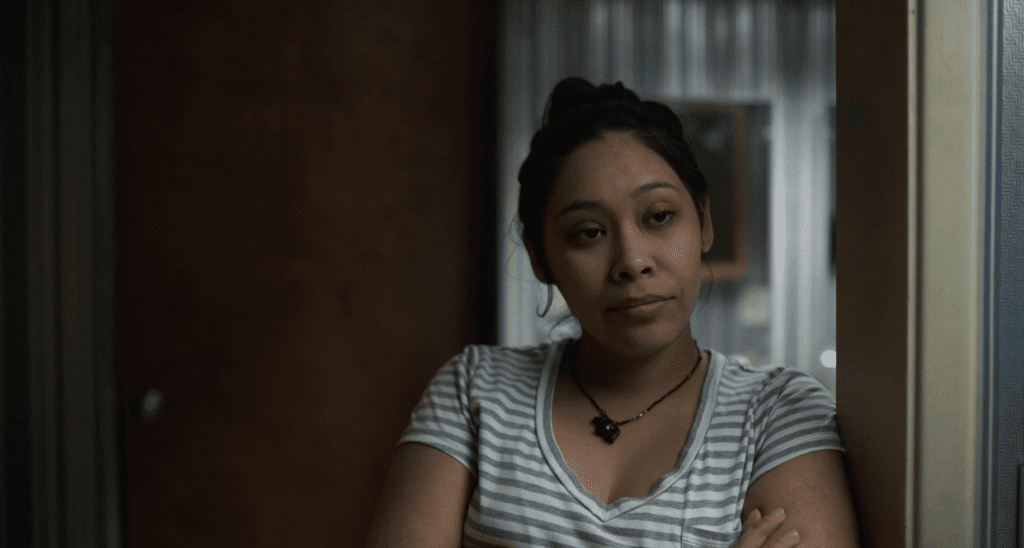
Whereas the first monthly film, January, contained more insulated impressions—largely confined to the hallowed halls and backrooms of a local church with crotchety elder volunteer Marty (Becky Brown)—February is more physically and thematically expansive. Its closing act features a 20-plus-minute sequence shot entirely outdoors on and near Lake Altoona. However, at the start, its focus is on the routines of a Mexican working-class family that includes a young couple—husband Luis or “Louie” (Erick Inestroza), a construction laborer, and wife Rosa (Nayeli Michelle Hernandez), who works as a server at a Mexican restaurant. Rosa’s younger teenage brother, Miguel (David Duran), has just recently immigrated to the middle of Wisconsin to live with them, but he is visibly struggling to healthily express himself and connect with any outside interests.
After Rosa sends Miguel on a simple errand to a sporting goods store in town, Miguel becomes preoccupied with the foreign concept of ice-fishing. He pursues literature on its basics, and, most importantly, a buddy who’s brave and brazen enough to trek out on the lake in biting midwinter temps. Enter the eccentric Carl (Ritchie Gordon), an acquaintance of Louie’s construction pals, who agrees to pick up Miguel for his first session.
Exquisitely shot by Leo Purman, February marks a resolute leap forward for Tomah native and currently Los Angeles-based Deming in terms of writing and directing. It’s garnered attention from a wide swath of Wisconsinites, including the programmers and jurors of the 2024 Wisconsin Film Festival, where it won a Golden Badger Award. Further fine-tuning the tonal tightrope act between dramatic sentimentality and irascible comedy that teetered in January, Deming extends his interest and insights to people outside his own life experience. In February, he finds mutual empathy between seemingly disparate personalities lurking just below the surface, perhaps like the very ice below the tent that Miguel and Carl find themselves sharing one night.
Ahead of a special encore screening hosted by Wisconsin Film Festival director of operations Ben Reiser at UW Cinematheque (4070 Vilas Hall) on Sunday, March 2, at 4 p.m.—just a bit late for the intended titular month, so let’s call it February 30—Deming caught up with Tone Madison via Google Meet. We touched upon a myriad of topics surrounding the film’s production and reception, some of which include: filming on Lake Altoona, the thrill of improvisation with his ensemble of actors (and non-actor), thematic emphasis on identity, and Latino life in Wisconsin. Deming also delved into the arc and ambitions of his “Year Project” and the personal rewards of watching his movies with audiences all over the state.
Editor’s note: This interview has been condensed for clarity.
Tone Madison: I watched your January short more recently than February, and I realized that January was shot mostly indoors. What sort of challenges did February pose in pre-production and production stages for you?
Nathan Deming: The goal of the whole project is that it will grow each time. January was less than half the budget of February. So, that was on purpose. Since this whole thing is about the months of the year, or a huge theme is how environment affects us, I thought I could get away with one film in winter being set indoors. Because that is an experience of winter in Wisconsin. Most of your day is obviously indoors, unless you do something like ice-fishing or other winter activities.
But yeah, I was excited to expand it, ’cause I think winter is so beautiful on film. I just recently rewatched Fargo (1996) [which was shot in snowy Minnesota and North Dakota]. There are some shots that are probably really simple if there was no snow, and once it’s there, it’s this magical kind of other world. I was kinda stressed watching it this time because of filming February. I was like, “How did they know they’d have that much snow?” [Editor’s note: Actually…] That was the challenge. There were some days that were perfect for the look, but towards the end—or I can’t remember when it fell—but we had a spike of 50-degree days. This is pretty common now in Wisconsin, where the snow that had been around suddenly started receding.
Tone Madison: It sounds like there was a range of temperatures you were dealing with outside. Do you remember the coldest day you were out there on the frozen lake? What lake was that? And could you name the locations? They’re not listed in the credits.
Nathan Deming: We filmed all over Eau Claire and Tomah. Tomah is where I’m from, but Eau Claire is where my family lives now, so if I come back [from Los Angeles], I’ll visit them. But the lake, Lake Altoona, is a pretty popular ice-fishing lake. There are always tents and shacks out there. I feel like it was true Wisconsin winter. A week before we started shooting, the [director of photography Leo Purman] and I—he’s from Milwaukee—we went ice-fishing with Ritchie [who plays Carl] and talked about Covid and listened to his theories and stuff. [Laughs.] But that day was like -6. That’s kind of the surreal thing about ice-fishing. At -6, the winds were really strong, so it felt even colder. He’s got a little gas stove or a little burner going with a flame, and suddenly we were down into our hoodies. It was really warm in there.
Tone Madison: Very insulated, then?
Nathan Deming: Yeah, more than you’d expect. That was also like a week before we started filming, so I was like, “Oh my god, this is going to be a brutal, brutal shoot.” But then we got lucky. You know in Wisconsin, too, when you’re used to that weather, and then it’s like 29 or 30, you’re like, “This is warm! This is amazing in comparison to what we just had.” [Laughs.] And then we had that spike of 50-degree days, which despite losing the snow, was way more pleasant to film in.
Tone Madison: If you’re on a frozen lake, though, isn’t that cause for concern if it’s that warm? [Chuckles.]
Nathan Deming: I was definitely concerned the entire time. Those 50-degree days didn’t happen on the lake.
Tone Madison: Oh, OK, I’m sorry.
Nathan Deming: Also, I was told that you’re pretty safe if it’s a sudden [temperature] spike. Even though it was cold, it was unusual. You have to think about safety all the time, obviously, and we had three vehicles scurrying back and forth on the ice constantly. That’s not an unusual sight on [Lake] Altoona. There were trucks everywhere. If we’d ask people if it was safe, they’d laugh at us ’cause they thought we were wimps or something. But I was just concerned if we lose a rented truck or the crew, this is [laughs]—
Tone Madison: The whole “You’re not from around here, are ya?” attitude, maybe. [Laughs.] That feels like a legit question to me.
Did you write out the Spanish-language dialogue in English first, translate it, or are you bilingual?
Nathan Deming: I’m not bilingual. I had a guy, who didn’t want a co-writing credit or anything [and did not want to be named], but I wrote the dialogue and he translated it. And then if there was anything improvised, that was the actors bringing that into the film. They had a lot of little nice touches, too. Obviously, there’s even more regional differences. Sometimes they had a moment where they were like, “Well, in my family, we’d say it this way.” As a director, I thought it was sort of thrilling. Although I love dialogue, it’s kinda nice to not have to think about it too much—to just be focused on the characters and shots and things like that. It was really interesting to put even more trust than usual [into them]. Otherwise, you get stuck in maybe being like, “I wish they would’ve said the line inflected here” when you know the language.
Tone Madison: Sure, you mean emphasizing a certain word in a sentence or the verb in a sentence.
Nathan Deming: Yeah, I might get stuck with how I had it in my head or something like that. So it was kind of cool to let it go and let it be theirs.
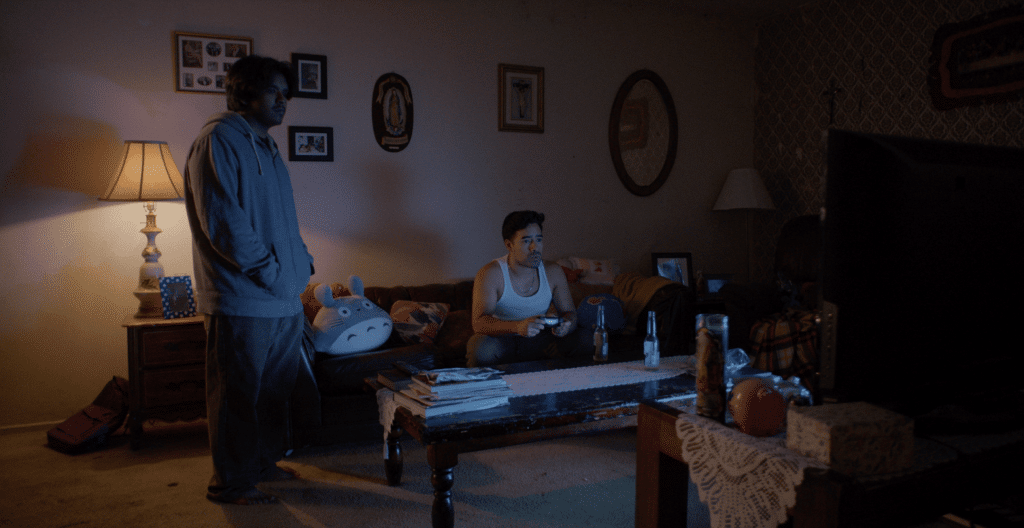
Tone Madison: Second part to this is me basically just picking apart one of my favorite scenes in your film. So, I’ll set this up. Sorry if this is kind of long-winded. [Laughs.] One of the more interesting moments, for me, is when Miguel comes home, and Louie is preoccupied on the couch with playing a Call Of Duty-like video game. Miguel tries to talk to him about wanting to ice-fish for the first time.
But before they even get into that, Louie lets Miguel know he’s aware of an incident that happened with him earlier that day, dropping a comment about how he perceives white women as getting mad for just looking at them. It’s a striking and dicey piece of dialogue, that, to me, comes off as kind of jokey. But at the same time, it seriously speaks to the present moment as well as cultural differences between what is perceived as threatening and inappropriate. I really like the line. Is that something you wrote yourself, or was that improvised with Erick [Inestroza], who plays Louie?
Nathan Deming: No, that’s something I wrote myself. That whole subplot I thought would be really interesting for the reasons you just outlined. I guess I don’t approach anything politically […] but I wanted to dramatize or show those little cultural differences that can happen, not just even Latino to white culture or Mexico to America or something. Just small town to big city, even. Those little cultural things that can get lost in the way, and you don’t realize how you’re being perceived. On top of it, the added racial bias that if it was a local white kid staring, they’d write it off. “That’s just Steve.” But there can be an added racial bias of “Oh my god, this person was checking out our girls.”
Tone Madison: There are a lot of subtle touches of originality to the premise of this film. The dynamics between the young family and the living situation all feel well-realized. Louie in particular feels vivid and nuanced. How did the idea for this family come about, and what sort of research did you do before writing the film?
Nathan Deming: I have a lot of Hispanic friends in LA. Being in LA for 10 years, I got more introduced to the culture than living in Wisconsin. That co-writer or uncredited translator, the actors themselves, the production designer was Latino, and other crew members were Latino. I tried to do my homework to get the nuances right. And then also trying to start from the basic premise of that, we are all human, so there are immediate touching points you can just find.
What I’m really excited about with this series is that, as I keep changing characters, I can hopefully keep trying to investigate different themes, including community, family, and identity. I think identity is so fascinating, and there’s images and types of scenes in this movie that also I hope will continue echoing in the future installments as I build similar-type scenes. And then they’ll be an added layer you’ll return to February with, and [as a viewer], you’ll be like, “Oh, and this moment was also capturing this very similar idea that keeps popping up between different people.” Even a simple thing—I think it’s so interesting how we all have different bedrooms, even. What we end up decorating on our walls. What that says about us. Why we need that there to feel [like] home.
But then for this family specifically, because Miguel just landed in Wisconsin, I thought it’d be really interesting to explore the other stages of immigration, I guess you could say. If you noticed, the kids speak English, the next generation. They respond once or twice in Spanish and understand Spanish, clearly, but their speaking English is a common thing. The language doesn’t always move on to the next generation. And then, even Louie himself, he’s very Americanized. He’s been there for a while, so when he’s with his coworkers, he’s a total bro, you know?
We had a screening [recently] in Wisconsin Rapids, where a guy who was a foreman on a construction crew, came up to me. He made the comment: “I was really glad how you portrayed that, because that’s entirely how it is.” There are a lot of Latinos moving into construction, working with him, and there’s 100% assimilation. They’re all just like bros together. [Laughs.] So I thought that was interesting to explore. I thought it’d be fun to see the different stages of that. Louie more easily switches between these personalities, right? He can speak Spanish with his wife [Rosa] and Miguel, but with his coworkers, he has a flawless American accent.
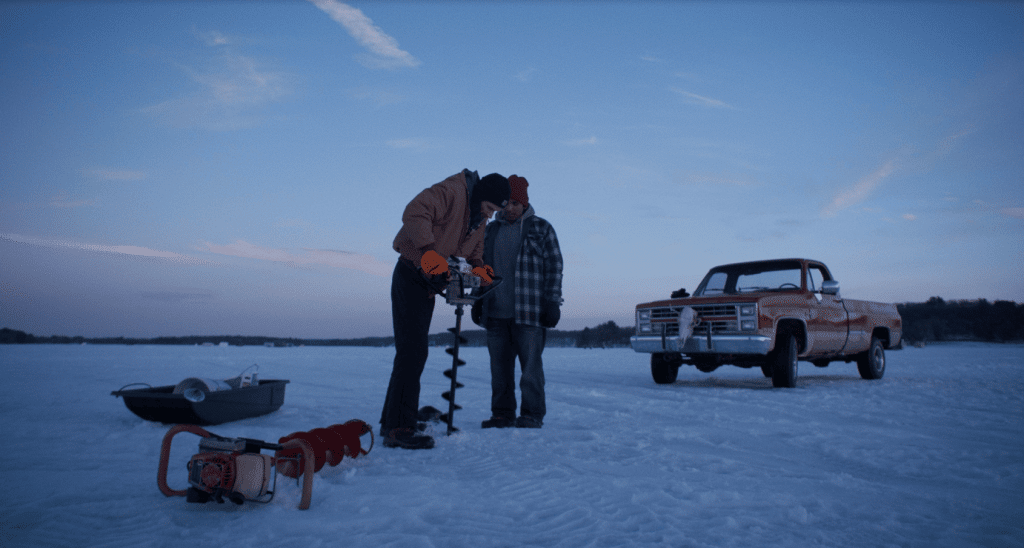
Tone Madison: Carl’s arrival in the third act sort of shifts the tone of the film in his crotchety zaniness as he pairs up with the reticent Miguel. How did you and actor Ritchie Gordon develop Carl for the screen? Was he maybe a little harder around the edges on the page at first? Or did you immediately sync with Ritchie’s idea for the character when you were rolling?
Nathan Deming: Ritchie is not an actor; he’s from Craigslist. I threw up an ad, and he responded. Honestly, that character was really hard on the page and hard to find. Because I thought it was one of those things where it really wouldn’t come to life until you saw the person. On the page, the wrong detail might get it feeling like a caricature or—I don’t know. I just didn’t want it to be perceived as the wrong thing. And then Ritchie basically is this guy I was envisioning. As I got to know him and prep with him—and I give him a lot of credit, ’cause he was pretty fearless. He’s never acted before, and he was so flexible in trying things and just did not have an ego. And then he would add little things. There wasn’t a lot of improvisation, but the first time he meets Miguel, he says, “Michelle?” I don’t find that very funny as a joke, but Ritchie found that hilarious. And I thought, “Well, the character finds that funny, so he has to say that joke.” I think it’s just him kinda presenting himself, really. Even those dirty jokes they tell—the last one he tells, I hate that joke [which involves KFC], but it’s his joke, so I had to put it in the movie.
Tone Madison: As a non-actor, did you have to work with him more than—other cast members who have more experience or are in the profession/field?
Nathan Deming: Erick [Inestroza] and Nayeli [Michelle Hernandez], Louie and Rosa, were most experienced. David Ezekiel Duran [who plays Miguel], this was his first film. He’d done some theater acting, but he’s very young, too. But he was very professional and did a great job. But for Ritchie, yeah, I think the cool thing is that, during the first few days in rehearsals, we just tried everything. Every possible way to just see what worked with him. And he found ways that were comfortable and some that weren’t. The first few days of filming with him were slower, because he was trying it out. But I think it was the third or fourth day, he was doing stuff without notes or anything. He zeroed in on how to do it. I remember [thinking], “Oh, this is awesome.”
I think also, giving him props that the character would find—the character also uses as a shield. He’s always lighting up a cigarette, because that’s also what [Ritchie] does. I think the moment he had stuff like that in his hand, it was very familiar, you know? He just became more of himself. Even the beer—we’ve been telling this story on the road—I don’t how, but we were supposed to be replacing the beer he drank. David’s drinking Coke in a beer can. And then somehow Ritchie kept getting actual beer, so we knew that he was drinking for some of the scenes. We were like, “Whatever, it’s not affecting anything, and it’s what he wants.” [Laughs.]
Tone Madison: I liked that you framed it as “somehow.” [Laughs.]
Nathan Deming: Yeah, well, I don’t know, ’cause somebody was supposed to hand him the drink. But then we’d take a break, and then [Ritchie] would be back with a new one. He knew where the props were or something. [Laughs.]
Tone Madison: I want to move on to this “Year Project” you’re doing, and your filmmaking more broadly. I wanted to compliment you on the continuity that’s already there, that you’ve created even with only two films under your belt. The refrigerator calendar shots as stealthy title cards are a shrewd touch. I also noticed in both films you’re using the radio to convey news or environmental information while the actors are given room to emote or maneuver around in the frame. Did you pick up elements of radio broadcasts from other films or a filmmaker, or is this just a preference you developed on your own?
Nathan Deming: You know, that’s a moment that I might repeat a lot, but I haven’t decided if I’ll be super repetitive with it. In this case, I thought it was interesting, at the start of the year and start of the project, to really connect. The radio goes out to everybody, and part of the idea is that all these characters live next to each other. So, one day it’s reaching this older white church volunteer [Becky Brown in January], who might have one reaction—I think the dialogue then is about Covid and people dying, which she’s in her 70s and probably knows a lot of people—she’s reacting a certain way, you know what I mean? And then meanwhile, down the road, is Louie and Rosa’s family. They have different things they’re thinking about.
Tone Madison: Is it the same radio station—is it WIMC? The call letters. I was searching for it—
Nathan Deming: You know, I’m trying to keep the town a little placeless. On purpose, I’ve chosen little random things. But I know in February, they definitely mention Tomah and Antigo, and a couple different cities for the weather forecast.
Tone Madison: But that’s not something you saw in a film, and thought, “I wanna do that.”
Nathan Deming: I don’t want to claim full credit. I’m sure I saw it in a movie somewhere.
Tone Madison: It’s in your subconscious, creative mind.
Nathan Deming: At the moment, I can’t name the film, but yeah. Probably in my subconscious.
Tone Madison: I was looking up just some basics on IMDb, and I was curious if there were any shared cast members between the films? I noticed Becky Brown’s name [main character of January] on the February page, but I don’t remember seeing her in the film.
Nathan Deming: She pops up in a very brief moment, asking [Rosa] what a torta is.
Tone Madison: Oh, OK. So it’s just a cameo. [Editor’s note: Watching the films in backwards order two weeks apart was the cause for the momentary absentmindedness.]
Nathan Deming: I love Robert Altman’s Short Cuts (1993), and—throughout the movie, the idea that you’ll watch character X bump into character Y, and it’s so thrilling every storyline that’s going on. I think that’d be fun to continue; just little cameos and the idea that they’re all connected.
Tone Madison: That’s like a 1990s indie hyperlink cinema thing. I guess that’s what it’d be characterized as. You don’t want to imitate that exactly, but I know what you’re saying.
Nathan Deming: Yeah, a fun little background thing. I don’t want it to be just that. That’s not the thing I’m most interested in.
Tone Madison: Are there actors and crew from January and February who you hope to continue working with?
Nathan Deming: Well, the crew can easily be—I hope to work with a lot of them again. Leo Purman, the DP on this one, was amazing. His career is kinda popping off right now. He just had a movie at TIFF, and now a movie at SxSW that he [was the cinematographer on]. He’s really talented. And then Mark Khalife, who [shot] January, is my longtime collaborator. He did my first feature [Speaking In Tongues in 2020], and we went to London Film School together. Even though he’s from Beirut, he’s actually made a ton of stuff in Wisconsin, funnily enough.
And then for the cast, I definitely like all the people I’ve worked with. I’d love to have them back. The fun thing about an anthology series is that you get to change characters and get to meet a new group of people every time. As I said, this is starting out from humble indie origins—the hope is that, if there’s an audience there for these movies, by the time I’m getting to April, it’s recognizable names. I could get some bigger actors to also start starring in them. Hopefully ones with a Wisconsin connection.
Tone Madison: Yeah, I hope that can happen. Before we get to April, can you tell us anything about March? How will that link up or diverge from, thematically and visually, from these prior two films?
Nathan Deming: To be clear, I want this whole process to take like 15 years on purpose in and around the rest of my career. I hope to make other features and other films back in LA. But I guess that’s what I’m experimenting with now, is that I wonder if there is this niche here. I think there is hunger in Wisconsin audiences for Wisconsin stories. And I just saw it this weekend with the start of our tour [and I can get into this later], and I think it’d be so cool to build a really unique thing just for Wisconsin. Every two or three years, you hear from me, and maybe it gets to the point where I’m not just touring [them] around. The films go to every Wisconsin cinema for the month of the year [that they take place].
It will be a year or two before I do March. That’s the fun thing—to start with the months of the year, and how they feel. Like, January is very austere and silent and empty to me. And then February is the doldrums; it’s repetitive. You’re just waiting for the thaw. So I haven’t said much about March, because I have this arc currently that I have up through June that I’m really excited to see through. I would like to try to keep [that] under wraps. But I will just say that I’m really excited for the thaw, basically. The transformation.
Tone Madison: Representing March in Wisconsin is interesting. I don’t think people have a universal concept of what March looks like compared to the months of January and February. You’ll have some years with a snowstorm, and then others where it’ll just kind of be unseasonably warm for 10 days.
Nathan Deming: I am excited to explore that. And I kinda said this, but I really believe that our environment affects us and affects our identity and character. It’s an obvious thing, but Wisconsin is the main character, I guess, in the background of all these, [as with] time and the seasons. At the same time, I’m trying not to let this become a Wisconsin greatest hits, where it’s like, “Oh, there’s the Packers. Oh, there’s cheese curds.”
Tone Madison: [Laughs] Oh, god no. Yes, thanks for not doing that. In a recent email, you mentioned doing a little roadshow around Wisconsin with February. In one message, you wrote: “I’ve never been in a band, so I guess I get to live the life of a travelling musician for a month.”
Nathan Deming: Yeah, yeah, that’s pretty much my motivation right now.
Tone Madison: So, it sounds like you’re continuing the tour. Do you want to give some specifics about where you started, and where you’re ending up? Is the last screening gonna be here in Madison?
Nathan Deming: For the official tour, yeah, but there are a couple universities that just added us. But for the spirit of it, that’ll be kind of our final thing. Excited to show it at the Cinematheque. I’ve definitely always wanted to be in a band, and I guess as a filmmaker, especially in this era, I’ve been out of school now for just about a decade, and watched a lot of transformations in the industry since then. It’s thrilling to take your films to festivals. It’s thrilling to get your film on a platform like Amazon, and sell your first feature. But nothing compares to being a room of people and watching your movie. So, fulfilling that dream is really fun. You know what I realized? The first email you sent me [in April 2024], when I contacted you around the film festival, you said something about maybe showing it in February. I was like, “Oh, he had the same idea.”
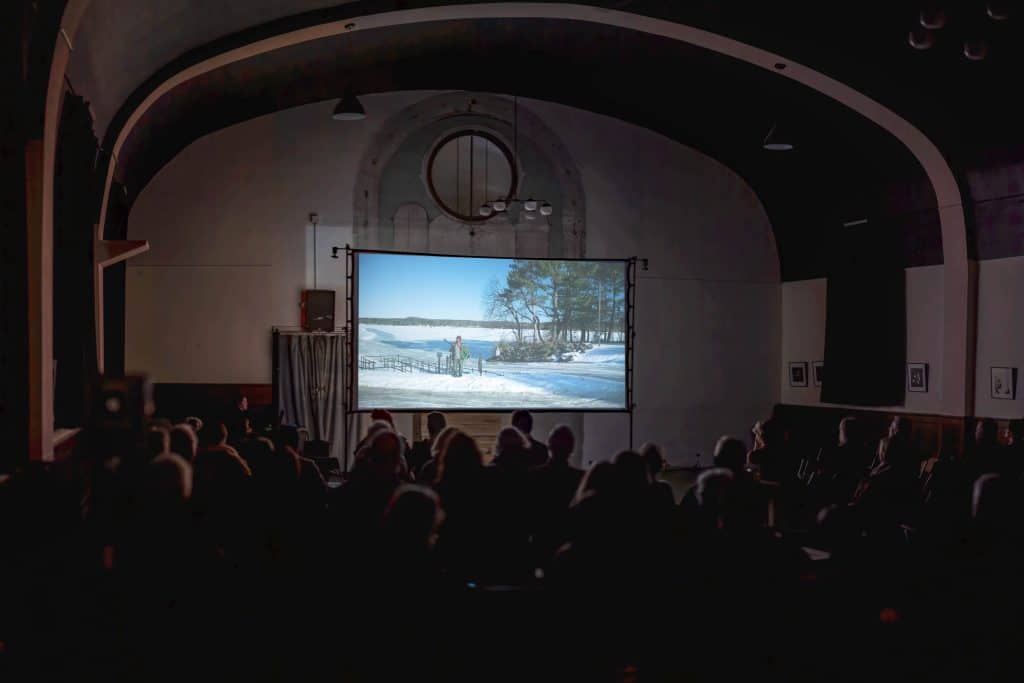
Tone Madison: I try to do that with my viewing if I can. Like, try to watch something at a seasonally appropriate time of year, whatever occasion that’s relevant to the film, even if it’s not the most transparent.
Nathan Deming: But yeah, we’re going all over. I’m especially excited about going to small theaters. Being from a small town like Tomah, I just think it’s cool to try to create cinema and art there and say, “You guys are part of this conversation, too.” Oftentimes they are made to feel very little. We had a show in Tomah [on February 2], and someone asked me: “What do people think of us in LA?” And I had to be like “Honestly, yeah, that’s what I don’t like. You’re invisible.” [A famous writer] told me the other day that he’s noticed the same elitism.
Tone Madison: What was the first location screening in Wisconsin?
Nathan Deming: In the last month, we had the first kind of test of the whole show in Appleton at this cool [former] synagogue and church and now photography-art collective called PhotoOpp. They hosted the film. Kind of the idea is in the show itself, try to build in some extra ideas. Not just a Q&A, but I’m reading some poetry about [the month of] February, by Margaret Atwood, and kinda have fun with getting people to think about the month of the year and the seasons.
Tone Madison: Would you do this tour again based on the experiences you’ve had this time around?
Nathan Deming: Definitely. Like I said, at some point, it’d be cool if [these films] were able to be [widely] released. One, I’d always want to premiere them at the Wisconsin Film Festival, if they’d have me. But then set up this kind of tour thing [later]. It’s just so invigorating, especially for this series, more than other things. It’s so fun to see the light in people’s eyes and the enthusiasm of the lives that they know getting up there on the screen correctly.
Tone Madison: You mentioned one story from the Wisconsin Rapids screening—but do you have anything else fun or amusing that you’d want to share from the tour?
Nathan Deming: Our big kick-off screening was in Eau Claire. They did turn out. It was packed; it was really fun. One thing I’m also really hoping for, is that Latinos in Wisconsin enjoy the film and find it accurate. That screening was hosted by professor Gerardo Licon of UW–Eau Claire, Assistant Professor of Latin American [and] Latinx Studies. He said some great words before and after the film—not just about the film, but about Latinos in Wisconsin, who are the fastest-growing demographic. One of the best comments was from a woman in the crowd, who had to be translated, because she only spoke Spanish. But she said something that I kinda knew was in the back of my mind when filming it, but then [when she said it aloud], I was still very moved by it. She really liked how the film just wasn’t about Latinos adapting to Wisconsin, but Wisconsin learning from Latinos and getting Latino culture. That’s a huge thing that’s happening with main streets in small towns. People have vacated, but Latinos are moving in and starting businesses and grocery stores and restaurants. They’re a big part of our culture.
I talked to a woman in Wisconsin Rapids, who—her mother was deported when she was two [years old]. She shared some moving stories about how unfriendly it was at times, being in Wisconsin. So, there are some uncomfortable details in the film that hopefully represent things accurately.
Tone Madison: We’re close to 11 months removed from the Madison premiere of February. What have you taken away from the film personally? We’re living in an even scarier and more oppressive time, even just two weeks [at the time of conversation] into the 47th Presidency. We’re already seeing devastating consequences for immigrants with ICE raids.
Nathan Deming: I don’t see myself as a political filmmaker or anything. I just want to tell stories that I think will last—find something universal in them.
My first feature is about a guy leaving Christianity, and I hope it has some prescient observations. But one lesson I took from that was—I want to reach people in that world. Sometimes you want to reach people with a message, but you’ve gotta find the right way to do it. With that movie, I did have to delete certain moments that especially were a little too satirical or on the nose.
I think I carry that forward, too. I don’t have any pretenses that I’ll change any minds. Though, I know art can do that. I do hope that, if anybody has a closed mind about this subject, and then ends up at the screening, I hope they can walk away with something. Because ultimately we have more in common than the guys up top. Insert whoever you want there.
Tone Madison: Yeah, you’re trying to tell a human story. Something reflecting on Roger Ebert’s quote about cinema being a “machine that generates empathy.”
Nathan Deming: Yeah, you see stories for the first time that, once you have that emotional experience—that’s such an interesting thing about film, is that nearly every story is about consciousness transformation. That’s what most main characters go through in some way. It can be done very obviously, where it’s a Hallmark movie and the character learns that Christmas is the most important holiday. [Laughs.] But also it can be other things. I think it’s what we crave in the dark in that movie theater. It’s why we got out of the house and drove down to the cinema. We seek absolution and insight ourselves, and that by watching other people transform we might, too. It’s what I love about the movies. I guess it’s also kinda what my characters are seeking and find in that ice-fishing tent.
We can publish more
“only on Tone Madison” stories —
but only with your support.
Author
Related Articles
Continuity and expressive experimentation in the 2026 Wisconsin Film Festival
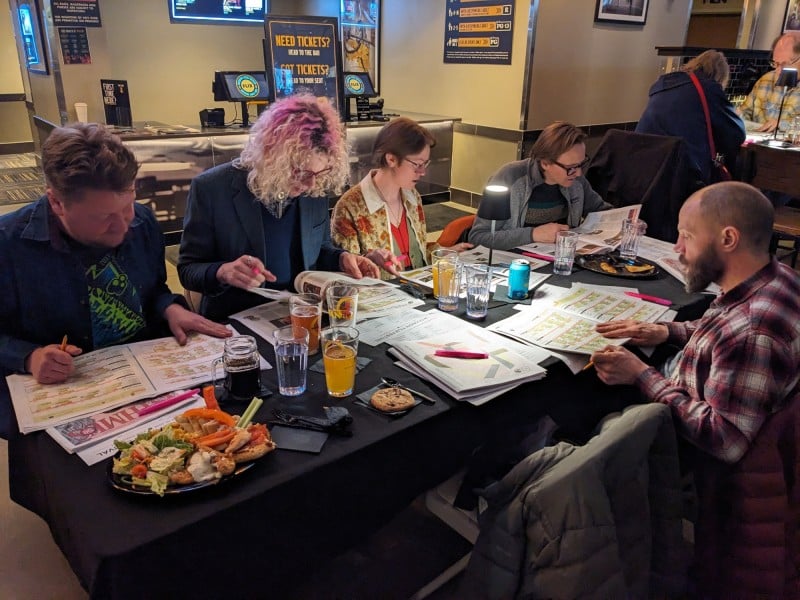
Eight writers share their initial insights on the eight-day extravaganza, April 9 through 16, across UW campus and Madison.
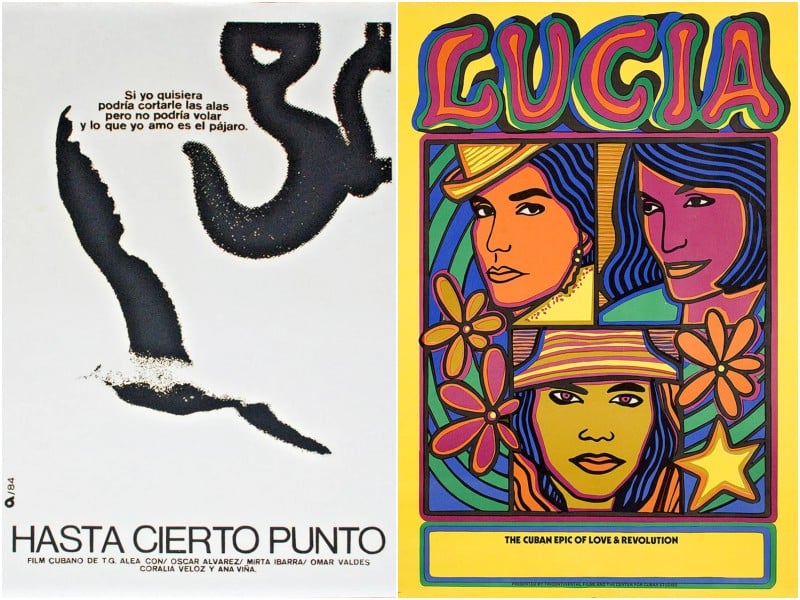
The Cardinal Bar’s Cuban film series invites local support for Madison sister city
Cine Cubano bridges interest in Cuban cinema with the cultural exchange and aid mission of the Madison-Camagüey Sister City Association.
Three video artists tap into personal histories in the 150 Artists x 150 Years exhibition
Chele Isaac, Toby Kaufmann-Buhler, and Aaron Granat reveal the creative depths of their works, which are on display through February 28 at Central Library.