
Basketball is back, but it never really left
Madison’s basketball courts are reflective of endurance, persistence, and Wisconsinites’ growing embrace of the sport.

This is our newsletter-first column, Microtones. It runs on the site on Fridays, but you can get it in your inbox on Thursdays by signing up for our email newsletter.
After a certain amount of time living anywhere, it’s common to start taking the benefits of that location for granted. It’s an unavoidable trait that becomes even more understandable when those benefits are viewed as distinctly common. I’ve personally found myself in this position too many times to count, whether it’s pertained to DIY venues, specialty shops, comprehensive public transit, food carts, or skate parks. And I’ve cursed that unsuspecting complacency when faced with their sudden absence.
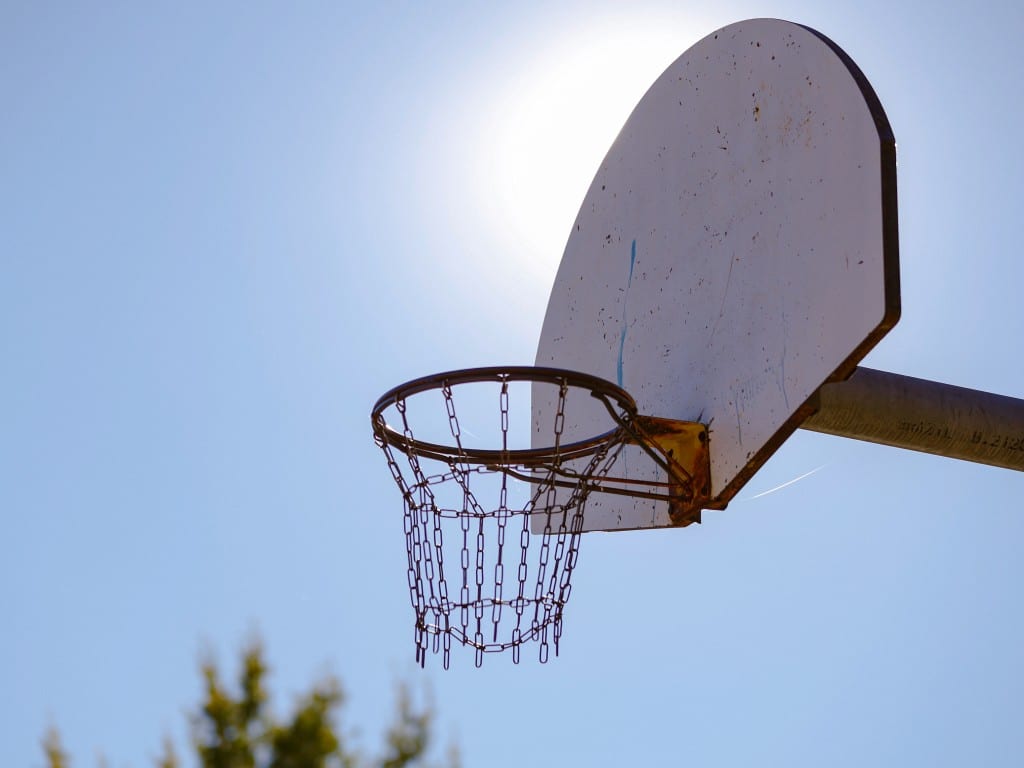
Madison’s thought of as many things by many people. I don’t know how high up “basketball city” ranks on the list of its perceived characteristics. After all, most cities have basketball at their immediate disposal in some capacity or another, whether that be through courts, organized sports, or the broadcast of games. And yet, basketball is overwhelmingly prevalent and accessible in Madison, thanks in no small part to the city’s robust public parks system. A fairly significant number of those parks feature courts, which translates to Madison ranking third in the nation for its courts per 10,000 residents ratio. (The Madison Parks website had previously touted Madison as having the most courts per capita, but that language seems to have been removed.)
I grew up 100 miles north of Madison, in the comparatively small city of Stevens Point. Over my 25 or so years of living there, I put together a strong mental map of not just where the best outdoor basketball courts were located, but the quirks of those courts. After all, “home court advantage” is even more advantageous when you can use your familiarity with the courts’ eccentricities to steer defenders towards a key divot or deep crack. When the weather was favorable enough, I’d petition my friends to play a friendly (read: hyper-competitive) game of HORSE, 21, Around the World, Lightning, one-on-one, three-on-three, or even five-on-five, on the rare occasion we had the numbers to do so.
I was hospitalized after one of those full-court, full-numbers pickup games, somewhere in the early 2010s. After getting in a quick dunk attempt, I clung to the rim a few seconds too long. My forward momentum swung my knee up into the base of a low-hanging backboard, and the force sent me rocketing into the pavement, back-first. A day later, I went to the hospital after struggling to regain regular, pain-free breathing, and was led through a battery of x-rays that revealed tissue damage, muscle spasming, light internal bleeding, and an unpleasant mixture of rib sprains and deep bone bruises. I was told that had the fall been half an inch higher, the most likely outcome would have been a shattered ribcage.
But my love for basketball never dissipated, even when I was on a regimen of painkillers and being transparently nudged out of a truck-loading job as a result of the injury. (Strenuous physical activity that’s graded on a timer is not a very precise fit for the guidelines of effective physical therapy. Who knew.) Even while going through a surprisingly arduous recovery process, I would go out to the sidelines of those courts and watch a pickup game or two, or turn on a game from the then-abysmal Milwaukee Bucks to satiate my craving for all things hoops.
Right around this time, the Bucks’ luck would begin changing, thanks to their 2013 first-round draft selection: a twiggy prospect from Greece named Giannis Antetokounmpo. At the time, Antetokounmpo was viewed as a developmental project; a wild dart-throw that came with a compelling, heartstring-pulling back story. Despite what were believed to be slim odds of NBA success, within five years of being drafted, he profoundly transformed the state of Wisconsin’s relationship to basketball. By 2018, Antetokounmpo had achieved an unimpeachable superstardom, and firmly established his status as one of the league’s most enticing draws. (Hell, Antetokounmpo’s impact on Milwaukee itself wound up proving so profound that he’s often cited as the core engine of the city’s recent economic transformation.)
But Antetokounmpo’s emergent basketball prowess also arrived in tandem with another notable feat that led to a spike of Wisconsin-centric basketball enthusiasm. In 2015, the Wisconsin Badgers’ men’s basketball team went on a March Madness run that was potent enough to earn a 10-year retrospective from the Milwaukee Journal Sentinel. The crown jewel of that particular run came in the Badgers’ shocking Final Four defeat of the then-undefeated Kentucky Wildcats, a team that was brimming with players who would go on to achieve either strong careers or genuine stardom in the NBA. Every once in a while, I’ll pull up the replay of the game’s final minutes. And I know I’m far from the only person in the state to do so.
But that fleeting moment of 2015 joy circled right back into the typical sports heartbreak when the Badgers came up short in the national title game. After the Kentucky upset, many speculated an energy depletion simply caught up to the team. Whatever the case, they got outplayed, and final scores are frequently unforgiving. Still, the team’s prior victory would go on to become a hallmark of Wisconsin’s re-energized investment in hoops. While the most concrete evidence of the state’s surging interest in the sport likely rests in increased revenue totals from merch and ticket sales—or the greenlighting of expensive venue expansions—the more immediately evident tell was socially, which ultimately comes down to the unquantifiable: lived experience.
From my own personal account, I can say that between the years of 2015 and 2020, a number of my own family and friends were—some, for the first time in decades—actively and increasingly engaging with both the Bucks and Badgers basketball teams. And rather than being the person asking others to shoot, I was the one receiving the asks.
During that stretch of time, I moved from Stevens Point to Brooklyn, NY, and then to Madison. The first apartment my partner and I lived in was near James Madison Park, which boasts one of the busiest courts in the city. At James Madison, the pickup games’ intensity felt like a perfect bridge between the overwhelming aggression of pickup games in NYC, and the more idyllic nature of most of the games going down in Stevens Point. I made myself a part of the action when it felt responsible to do so, and was happy to take notes when the available players’ capabilities clearly exceeded my own. I also wondered how many of the Bucks logos I saw would have been around had I arrived at that court a decade prior. I spent a solid chunk of every spring and summer from 2017 to 2020 on or around that court.
In 2021, there was yet another burst of increased interest as a direct result of the Bucks going on an exhilarating playoff run. Ultimately, the team wound up breaking a 50-year championship drought via a thrilling game six against the Phoenix Suns that solidified Antetokounmpo as an all-time basketball great. When the clock hit zero at the end of the series, I uncorked a bottle of champagne in front of a television, my body shot through with nervous energy and catastrophic excitement. A small moment of irrepressible joy during a time that felt more bleak than not.
My friend Jesse and I drove out to Milwaukee for the ensuing championship parade, and were treated to a poignant reminder of what communal celebration can mean. (This was the only mass gathering I allowed myself to attend between the years of 2020 and 2022.) Looking out across a sea of people, the disparate nature of the crowd was striking. The Bucks had inadvertently created a cultural melting pot of fandom that, for a time, largely chose to set aside any of their differences to simply celebrate a hard-won moment. At its purest form, therein lies the magic of all sports: an ability to pacify, electrify, and unify huge swaths of people rooting for a decidedly simple common interest.
When my partner and I made the recent move into our house, my first “search nearby” entry was for the same thing it always is: basketball courts. There are at least three within walking distance. And now, every time I visit one, I’m reminded of how entwined their histories are with Wisconsin’s own relationship to basketball. I think back to the Badgers’ 2015 run that ignited so much excitement and passion. I think about how Antetokounmpo’s emergence in Milwaukee flipped the prospect of watching a Bucks game on its head. Where there was once fear and hesitation, there was now unbridled excitement. (The week this piece was published kicked off with Antetokounmpo burying a turnaround, high-arc’ing, game-winning, fadeaway buzzer-beater at the elbow to put away the Indiana Pacers, highlighting the ongoing nature of that excitement.)
I also think about persistence. For what often feels like forever, Madison’s outdoor courts are swept over with snow and ice, yet they endure. Every year, the re-emergence of pickup games on those very courts—often looking a touch worse for wear—help signal the start of spring. It feels a touch cruel that the start of both the Bucks and Badgers seasons begin in October and November, respectively. (The Bucks won their October 22 season opener. The Badgers men’s team also won their season opener on November 3, and the Badgers women’s team completed the season-opener hat trick with a win of their own on November 5.) All of the excitement that season openers generate—whether in the case of wins or losses—may be a bit tempered, sooner than not.
In a month or so, Madison’s outdoor courts will be unnavigable, and hoopers will have to turn to the indoor spots. The options are a bit slimmer (and typically more costly), but some availability will remain via gym or rec memberships, or maybe even a quick stop at Pooley’s. But they’ll endure, just as the winter-covered courts endure. Watching our chosen teams will be a light in the early-setting darkness. Hopefully, the Bucks and Badgers will continue to incite excitement, and, should all go well, maybe even another raucous celebration or two. Maybe the state will lean even more into throwing their support behind the sport, and recognizing the value of its accessibility. And this time, hopefully, that support and enthusiasm won’t diminish. Only time will tell, as it always does.
We can publish more
“only on Tone Madison” stories —
but only with your support.
Author

Related Articles
Stop spotlighting new films by known abusers
Madison boasts a dynamic movie culture, yet still needs programmers and community voices to facilitate change.
Achieving a broader focus through music photojournalism in 2025
The fourth installment of our live music photo essay series centers a more personal vantage point.
Madison’s musical odds and ends of 2025
A meditation on the past year’s musical margins.