
Band-introducing poet Thax Douglas rekindles his own music career
The multidisciplinary artist talks with us about his growing discography and creative approach.
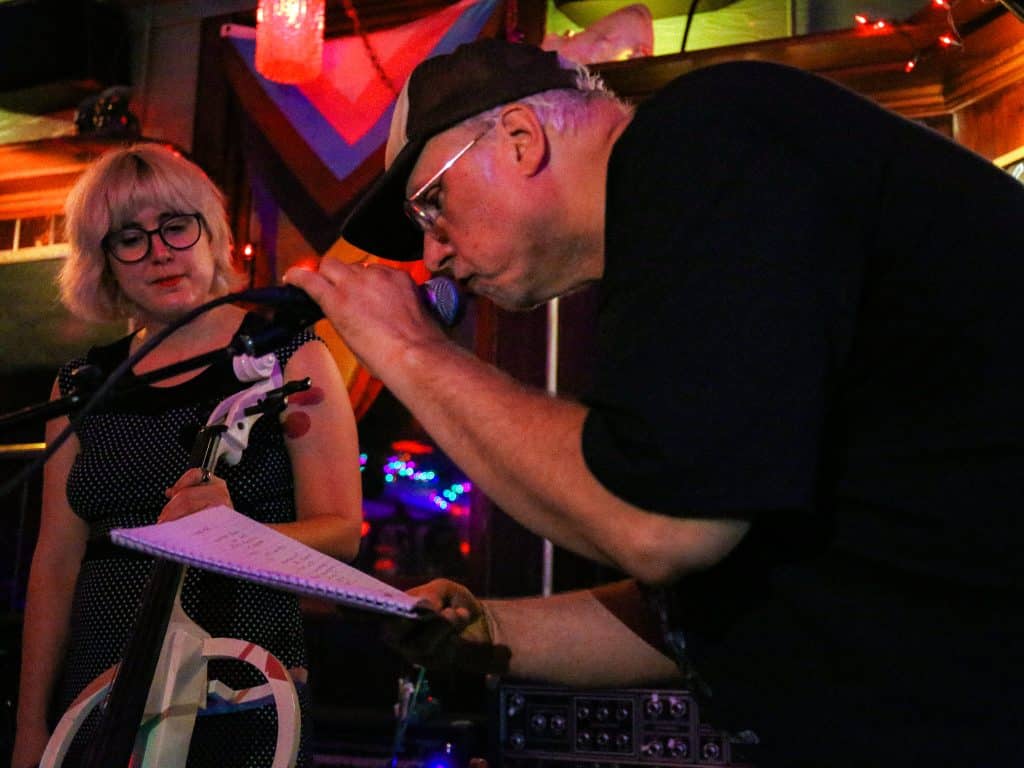
The multidisciplinary artist talks with us about his growing discography and creative approach.
Thax Douglas should be a familiar sight to many Madison showgoers. Douglas frequently appears in Madison, and regularly introduces local and touring bands with a short poem. Over the past few years, he’s read for Heavy Looks, TS Foss, Graham Hunt, and several others, often multiple times over. (The last time I saw him introduce a band with a poem, it was for powerhouse Cincinnati duo Lung at Mickey’s Tavern in early September.) Show poetry is something he’s been doing for nearly 30 years, and it helped turn him into a Chicago staple in the ’90s and 2000s. But not many of the people who have seen him read know that Douglas has a discography of his own.
In 2010, Douglas, Sam Chown, and Zac Traeger recorded an album in Austin, Texas, under the name AYBA440 (named after a license plate of a car the band was once trailing), leaning into Douglas’ fascination with microtones. In its classical musical definition, a microtone is “an interval smaller than a semitone.” (Breaking this down in guitar-centric terms: this would be a note between the frets in most tunings, only achievable via bending.) For many listeners, microtones can produce a feeling of light seasickness. Traditionally, microtones are more prominent in Eastern music, but Douglas’ insistence on integrating them into Western-leaning musical structures results in a quasi-kaleidoscopic effect that’s perplexingly absorbing.
Douglas had previously experimented with a microtonal record in New York City in 2006 via his project with multi-instrumentalist Matt Mehlan, Chicken And The Chick Flicks. The duo’s sole record, Too Bad About The Sun, uses that microtonal bent to enhance a wiry, introspective, dissonant minimalism. On AYBA440’s self-titled record—released for the first time in September, 14 years after its recording—Douglas, Chown, and Traeger turn a similar microtonal focus into a woozily expansive dance party. It’s a fascinating, utterly irrepressible album that comes laced with a singular charm.
Traeger and Chown’s other project, Zorch, is a strong reference point for what the two created with Douglas. Unpredictable bursts of electronic synth and frenetic rhythm dominate both Zorch’s discography and AYBA440. Douglas is the point of difference and he makes an unmistakable imprint on the latter. Both Douglas’ writing and actual voice have a distinct bite and timbre, and each cut through with no shortage of clarity on a track like the seven and a half minute “Mountain Of Love.”
“Someday when you have drunk the whole world / You will live up on top of there,” bellows Douglas at the track’s midway point, punctuating a bleary-eyed euphoria. “Keep me going strong / So I can find a home / Somewhere in the sea / A mountain waits for me,” sings Douglas in the hook. An uncanny, high-pitched vocal echo trails the segment, augmenting the track’s joyous deliriousness. “Mountain Of Love,” in many respects, is emblematic of AYBA440‘s free-flowing appeal.
“What Goes On,” the album’s centerpiece, extends over 24 minutes, and arguably reveals the largest swath of artistic influences and sensibilities inherent to the band as a result. New wave, post-punk, psych-rock, noise, disco, electro-pop, and a whole lot more all coalesce into a mesmerizing musical sprawl that’s as tight-knit as it is chaotic. Within that centerpiece is the galvanized abandon of an act that has locked into its own groove and is weaponizing their fiery symbiosis as a source of energy. It’s a relative rarity, but one that produces compelling art that tends to be remembered more fondly than not.
Even over a decade after AYBA440 was recorded, it retains that feeling of a band seizing upon a moment of artistic energy and confidence. A similarly energetic dynamic has become a critical component of Douglas’ poetry, which necessarily informs and complements AYBA440’s music, but also carries a potency when delivered in a standalone context. Douglas has sharpened that dynamic—and his poetry in general—over time, thousands of show appearances (some of which have been lovingly preserved), and a number of literary releases.
In 2007, a fascinating documentary called THAX debuted at the Chicago Underground Film Festival. It’s a sly work that attempts to paint a full picture of Douglas, while making a point to come across in a determined, DIY style, reflecting Douglas’ own ethos. But the doc rarely, if ever, mentions Douglas’ original musical excursions. THAX focuses more explicitly on his personal history and the show poetry, regularly indulging Douglas’ connections to recognizable industry names like Wilco, Ted Leo, At The Drive-In, and Smoking Popes. And while it ultimately feels like a serviceable summation, it doesn’t always come across as the most truthful portrait imaginable. Whether that’s by design is anyone’s best guess.
THAX does get a handful of things right, however. The doc’s opening line is an Oscar Wilde quote, “Everything popular is wrong,” which establishes a tone that feels authentic to Douglas. Whether examining his music or his poetry—both of which remain deeply intertwined—it is not difficult to find prominent strains of firebrand individualism. Douglas’ intrepid, seemingly indefatigable spirit has endeared him to many onlookers and artists, with several bands working him into their material and penning their own heartfelt odes. Damien Jurado’s “Thax Douglas #1” is a clear-eyed, full-song tribute. For as much as Douglas invests, it’s abundantly clear that effort does not go unappreciated.
Douglas recently sold the house he’d been living in for several years with his father, who died in 2022. The poet/musician is currently spending time in motels while contemplating a new landing spot. After years of living in Brodhead (about 30 miles south of Madison), he’s enjoying an exploratory freedom and a sudden sprawl of potential outcomes. He’s considering a move to England, having deeply enjoyed his time and the company the country provided him in the past. In the meantime, Douglas is navigating AYBA440’s sudden return, and still reading poetry (he recently read for a dozen bands at Strange LaGrange in Whitewater). Douglas’ future is wide-open, but he’s making the most of the journey.
Tone Madison met up with Douglas for an in-person interview in early October to discuss AYBA440, his ongoing interest in Madison’s local music landscape, and his artistic process.
Tone Madison: Let’s talk about the record.
Thax Douglas: I’ve always been into microtones, [for a] very long time. Since the ’70s. And I’ve always liked the idea of having a band, you know. Even in the ’70s, I tried to get people to tune their guitar [to microtones] and stuff like that. But, you know, there’s a combination of various things. I wish I wasn’t, you know, sometimes you read about [how] there’s somebody who takes control of a band or something, and I wasn’t really like that. [Laughs.] I can blame [my] autism to some extent. But I think there are a few autistic people that managed to take control of bands, but I don’t know. And then when synth stuff came out, I got excited. That would make it so much easier, but it just never happened. But I still managed to put out a couple of records.
There’s another record that’s on Bandcamp. That project’s called Chicken And The Chick Flicks. I made it in Brooklyn with a guy who just played guitar and a keyboard, and that’s a lot slower and meditative, but I always wanted to do a dance thing. I managed to do it when I moved out of there. There are certain sociopathic aspects of Chicago, where that’s why it never happened. And I know whenever I brought it up in Chicago, people, they would just act like I didn’t say anything. They would change the subject, but out of Chicago, I managed to do two records.
I always loved the [AYBA440] record. I said, when we made it, just put it out on Bandcamp. And [the other two] said “No, we need a real release” [Laughs.] And they prick-teased me forever with that. Like, in 2012 we did an extremely elaborate photo shoot for the album cover. This is one thing I’m glad didn’t happen. We were gonna call the album Official Afterparty Of The Heart. I’m really glad that didn’t happen. It’s a bad title. It’s terrible. It was supposed to be ironic, but even as irony itself sucked. And then there was a label that was going to put it out. It was a big deal in Austin.
There was a guy. He owned Beerland down there. He had a label, and he had a great reputation, because he gave bands money. One band—he bought their touring van for them. Stuff like that. He was his own Ponzi scheme, or whatever. He just kept spending until he ran out of money. He made enemies of everyone because he didn’t tell anyone he ran out of money. And especially with Beerland, he told the people working there, “I’m sorry I can’t pay you right now, but I’ll pay you real soon.” They worked basically for free for three or four months, and then he just shut down. Everyone in Austin hated him, despite his previous generosity.
So one of his projects that never happened was this record. Finally, I get to talking with Sam. He lives in LA now, and he said to me, “I think we can make a really great microtonal record,” and maybe he’s not really happy with this, but I said “I’m not working with you until you put this on Bandcamp,” and he finally did it. [Laughs.] I love it. I think it’s a great record. I really love it.
Tone Madison: Are you and Sam going to work on more music?
Thax Douglas: Yeah, I think next year, sometime. I’m gonna go out there and do it.
Tone Madison: How did that group come together in the first place?
Thax Douglas: Sam and the [Zac] had a band called Zorch in Austin. I just started reading for them. And of course, the conversation, my microtone thing came up and they said, “Oh, let’s do it.” So we did. Over a period of months, like maybe once a month, we would record a song.
They lived in a house on the south side of Austin and basically the entire house was a studio. And I don’t know. It sounds good to me, you know? I think good rock or pop music should have a bit of sloppiness about it and it does have that, so. It was the sort of thing where I knew what I wanted. I’m very into Italo. Partly, I danced a lot to Italo in the ‘80s, but I didn’t know it was called Italo. I didn’t know it came from Italy, I just assumed gay men in New York and LA put it out. And we found out years later that most of it came from Italy.
So I played on some guitar stuff. One of the songs is an Italo cover. That song called “Fred’s Swimming Pool,” is a cover of a song by Fred Ventura called “I’m Not Ready,” from 1982. And also a cover of a band I’ve been obsessed with. There’s a band called Ou Est Le Swimming Pool. They very briefly had some popularity in 2010, but I heard about them because of the guy’s spectacular death. There was a weird week in 2010 where there were three falling deaths all the same week. Just one of those weird coincidences. Someone jumped at Red Rocks onto the stage. And the same week, somebody jumped off the balcony at a Phish concert and survived. And then at Pukkelpop, the singer of Ou Est Le Swimming Pool, just went up on a cell phone tower after the show and jumped. And he died. It all happened in the same week. And I’d never heard of them, but I liked their music and I’ve been obsessed with their music ever since.
Tone Madison: I can definitely hear a disco influence in AYBA440. So, this was all recorded in Austin. And were you in NYC before or after?
Thax Douglas: New York before Austin. The [Chicken And The Chick Flicks] record happened in ’06. I made a big deal out of moving there. That was one of the frustrating things about Chicago. All of a sudden, saying I’m moving [to] New York, there was all this attention. I went there with no money. Stuff like that. Knowing there was no way I could stay there. And I had a very weird situation in Chicago that enabled me to survive.
The reason I survived Chicago without an income for eight years doing my thing was: I moved in with a poet friend of mine. I found out pretty quickly that he had a weird reverse psychology thing, where if I paid him rent, or particularly if I paid rent in advance, he’d get extremely angry at me. But [he] would be perfectly fine if I didn’t pay him rent. Soon as I figured that out, I stopped paying rent and I didn’t pay rent for almost eight years. So after a couple months in New York, I just moved back in.
When I first went [to NYC] in ’91 you could still get a two bedroom apartment in Williamsburg for $400 before I got [there], but something happened in the ’90s. I was gonna move there in ’91, but I didn’t. I just visited. [I did] the same thing in ’06, and now I don’t care. New York, unfortunately, is too much like Chicago. It has a magic Chicago doesn’t have, but the day-to-day living there is [similar].
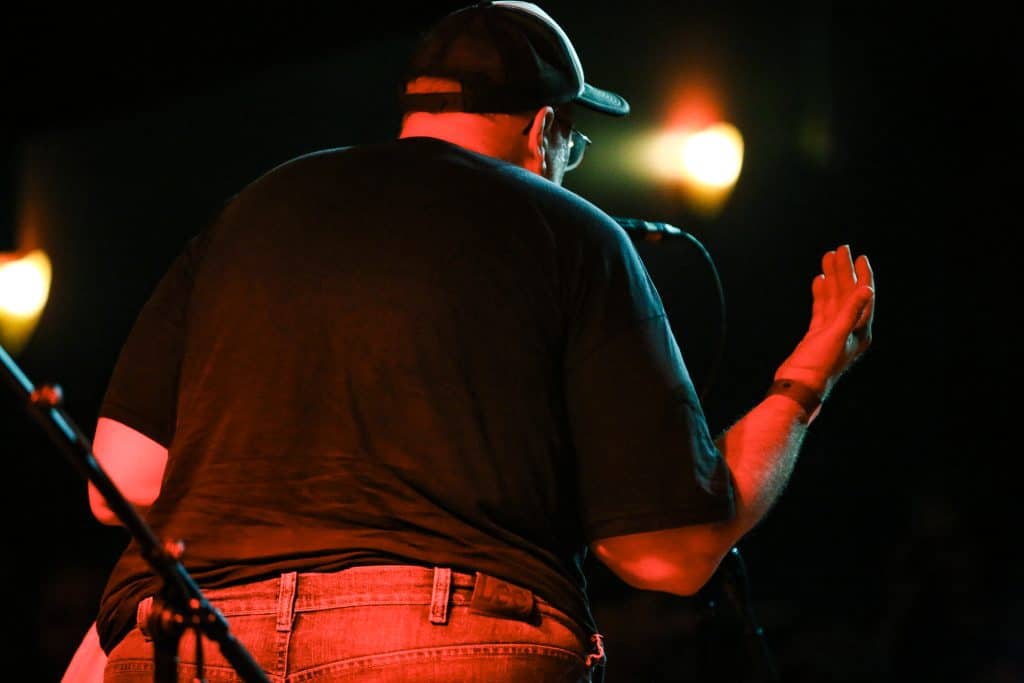
Tone Madison: That is something that sticks out to me a bit. You’ve lived in a number of these enormous cities, but have been consistently pulled towards Madison over the past decade or so. What do you find appealing about Madison?
Thax Douglas: I like it. The way I put it is that it’s small, but it’s deep, so I can read for these bands again and again and again. That’s it. There’s not a lot of careerism, even among people who work hard on having a career like Bobby Hussy. Even Chicago and of course, New York, has a little cynical quality about it. Like, oh, it’s all a business. Madison doesn’t have that.
And fortunately, I don’t think we’re gonna have a repeat of the ’90s where, you know, no one’s looking for a scene to exploit and turn into a product like they did back then. I’m not worried about that happening in Madison or Milwaukee. Another nice thing about Madison is it’s small enough that there’s not that division in the scene. You have bands playing together that would never play together in Chicago because of that. And they’re all friends with each other, so it makes it a lot easier to lionize.
Tone Madison: At this point, how long have you been doing poetry reads before shows?
Thax Douglas: Since ’97. I just got it slowly. After the early times. The one other thing on Bandcamp is that Produced By Steve Albini record. If you listen to that, it’s from ’91. And it’s a lot different than what I do now. Anger and bitterness were kind of in during the ’90s. It’s in that style, and it’s definitely of its time. But I kind of burned out on how bitter you can get, you know?
So when I was searching around for what to do next, I [was] inspired by the reading of poets. I was reading mostly Russian poets, Silver Age poets. I tried doing poems through portraits of people, and I did that for about a year, but that kind of fizzled. It’s easy for me to get bored aesthetically. And then I started doing the band thing.
I slowly realized that it suited my needs. When I first started doing it, I thought, well, maybe one band out of 20 will say yes to this. It turned out to be the opposite. That most bands like it, and for the most part audiences like it. So I just kept doing it. For the most part. I haven’t been bored doing that.
Tone Madison: It’s hard to feel stagnant when you’re constantly presented with a new opportunity to consider different modes of thinking. Do you still keep all your notepads?
Thax Douglas: Yeah. I have a copy of it, and I put them on my Facebook page, too. I keep meaning to do more stuff, more proactive stuff. But for the most part, I have copies in one way or another. I lost some notebooks, but fortunately, before it shut down for good, I printed out all the poems on MySpace. I put them on MySpace. So I have a good print out of that, and that covers the notebooks that I lost. There may be 50 poems from the very first few years that I lost. For the most part, of the three and a half thousand I’ve done, most of them are still there.
Tone Madison: Do you have an estimate of how many poems you’re reading every year?
Thax Douglas: I simply retired for a long time. Part of the reason was I thought music was boring at the time. But something happened. After my dad died at the beginning of ’22, a few months later, I tentatively thought I’d try doing something again. I thought I’d still only do it a few times a year like I had been doing, but somehow I got caught up into doing it a lot.
Now I do it at least as much as I ever did in Chicago, or in Austin. [Laughs.] [At the start of September] I read for 12 bands. It wasn’t difficult to do. Because there were so many, I wrote them the day before. I usually do them the day of. I didn’t want to spend all my time writing after that, you know. So that was great. And now the music scene seems good, so I don’t know how long it’ll last, but I’m going to keep doing it.
Tone Madison: In the last interview you had with Tone Madison, you mentioned you generally look into a band before writing about them, but how long does it take you to actually write a stanza?
Thax Douglas: Oh, very quickly. I just sit down and it usually just comes right out. So that’s good. I call it “letting the talent do the work.” There are other ways of putting it. It’s funny, because of the autism thing, I could not recognize people and forget their name or even get the name of the band wrong. But how a band makes me feel? That’s preserved. So when I sit down to write a poem, I just think about how the performance or what I saw online makes me feel. Start writing. And it comes out.
The ideal is that the band picks up it’s about them, the fans pick up it’s about them. So then I read, and then it’s part of the event. I sort of consider myself a member of the band the night I’m doing it. Which also kind of suits my needs. I know I wouldn’t like a band—like, if AYBA440 got successful—I wouldn’t enjoy touring and playing those songs every night. It’s too much for me. One thing I really hate is sound checks, stuff like that. Things that bands are forced to do. I hate having to witness a sound check.
That’s one reason I’ve kind of stopped doing big shows, because I don’t like managers. I don’t like security. I don’t like anyone except the band. They’re all I want to deal with. I only did big shows because, I mean, those are the shows people talk about. But I only did it because I wanted to get out of Chicago. That was the second best way to do it. At least there’s life outside of Chicago.
Tone Madison: Going back to one of your prior points about Madison, it does genuinely seem like there’s a growing local appetite for more multi-genre bills and a stronger collaborative community.
Thax Douglas: People, way back in the day—well, you know, I barely remember this—but punk shows in the ‘80s always had poets as part of them. And just something I realized that I wasn’t part of the music scene then, but I knew that I was going in. And that sort of disappeared too for some reason.
But the reason I’m completely accepted now is because of hip-hop. There was still—when I first started doing it—a lingering anti-poet prejudice. It was a 20th century thing. But hip-hop totally liberated that. It’s poetry with a bunch of bells and whistles. So the idea of a poet is not weird to people In a way it was at one time.
We can publish more
“only on Tone Madison” stories —
but only with your support.
Author

Related Articles
Madison acts rivetingly ring in 2026
Five local bands offer new songs and projects, and capture a hopeful feeling in the new year.
Achieving a broader focus through music photojournalism in 2025
The fourth installment of our live music photo essay series centers a more personal vantage point.
Tone Madison’s favorite records of 2025
A celebration of 20 local releases that defined the year.