
Atwood Music Hall is putting century-old silent film on its grand new stage
The east-side venue launches a free trio of Silent Movie Nights featuring live DJ accompaniment, starting with “Metropolis” on August 8.
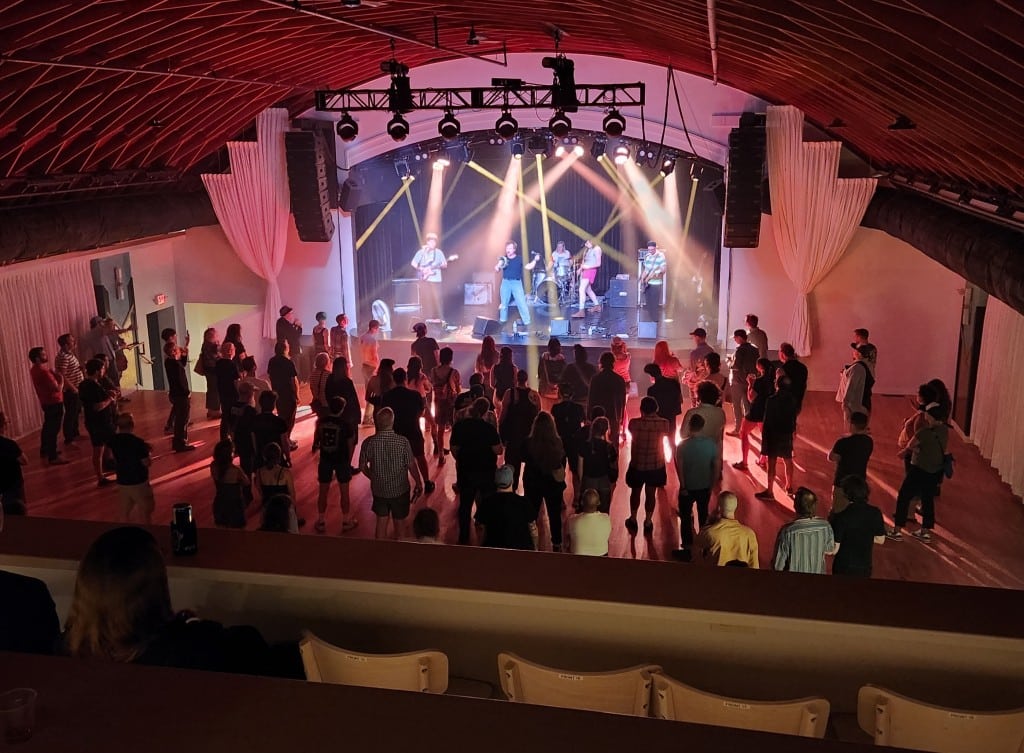
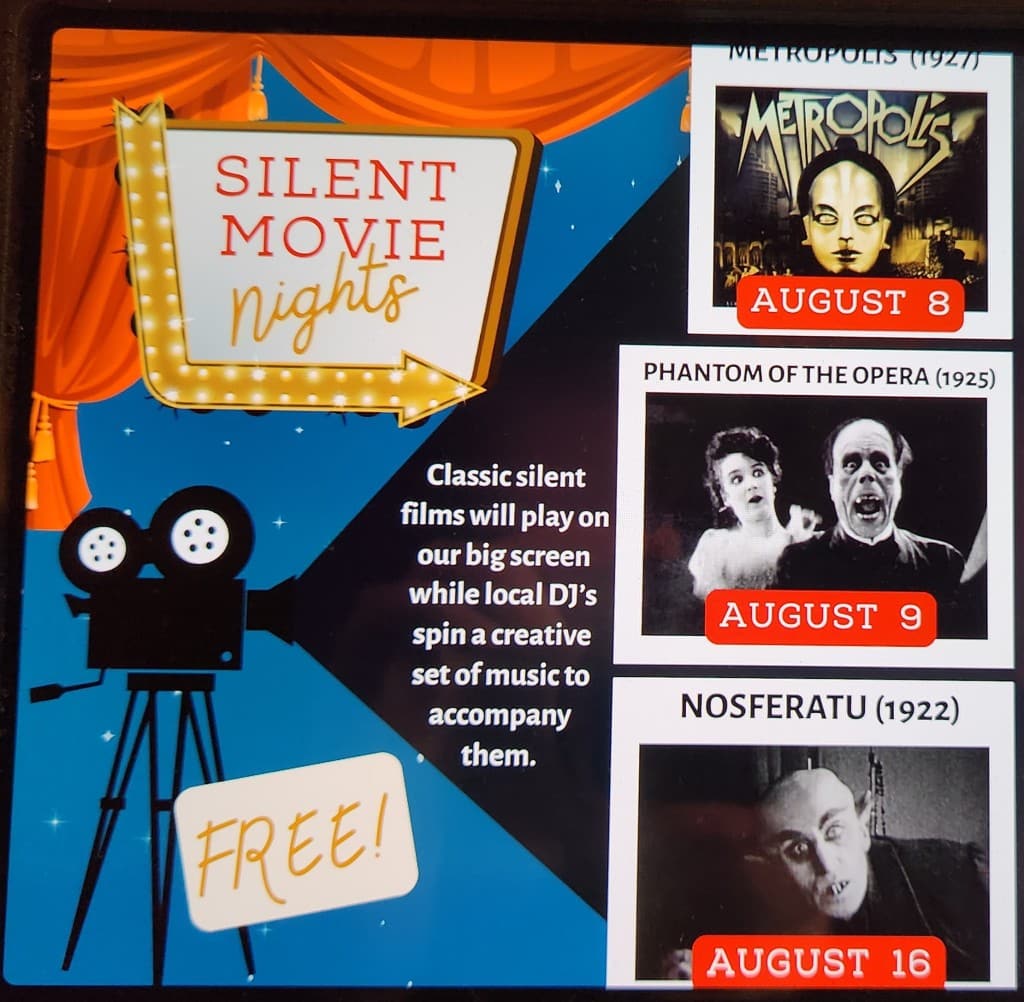
Less than two months after its grand opening, Atwood Music Hall (1925 Winnebago Street) is launching free Silent Movie Nights with live DJ accompaniment on Friday, August 8, at 8 p.m., with Fritz Lang’s indelible Metropolis (1927). Phantom Of The Opera (1925) and Nosferatu (1922) will follow on August 9 and 16. The events are situated somewhere between formal screenings and social functions, offering a luminant alternative to the plethora of dive-bar hangs in the east-side vicinity.
While the trio of screening events appear to be a test run helmed by Music Hall owner Toffer Christensen, the weekend dates are still an encouraging development this summer. The month of August is generally scarcer for movie fare in Madison before a deluge of autumn announcements. And they also complement several free, come-as-you-are screening series that have popped up in unassuming places the past few years.
Those include Leopold’s Werner Herzog and art-film patio series (which sadly didn’t stick around after 2022), Crucible’s Thursday “Schlock And Awe” presentations with live comedic commentary à la MST3K, Lola’s Sidecar Lounge movie parties in collaboration with Four Star Video Rental, and Bierock’s more long-running Public Domain Movie Nights on the first Tuesday of the month. The latter is the closest analogue to what Christensen has devised for Atwood Music Hall with films of the silent era, all free of licensing concerns.
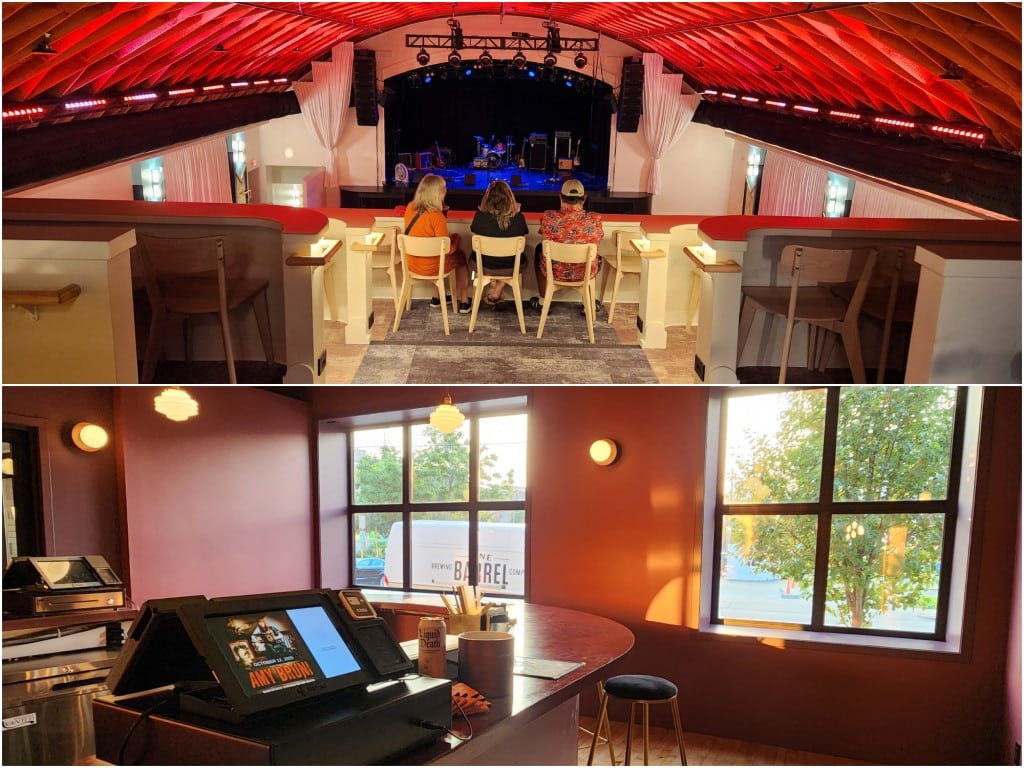
Visiting the mid-size space for live music for the first time on August 2 to talk with Christensen, I instantly understood his motivation for starting up Silent Movie Nights when I ascended the steps to the balcony area. With a somewhat comparable floor plan to the Orpheum, yet possessing a cozier and sleeker feel, the prospect of watching a classic movie there seems compelling. And it’s a little more luxurious than sitting on a picnic table, in a library lecture room, or even on an open floor watching something projected on a wall or screen 20 to 30 feet away. The ambiance of the Music Hall’s second floor, with its under-counter mood lighting, also doesn’t feel far removed from a conventional movie theater.
The balcony seats 45 people in the three main rows (plus a few stools in a fourth row), who will be farther removed from the screen across the auditorium. A Panasonic projector is mounted at stage front, and will beam onto the screen hidden behind the black curtains. “If we get more than 50 people, we’ll open up the floor downstairs [for people to sit closer],” Christensen says. “But… we’re gonna start with [the balcony], and see what kind of demand there is, and go from there.” The taproom or front lounge on the first floor, on the opposite side of the sound booth for the DJs, will remain open for people to order drinks and socialize.
Rather than begin with a breezy classic from a master of slapstick, like one of Chaplin or Keaton’s flicks, Christensen gravitated towards the dramatic with these three selections that run on the slightly longer side. “I went through public domain and looked at the films, and picked a few I thought sounded cool that were about the right length,” Christensen says. Though it appears the inaugural event is foregoing a formal intermission for this 148-minute “complete” restoration of Metropolis, the substantial runtime of the film will likely help first-timers settle in to the space.
Metropolis, often regarded as one of the most influential films of all time and the first sci-fi epic—a progenitor of the imposing architectural marvels in everything from Blade Runner (1982) to Poor Things (2023)—is quite an audacious statement to make for the first go-round. Let that choice signal to local cinephiles that these Silent Movie Nights intend to stand apart from the other aforementioned free series around Madison.
Further, these events are distinguished by their manner of presentation. Eschewing the standard synchronized orchestral score or a live pianist as UW Cinematheque regularly does with maestro David Drazin, Christensen is instead recruiting two DJs—the locally based DJ Slimzy and Milwaukee-based DJ Kelly Aiglon—to spin vinyl and establish their own distinctive vibes for these silent-movie events. And it was as simple as Christensen presenting the idea and asking, “You wanna try it?” Slimzy, whose given name is Andrew Thomas, will be on the decks for Metropolis and Nosferatu, while Kelly Aiglon will be handling Phantom Of The Opera.
In an email to Tone Madison, Thomas writes that it will be his first time doing something precisely like this, though he has become more interested in the possibilities of DJing to complementary video after an experience this past May at the Immersive Worlds interactive art exhibit at Next Wave Studios in Monona. “After my DJ set, I also did some of the video mixing for about 45 minutes while another DJ played tunes,” Thomas recalls.
For Metropolis specifically, he’s planning to create a general mood rather than structurally align tunes with the film’s scenes. Thomas will be alternating between a selection of film soundtracks, like the progressive electronics of Synergy’s The Jupiter Menace (1982) and the psychedelic jazz-funk of Alain Goraguer’s Fantastic Planet (1973). The approach seems to evoke a sound-collagic dimension, putting Metropolis in an intriguing dialogue with pre-existing cinema that came well after it. Thomas will further augment those with a mix of ambient and neo-classical records, which adhere slightly closer to the impressions created by Gottfried Huppertz’s original 1920s score.
“My goal is to have sounds that are expansive and contemplative that invite seeing and hearing the films in new ways,” Thomas adds. He acknowledges the potential to adapt for the Nosferatu gig the following week. “Based on how things go for the first show, I’ll adjust accordingly.”
Aiglon concurred and emphasized an adaptability in a brief phone conversation with Tone Madison about her forthcoming gig. “I’m actually taking screenshots of every different scene change in terms of plot point or mood shift,” she says, citing the Phantom Of The Opera‘s wilder twists and turns than Metropolis or Nosferatu. Aiglon continued to lay out the meticulous way she’s approaching the event as a DJ, but left an air of intrigue surrounding her music selections.
“I’m gonna be doing some dark synth, and—I’m still digging through [my] record bins—some historical orchestral organ music. But I also want to throw in some surprising pop elements. There’s a ballet in the beginning [that] I thought could be fun to do something more modern with,” Aiglon says. That eclecticism and variability unite in a way that will elevate the Phantom Of The Opera‘s own unique amalgamation of melodrama and gothic horror. And there’s also a livelihood in the tradition of the silent era’s exaggerated acting gestures that Aiglon feels will be essential to reflecting in her playlist sequencing.
On the scope of these events, Aiglon concludes, “It’s really cool that they’re having us do it on vinyl, ’cause it matches the old-time spirit of it all. The crackle of the [format] will add something you can’t get digitally.” Thomas seems equally enthralled by the unique request, and appreciates Christensen’s “outside-the-box” thinking. Particularly taken by the Music Hall’s sound system, he says he’d “love to see more multi-media events in the space with other artists and musicians alike.”
Editor’s note: The screened version of “Metropolis” on August 8 has been corrected from the 124-minute version (prior to the 2010 restoration).
We can publish more
“only on Tone Madison” stories —
but only with your support.
Author

Related Articles

Continuity and expressive experimentation in the 2026 Wisconsin Film Festival
Eight writers share their initial insights on the eight-day extravaganza, April 9 through 16, across UW campus and Madison.

The Cardinal Bar’s Cuban film series invites local support for Madison sister city
Cine Cubano bridges interest in Cuban cinema with the cultural exchange and aid mission of the Madison-Camagüey Sister City Association.
Three video artists tap into personal histories in the 150 Artists x 150 Years exhibition
Chele Isaac, Toby Kaufmann-Buhler, and Aaron Granat reveal the creative depths of their works, which are on display through February 28 at Central Library.