
An interview with Shon Barnes, annotated
Madison’s outgoing police chief harangued us about body cameras and… Boy Scouts?
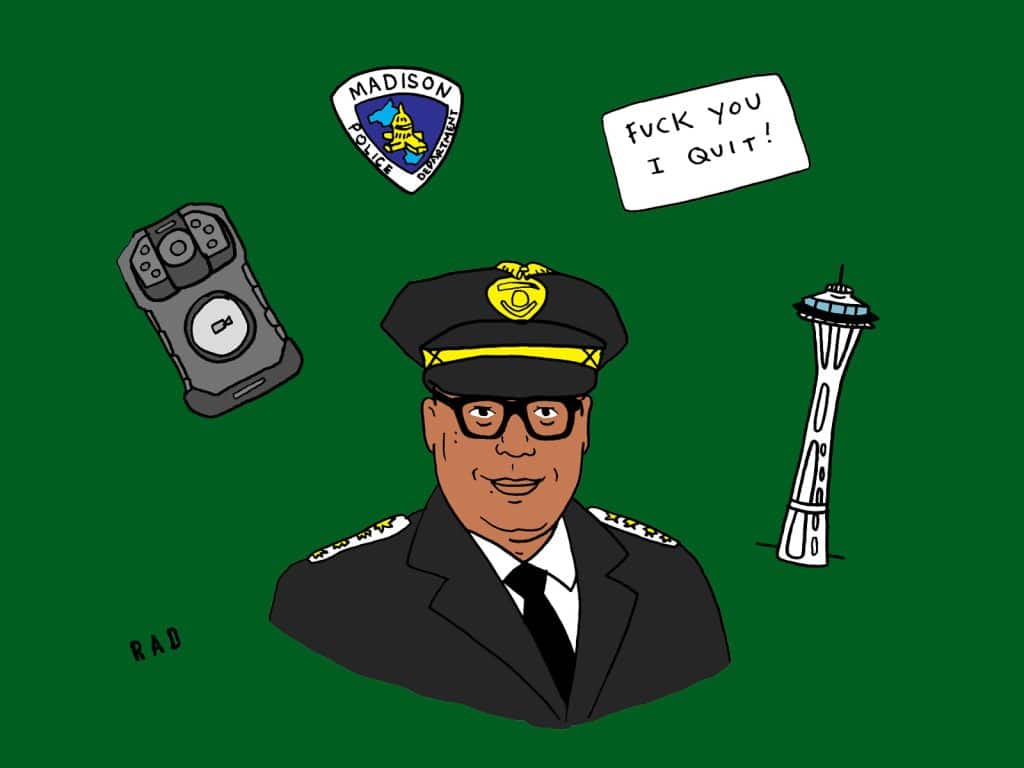
Madison’s outgoing police chief harangued us about body cameras and… Boy Scouts?
Perhaps Shon Barnes had a few scores to settle on his way out of town. During a brief January 16 interview, the outgoing Madison Police Department (MPD) chief and incoming Seattle police chief had some choice words for Tone Madison. He made a few statements, including false and questionable ones, that we thought we’d address for our readers. He also went through a pretty standard litany of gripes about the press, which are beneath response.
Here’s the background: Back in November, we published a story about a report MPD issued on its body-camera pilot program, and Barnes asked to speak with me after I sent MPD some questions for a possible follow-up story. The initial story focused on the fact that the researcher who conducted the main part of the study has ties to Axon, a leading vendor of body cameras and related software products. This is not hidden information, but MPD’s report didn’t mention it at all.
The researcher, Dr. Broderick Turner, a marketing professor at Virginia Tech, has conducted widely cited research on perceptions of body camera footage and on the intersection of technology and prejudice. He serves on Axon’s Ethics and Equity Advisory Council (EEAC), which the company’s website describes as “an independent body of U.S. and U.K. based community leaders, restorative justice advocates, and academics whose expertise is leveraged to enable Axon to responsibly develop and deploy new technologies.” He’s acknowledged that he gets paid some sort of honorarium for this work; how much is not clear.
Turner’s findings in the pilot study—about whether or not body cams affected the behavior or perceptions of officers and the public during a 90-day tryout in MPD’s North District—are even-handed, and we portrayed them as such. He’s not using the report to shill for any one vendor, or even for the adoption of body cams in general.
The point of that story was less about one person and more about disclosure. Why not get out ahead of any concerns about a conflict of interest, especially given previous controversy about the role of body-cam vendors in this process? This would not have been a story in the first place had MPD made sure it fully understood Turner’s relationship with Axon and included, say, a sentence noting it in the report. The researchers and experts I talked with didn’t necessarily think it was such a big deal for someone to get an honorarium for serving on an advisory committee. Indeed, it would probably raise more eyebrows if a large company like Axon didn’t compensate committee members, most of them people from marginalized backgrounds, for their time and expertise. They took issue with MPD not noting that information in the report.
MPD has claimed that this omission was an unintentional oversight, and that it doesn’t matter anyway because the information was already available elsewhere. “There is no nefarious reason or intent for not specifically stating the connection, as it was already known,” Eleazer Hunt, MPD’s Director of Data, Innovation, and Reform, told me in an email that we cited in November’s story. I think it’s important to note here that we’re always careful here about not going down the slippery slope of trying to guess at people’s intentions. It doesn’t take bad intent or even nefarious behavior for something to raise questions or concerns. Most of the time, it’s just a matter of flawed people making flawed decisions in a flawed world. (In all fairness, Hunt was more forthcoming in a later phone conversation, which is also cited in the story.)
Axon doesn’t currently provide MPD with bodycams, but it does provide MPD with Tasers, the company’s former namesake. If MPD does eventually take bodycams department-wide, the City will solicit bids from vendors. Axon and its competitors (including Panasonic and Motorola) would be fools not to bid on the contract. Madison is a city of about 280,000 people and growing. Vendors could make a lot of money selling the city body cameras, software, storage solutions, etc.
Anyway, that’s a long explanation of why we had this conversation and why I was asking the questions I asked. Here it is, with running annotations from me in highlighted text. Initial hello/greeting and various “ums,” “ahs,” “likes” etc. have been trimmed. Where this reporting goes from here, I’m still figuring out. For now, consider this a monument to the difficulty of getting straightforward answers to straightforward questions.
Tone Madison: I had emailed some questions over to Stephanie Fryer and Lee Hunt. And I think Lee mentioned that you wanted to address them. Did you get a chance to look at the questions that I sent them?
Shon Barnes: No, I did not…get a chance to look at him in detail, but I said, if you have a question about something, you could certainly have a conversation with me. You’ve run stories without the benefit of my comments, so I’m just giving you the benefit of actually talking to me for your next story. [Note: While reporting a June 2024 story about Act 253, a new state law that allows police to charge redaction fees when members of the public request body-camera footage, I reached out directly to Barnes. No response. We’ve also sought comment from MPD spokespeople over the years for various stories. And as we’ll see, said benefit is in the eye of the beholder.]
Tone Madison: We have reached out to MPD for comment on these things previously, and gotten the answers that we got. Did you kind of see what I was asking about in that email about the body camera study?
Shon Barnes: No, not really. I mean, I’ve had a lot going on, but I believe you have some questions about Dr. Turner, which are probably best suited for him, but he doesn’t do media, and I certainly can’t speak for him. I can only speak for my own judgment. So we can have a couple of minutes to chat about it, and then we’ll let you meet your deadline.
Tone Madison: We’re doing a follow up to the story we ran in November, and we’ve gotten some more information, which is publicly available, mostly on Axon’s website, about Dr. Turner’s involvement with the company, and raises some questions about like, whether he fully disclosed his role when he was answering questions from the Common Council. And from my standpoint, the reporting that we’re doing is less about this one person and more about understanding the report and how it’s been presented to the public, and understanding how people navigate the intersections of law enforcement, technology, public policy and academia. And I do have questions that are more, toward the MPD side of things. To start with, when selecting somebody to conduct the body camera pilot study, what was the criteria like for that? And did MPD have a process of considering multiple candidates, or anything like that?
Shon Barnes: Sure, we talked to multiple candidates. I talked to Anthony Braga. If you have done your research, and you know who that name is, you know he did the NYPD body camera pilot. He was in transition from Harvard to Penn, and he disclosed that it was about $250,000 that he charged for that, and that was definitely well out of our budget. I talked to Dr. Cynthia Lum—if you’ve done your research, you know who she is, and her experimentation with body-worn cameras. She was not able to do it, nor would we probably have been able to afford her. And I have known Dr. Turner for a little while, and I know that he runs a lab at Virginia Tech called Technology, Race and Prejudice, and that lab is specifically set up to ensure that technology that police departments implement do not influence racial prejudice among specifically minorities, specifically Black people. If you can find another person that’s specifically dedicated to that, I would like to know who that person is, but he is certainly someone who has breadth and wealth of knowledge to do it under our constraints of budget and time.
Tone Madison: So it sounded like it came down to qualifications, budget, and the availability and pay demands of the different candidates?
Shon Barnes: In addition to the fact that if you had an opportunity to hear some of those listening sessions and even reading the body-worn camera feasibility report, a big issue that was brought up is whether or not this technology adversely affects minorities, specifically Black people, and that was something that obviously is concerning to me as a Black person, as someone who’s also a chief of police. So that weighed heavily on my decision, and I think I picked the right person to do the job.
Tone Madison: Was this decision all down to you? There wasn’t a committee or anything?
Shon Barnes: No, it was my decision. Obviously, everything is my decision. But I did have people who were working on the pilot and the project, and thinking about research questions that we could answer within 90 days within the scope of our budget, certainly.
Tone Madison: Were there any formal processes around assessing the qualifications and independence of those candidates. I realize the qualifications of all three of those people are quite clear, but just wondering if there was any sort of formal metric that was used for that.
Shon Barnes: I’m not sure what you’re referring to. Because of the amount that we had to spend, we did not have to do an RFP [request for proposal].
Tone Madison: So then he came to your attention as a candidate because you knew of his work from before.
Shon Barnes: Absolutely.
Tone Madison: I know he told MPD about his involvement with Axon’s EEAC. But did he provide, or was he asked to provide, detailed information about compensation or his role with Axon?
Shon Barnes: He didn’t have to, because I know what he does, and his job is to make sure that these companies don’t put out products that’s going to hurt Black people. That’s why the lab is called, again, Technology, Race and Prejudice. What more do you want? [Note: My line of questioning here is about how MPD made decisions about the study, not about raising doubts about the qualifications of the researchers considered.] Can you think of someone else in your research for writing the story that does that? [Note: There are a great many people across various academic disciplines who study prejudice and racism in technology, including law-enforcement technology. Turner is their peer, to be sure. Barnes, a strong proponent of predictive policing technologies, no doubt knows this.]
Tone Madison: What I’m asking, in the interest of information and fairness—
Shon Barnes: In the interest of fairness, Dr. Turner is not bought and paid for by anyone.
Tone Madison: I’m asking what MPD did to assess any potential conflicts of interest.
[Note: Barnes is about to make a false statement about Tone Madison‘s coverage. I’ll break down why it’s false in a moment.]
Shon Barnes: I did not voir dire him, and I wasn’t going to do that. I don’t know if he’s a part of the Boy Scouts, or if he’s a part of the Cub Scouts, or if he’s getting paid by his local church as a deacon. [Note: Uh… neither did we, because that wouldn’t make any sense? Unless the Boy Scouts are getting into the body-camera business?] What I’m concerned with is, can he do what we asked with what we’ve given? And he was able to do that, and I’m very pleased with what he produced. Please understand that the report, as you have kind of misreported a couple of times, is not [about] whether or not the City of Madison should have body worn cameras. That is a misrepresentation of what he was asked to do.
Tone Madison: Yeah, that’s not how we represented it, for the record.
[Note: I have no idea what Barnes is reading. By the time I had this call with Barnes, we’d published two pieces that discussed the bodycam study and its purpose. In the first, I wrote that the purpose of the research was “to evaluate how the cameras would impact behavior and attitudes, on the part of both police officers and the public.” In the second, I wrote that the report “is wishy-washy about a lot of things—whether bodycams will deliver on promises of increased transparency, impact the behavior of the police officers wearing them, or have much impact on public attitudes toward policing.”
Policymakers and the public will take the report into account while making up their minds about whether or not MPD adopts bodycams department-wide. There is a distinction here between the scope of the questions the study answers, and the broader questions people will use the study to try to answer. And then there is the matter of how people on different sides of the issue will spin it. I did note in the latter piece that “MPD has made no bones about the fact that it regards this report as a major part of its argument for the City to authorize and fund a department-wide bodycam program.” When MPD submitted the report to elected officials, Barnes accompanied it with a memo in which he noted that he planned to “make the acquisition of BWCs a priority for the 2026 budget” and stated that “The benefit of deploying BWC greatly outweighs the costs; Madison community members will be well served to have an additional tool to record events.”
Personally I don’t mind people criticizing or complaining about press coverage or even making insinuations about our motives—nine times out of 10, you gotta let that stuff roll off your back. I do mind people misrepresenting what we actually said, so I made a point of pushing back on that a couple of times.]
Shon Barnes: You will see that he wanted to see whether or not there were any changes in officers’ behavior pre, post, and during the actual pilot. [Note: Yes, I did see this.] With most police agencies, probably 90%, now having body worn cameras, the question is: how many of them did an experiment at all before they implemented body worn cameras? And you’ll probably find that almost none of them actually did. Maybe zero.
Tone Madison: Granted, most of the examples out there, at least, that I’ve been able to find, have been for much larger cities. So that is a fair point.
Shon Barnes: Those studies were after the implementation, not before the implementation.
[Note: So, initially I genuinely thought this was a fair point but I checked into this claim about pilot studies conducted before full implementation. (Of course, you have to implement them a little bit to study them, right?) There have been body-cam pilot studies in more than zero places, including Boston; Fairfax County, Virginia; Hallandale Beach, Florida; Mesa, Arizona; New York; Phoenix; Santa Monica, California; Spokane, Washington: Tampa, Florida; Washington DC. Note that I’ve endeavored here to cite only instances of pilot programs that involved an outside academic researcher or consultant conducting a study. I did not lump in pilot programs sans studies, nor other academic studies of body cams, for gotcha points. Granted, all of these studies vary in their specific methodology, scope, sample size, and timing and the like. Some might have taken place after a department got approval and funding for full implementation, but before it rolled out fully, for instance. Still, I’m having trouble making sense of Barnes’ claim here.]
Tone Madison: We didn’t represent the study as [about whether MPD should have body cameras]. We were fair about saying the study was about some specific questions about body cameras. And we did also report that Turner has said in other contexts that he believes that police should use body cameras. So just to be clear about that.
Shon Barnes: And what’s the problem with that?
Tone Madison: Sorry?
Shon Barnes: Why is that problematic?
Tone Madison: I am clarifying to you what we reported, because you said that we misreported it. And I didn’t say there was anything wrong about doing a study to ask those questions, just to be clear.
[Note: Barnes might be saying “OK” here—the audio’s a little unclear because we’re both trying to say things at the same time.]
Tone Madison: If anyone from the Common Council or other officials or community groups or whatever, had asked more about this, would you have tried to get that information about what he gets compensated and what his role is?
Shon Barnes: That’s none of my business. I wouldn’t ask if he was a member of the Cub Scouts. If he gets paid to be a Cub Scout leader. [Note: Cub Scouts again. This is baffling, and would only make sense as an answer to a ridiculous and invasive line of questioning.] That has nothing to do with what we asked him to do, because science is science, and science is not ruled by individual biases. [Note: We were literally just talking about bias in technology.] Everyone knew that he was a part or had some affiliation with Axon. [Note: Define “everyone.”] We were on a Council meeting to get this approved, where the meeting went til 4 a.m., and he stayed on with us answering questions from Council. I would probably go back and spend some time watching that meeting that started at 6:30 pm and was over at 4 a.m.—well, 5 a.m. his time, because he was on the east coast at that time, I believe. [Note: Yes, and that is to his credit.] So, no.
Tone Madison: This was the Council meeting in April 2022?
Shon Barnes: Yes.
Tone Madison: I have watched that, and at least a couple Alders were questioning him quite a bit, and kind of pushing him on it. What he said at the time was that Axon paid him a couple thousand dollars to go to the meetings of of this, of this committee, and, you know, provide feedback aimed at making the technology, I think he said, less less racist, or like mitigating its impacts on on communities of color that might be negative. And what I laid out in my email questions was that, there’s some material, and again, it’s from Axon itself. You can just find it on their website that you know that indicates a deeper role in the company than that.
Shon Barnes: [Did they] ask him what his full role was, did they ask to see his tax returns? No. So what you’re trying to do, sir, is you’re trying to tear down someone that has done great work for us, for your own means, or for your own story, and that’s totally, totally unfair. [Note: I’m not sure what he’s implying about doing something for “[my own means].” Do I have something to gain here? Not really. If I look into a given story and find there’s not much to it, I drop it and move onto something else from my endless backlog of other projects. If I wanted to damage people’s reputations and make more money, I’d choose another line of work. Policing, perhaps.] You’re asking the what-if question from two years ago, and if it would have changed my decision? And the answer is no. We brought in someone who did an excellent job, and I would be very careful about what you write about him, because to be honest with you, you’re trying to libel him right now, and I’m not going to allow you to do it. [Note: Libel has a specific meaning, and I know it, and I know how U.S. law treats it, so I know when someone is throwing the term around carelessly. As the Reporters Committee for Freedom of the Press defines it, “Libel occurs when a false and defamatory statement about an identifiable person is published to a third party, causing injury to the subject’s reputation.” Additionally, trying to libel someone would be an incredibly foolish thing to do, especially in the current political climate.] I’m not going to allow you to do it at all. [Note: There is still at least a measure of press freedom in this country, fragile though it is. Government officials don’t allow us to do anything.] If you don’t like body-worn cameras, then write that. If you say police shouldn’t have body-worn cameras, then write that. [Note: I’ve published commentary and reporting over the years that is very clear about my skepticism of body cameras. I’m not sure I’ve ever been a hard “no” on bodycams, personally, but I’ve certainly become more convinced that our existing systems of policing and punishment aren’t the answer. I’ve been clear about that too. I’m amused at Barnes’ implication that I’m masking my perspective somehow.] If you say “I don’t accept the science,” then write that. Science doesn’t care whether you agree with what it says or not. It just gives you the answer. You’re forgetting that. And nowhere in the report do we say we have to have body-worn cameras. Now, either everyone in the world is wrong and we’re the only ones right, or maybe we’re behind the times just a little bit. [Note: The science around body cameras is a large and growing body of research about a relatively new technology, with a lot of different studies reaching a variety of conclusions. The Madison study’s conclusions are rather ambivalent; the study itself cautions that a 90-day pilot can only tell us so much. Therefore, I’m not sure what this has to do with accepting the science? Or that it has given us “the answer?”]
So what I will leave with you is this. Dr. Turner is a very well-respected person in the field of criminal justice research. [Note: I’ve never disputed that.] He works to ensure—to ensure—that people that are held accountable. And just so we’re clear, Axon already does business with the Madison Police Department. So am I biased because we’ve spent over, you know, $500,000 in new Tasers this year that are made by Axon? [Note: This is precisely why people ask questions about conflicts of interest. If the answer is benign, great—the important thing is that you checked.] So we all are connected in some way [to] Axon. [Note: Guy in Life Of Brian crowd voice: I’m not!]
We’ve probably given Axon more money than they’ve given Dr. Turner. Does that make the research wrong? They make Tasers. Panasonic, who has our body-worn cameras now they also do our in-car dash cameras. Right? We give them money. So does it make that biased? No. So I would urge you just to be more responsible in your reporting [Note: MPD has demonstrated, before and during Barnes’ tenure, that it has no business lecturing anyone about that.] and stop trying to convince the community that there was something nefarious going on here [Note: We did no such thing. There is a difference between pointing something out and deeming it nefarious.] just because I or we happen to know people who are the best in the business.
No matter what researcher you name, they’re going to have some type of connection to someone. Because how can you not study something and not be connected to that particular item that you’re studying? [Note: Barnes’ responses here are particularly striking in light of the comments he’s made, in two interviews this month, about Madison’s newish police-oversight agencies. More below, just after what remains of the interview.] So I wish you luck. It’s unfortunate, the tenor of what you’re trying to do. This is why Dr. Turner doesn’t do media, because, again, people will always write towards a slant. He is an excellent researcher, an excellent human being. And to be honest with you, I’ve been in policing now for 25 years. I’ve used several products, and it was clear that whoever invented and developed these products didn’t have someone in their ear telling them, “How do you think this is going to affect the people who are going to use it or be subject to it the most?” And that’s what you’re supposed to do as a leader. That’s what you’re supposed to do as a researcher. We’ve done the body-worn camera pilot. It was accepted unanimously by Council on consent agenda. [Note: The Council did indeed accept the report at its November 26 meeting. This is a fairly routine matter. It doesn’t mean Alders or the public are done asking questions about it, but fair enough.] It doesn’t mean anyone has to have body-worn cameras. I certainly, unfortunately, won’t be here to see it through the line, but we have a great start. You know, I pray that the City does the right thing, but whether we have body-worn cameras or not, this is one of the best departments in the country [Note: Dude, you’re leaving!], and we have an extremely high level of trust. And if there is an issue and we don’t have body-worn cameras to show what happens, I feel just as good [Note: What was all this for?!] because I trust the people here and we have great training. We have great policy. We have a lot of smart people here that want to do the right thing. So enjoy the rest of your day, sir, thank you. [Hangs up.]
Barnes’ misleading attacks on the Office of the Independent Monitor
The outgoing chief has expressed a very different view of another researcher the City has tapped to study policing matters. In an interview with Madison365 posted on January 24, Barnes attacked Madison’s independent police monitor, Robin Copley, for hiring a data analyst, Dr. Greg Gelembiuk. While not referring to Gelembiuk by name, Barnes notes that Gelembiuk has made public statements critical of MPD, and calls him “a hammer looking for a nail.” Gelembiuk has yet to issue any public reports in his capacity with the City—he only started that role in fall 2024. Yet Barnes characterizes Gelembiuk’s work, in the Madison365 interview, as “asking for data and fishing through research papers to find a methodology that you think will give you the answer that you want so that you can create some kind of sanction or punishment for the police department.” It’s not clear what basis Barnes could even have at this point for making these claims about Gelembiuk’s methodology or intentions. It seems Barnes is trying to convince the community that there was something nefarious going on.
Barnes is also misrepresenting the mission of the Office of the Independent Monitor (OIM). He portrays the very hiring of a data analyst as a departure from OIM’s brief. It’s not. The City ordinance establishing OIM states clearly that “It is anticipated that minimum staffing for the OIM will include the Monitor, an administrative support employee and a data analyst.” Barnes also frames OIM’s responsibilities as simply following up on complaints and compliments about police. But as Madison365‘s Rob Chappell has already pointed out, the ordinance gives OIM much broader powers to undertake investigations of its own. It even has subpoena power! The Madison Common Council approved this ordinance in September 2020. Barnes started as MPD chief in February 2021. He has absolutely no excuse for not understanding the basic legal foundations of OIM or misrepresenting it in this way.
Barnes went on to repeat his gripes about OIM and the data analyst position in an exit interview with City Cast Madison, released on January 27. (His remarks about this start at around the 24:48 mark.) “The office was doing really, really well, and then for some reason, they decided to get into the business of data analytics and looking for problems instead of looking for solutions, and that’s not going to move the department forward,” Barnes says in the interview, adding that he hopes the office will “slow down and work for what people voted for.” The “some reason” is that the City’s 2024 and 2025 operating budgets include funding for a data analyst position, and that, again, the position is right there in the ordinance creating OIM in the first place. It is, in fact, what people voted for.
In the City Cast interview, Barnes says OIM needs more of a defined investigation process “before we start trying to change, or attempt to change, police policy, through all these data requests.” This doesn’t make much sense. OIM has no direct power to change MPD policy. It has the power to make policy recommendations, but that’s it. In any case, a mere request for data does not constitute an attempt at a policy change. Again, Barnes is insinuating things about the intent and purpose of Gelembiuk’s work before anyone has actually had a real look at that work.
Gelembiuk’s activism and his criticisms of police are out in the open, as is the fact that Turner serves on Axon’s EEAC. Turner himself has also consistently cautioned that body cameras are not a panacea, and has published research that backs up that caveat. In both cases, these are clearly qualified researchers who use scientific and statistical methods. In neither case has anyone demonstrated that their potential conflicts of interest have skewed their actual methodology or results of their research, or that they go about their work with any kind of deceptive intent.
I also asked Gelembiuk last week if he’s ever received any outside paid work or honoraria that would present a conflict of interest in his work with the City. He says he hasn’t, “Unless you consider genomic analysis of copepods and fruit flies a conflict of interest here”—a reference to his career as a research biologist. (What? Did I ask Gelembiuk if he’s in the Cub Scouts? How dare you, sir!) Turner has acknowledged receiving honorariums. Both researchers have solid jobs, one with the City and one with Virginia Tech, so it’s not as if consulting or honorariums provide their main sources of income. Barnes treats one as a fair target for pretty dubious mudslinging, but the other as off-limits for vetting.
What’s next?
Like most stories worth reporting, this one also got me thinking about some further questions to explore in the future. Two of the big ones: How do people navigate the law-enforcement tech world and the complex intersections it creates between for-profit companies, public policy, and academia? And do Madison’s leaders, especially elected officials, understand that world well enough to kick the proverbial tires as they weigh important policy decisions about body cameras and other technologies? It’s no secret that Axon and other law-enforcement tech companies spend a lot of money to try and influence public policy and academic research.
There were a couple other things specific to Axon and the EEAC that I wanted to follow up on as well. A 2023 report publicly available through Axon’s website quotes Turner as saying: “As the board liaison, I’ve had the opportunity to try to connect shareholder value to stakeholder value.” The phrase “shareholder value” jumped out at me—is that something Axon asks EEAC members to think about, and does that compromise the body’s independence? Does the EEAC’s relationship with the company go beyond simply giving the company expert advice to mitigate the harmful effects of its technologies? These are reasonable questions to ask based on materials that Axon has itself put out for shareholders and the public, because they at least suggest that the relationship is complicated.
And how much do companies like this actually heed the advice of such advisory bodies? Has anything changed since 2022, when a majority of Axon’s AI Ethics Board resigned over the company’s proposal to use Taser-equipped drones to respond to mass shootings, including those in schools? That’s an important one, because Axon kept pursuing the drone project after a pause, and also because the EEAC partially grew out of the ashes of the AI Ethics Board. My sense is that people on these bodies want to make a difference from the inside. I think it would be valuable and interesting to understand more about their experiences and the challenges they face.
On top of all that, I’ve been working on other body camera-related stories, including our ongoing series on Act 253, a Wisconsin law that impacts public access to body-cam footage. I had some questions about that for Chief Barnes, but didn’t get to that before he hung up.
Another one I would have liked to pose: If all of this is about transparency, then why not err on the side of disclosure?
Who has power in Madison,
and what are they doing with it?
Help us create fiercely independent politics coverage that tracks power and policy.
Author

Related Articles

Starter homes? No, we need starter apartments
As homeownership continues to be out of reach for too many Madisonians, we should build more owner-occupied, multi-family housing.

The federal war on trans healthcare mirrors that of abortion
Hospitals are folding to anti-trans hate, but the community continues to advocate for trans youth.

Madison needs a wake-up call
The longer we pretend this City is a progressive haven, the more people will be harmed.