
American secular groups need to oust pseudoscientific bigotry
Atheists should know that dehumanization underlies theistic opposition to trans rights.
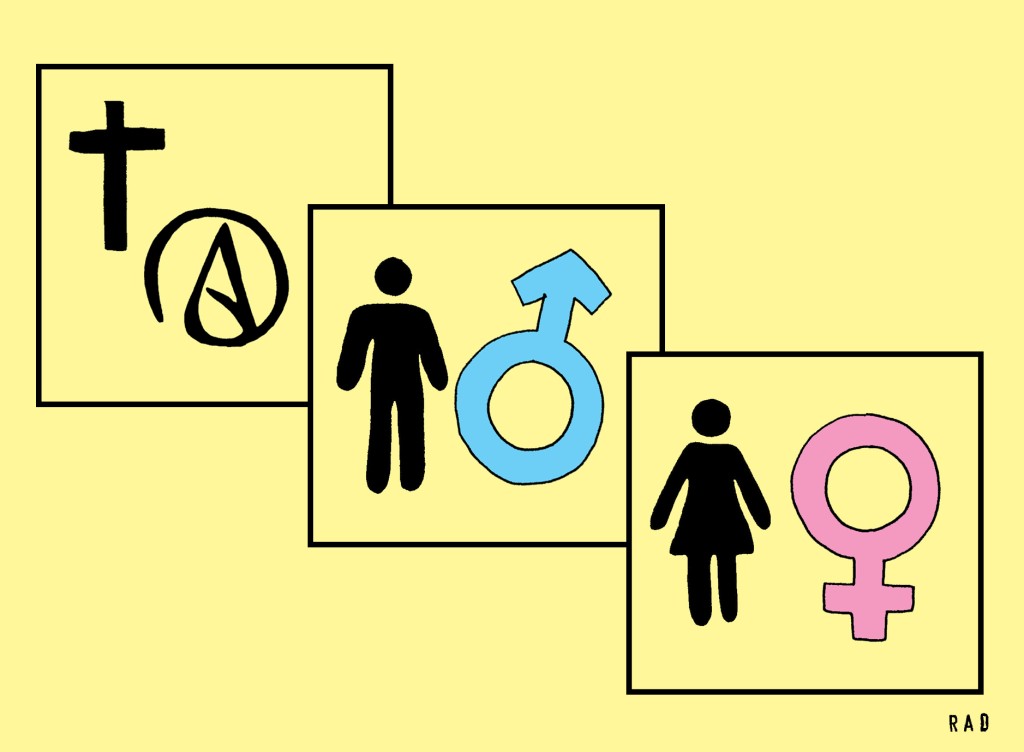
Atheists should know that dehumanization underlies theistic opposition to trans rights.
As a capital city that prides itself on progressive values, Madison is a relatively comfortable social haven for the nonreligious. I feel that way as a lifelong nontheist who has lived in Madison for over three decades. While I was made to feel different countless times growing up, I never felt outright ostracized or tormented like open atheists in other parts of the country and the world. I have experienced racism, xenophobia, misogyny, and other forms of discrimination, but I have no memories of hate directed at me in Madison for being a “heathen.” That’s not to say that atheism is not contentious in several communities and settings within our city, especially behind closed doors. Rather, it is to say that, in Madison and other cities like it, widespread discrimination doesn’t exist by employers or institutions against individuals due to their nontheism.
Outside of free-thinking refuges like Madison, nonreligious folks—who identify as atheist, agnostic, secular humanist, pastafarian, or nothing at all—badly need support. I fear that the network of secular organizations seeking to protect and advocate for atheists in America will not reach most of the nation’s growing nonreligious population because of the bigotry that has pervaded it for decades. The secular movement’s only hope is to finally oust the racism, sexism, and other forms of hate that have long dominated it. That’s been an uphill battle.
For some among the exploding numbers of nonreligious folks in the United States, especially those who experienced a religious upbringing, it can feel isolating not belonging to the type of close-knit community that congregates at a place of worship. Indeed, many closeted atheists don’t come out because the only accessible community support and resources—often crucial for someone’s survival and wellbeing—are tied to the religious fold.
Many atheists are unaware of spaces where the nonreligious congregate. A mosaic of local and national organizations around the country engage in a variety of activities—from organizing and lobbying for the rights of nonreligious Americans and against Christian privilege, to publishing magazines, hosting national conferences and local meetups, demographic research, and more.
Here’s a rough lay of the secular movement land: The largest umbrella organization uniting several of these groups, called the Secular Coalition for America (SCA), was founded in 2002. One of the coalition’s national member organizations, the Freedom From Religion Foundation (FFRF), was founded in Madison in 1976 and is still headquartered here. It is perhaps best known for the iconic commercial in which Ron Reagan introduces himself as an “unabashed atheist” and declares that he’s “not afraid of burning in Hell.” It first aired in 2014 on The Daily Show and The Colbert Report. (I know a lot of people find the Ron Reagan ad refreshing and edgy, but to me it seemed dated the first time I saw it.)
There’s also the Secular Student Alliance, a chapter-based national organization dedicated to supporting and guiding atheist, humanist, and other nontheist students for the last 25 years. Since 1963, American Atheists has protected the absolute separation of religion from government, raised the profile of atheists and atheism, and educated Americans about atheism. Then there’s Camp Quest; since 1996, the organization has provided a summer camp experience for godless children. Starting in 2011, Black Nonbelievers has provided support for and increased awareness of the growing number of nonreligious Black folks and their unique challenges. One of the newer coalition member organizations, the Association of Secular Elected Officials, has represented nonreligious elected officials in the political arena since 2020. One of the oldest, the American Humanist Association, has lobbied and advocated for secular humanists and nonbelievers for over 80 years. This is an abridged list of secular U.S. organizations—several of which have chapters around the country—that together form a veritable motley crew of unabashed heathenry.
By and large, my local friends, family, and acquaintances have been surprised to learn that there is an old and active set of organizations explicitly serving nonreligious folks. I was curious, so I took an unscientific poll of 22 self-identified Madison-based atheists—21 current residents who have lived in the city or the surrounding area between one and 65 years, and one former resident. Most of them were not aware of the Secular Coalition for America, and most had not heard of or joined any member organizations. I hope that awareness of the secular movement grows in Madison and beyond, because some of these organizations are doing crucial work that’s super relevant to nonreligious Americans.
I started paying attention to the U.S. atheist scene via the old-school blogosphere in the early 2010s. Since then, I’ve gotten to know several tenacious, fervent, and curious nonreligious folks who are active in organized nontheism and care deeply about truth and justice. They work tirelessly (actually, they all seem exhausted) to make the world a better place and uphold human rights.
During that time, I also learned this movement is largely dominated by white men, many of whom come with a hefty intellectual superiority complex. They have long come under fire for rampant bigotry in their ranks. This faction of atheists sees matters of social justice as outside the purview of organized atheism and scientific inquiry alike. They insist that science is pure and apolitical, but that faction is wrong; science and social justice are inextricable.
Racist and sexist incidents, often followed by swift backlash, have occurred regularly throughout the rich history of U.S. organized nontheism. The latest big showdown within organized atheism is around trans rights and gender identity. At a time when trans adults and children are facing an assault on their rights and fresh attempts to erase their very existence, nonreligious U.S. organizations would do well to unanimously push back. And many of them do vehemently push back against the fundamentalist Christian denial of trans rights.
Yet, some atheists who have been widely touted as leaders and intellectual giants, like biologist Richard Dawkins, philosopher Sam Harris, and psychologist Steven Pinker, undermine trans rights. They use pseudoscience to argue that human sex is strictly binary, and posit that “someone’s feelings” cannot change their sex assigned at birth. To these men and other scientists and scholars who share this view—including those with present tenure who publish in peer-reviewed journals—this view is the empirical, scientific truth. Further, transphobia is rooted in these nontheistic notions and underlies practically all religious and non-religious justifications for institutionalized bigotry.
In reality, sex assigned at birth is usually the mere observational verdict of clinicians looking at genitals and declaring whether a baby is a boy or a girl. And, as we know, doctors are human, and humans are fallible. Assigning gender at birth seems sensible because we’ve been hoodwinked for ages to believe that Mother Nature herself created the binary. The entire sex-assignment system has been fucked for centuries.
The non-creationist, pseudoscientific argument posits that no matter someone’s gender identity, their biological sex must be either male or female, and based on their genitalia, reproductive organs, sex chromosomes, and gametes (whether they make many small sperm or fewer large egg cells). This fundamentally flawed secular argument backs up right-wing and religious extremist talking points—if nature made humans in a binary, then it only makes sense to insist that God designed it that way. The false binary can be dressed up to sound legit and scientific, but it’s dehumanizing drivel. Reducing sex to gamete size oversimplifies biology to the point that it’s straight-up inaccurate. If you’re interested in learning more about what science says about gender and biological sex, these two articles provide a good start.
Gender and sex are distinct concepts, but they constantly mingle in ways that shape physiology, health, and lived experience—sex and gender are prismatic and interconnected, not binary. One of my favorite examples of the entanglement between sex and gender is bone density. It’s widely assumed that males tend to have higher baseline bone density than females by virtue of their biological sex. In reality, social norms influence who does weight-bearing activities and exercise. Studies show that women who engage in comparable physical activity have bone densities comparable to men.
In the same vein, a society that still largely believes in a distinction between men’s work and women’s work will produce stronger men; when we teach children that boys do the heaviest lifting, boys end up marginally more brawny on a population level. For all we know, this self-fulfilling prophecy has as much (or even greater) influence on people’s bone strength or any other trait as genetics or gonad type.
From my vantage point, the latest kerfluffle around pseudoscientific transphobia, involving the Madison-based Freedom From Religion Foundation, has played out in slow, dramatic fashion. It started in November of 2024 with a piece refuting reductionist definitions of womanhood in the organization’s Freethought Now blog, written by former FFRF Fellow Kat Grant.
Reports suggest that, upon reading Grant’s essay, somewhat prominent atheist Jerry Coyne, emeritus professor of Ecology and Evolution at the University of Chicago, was overcome with an urge to respond. He leveraged his influence with FFRF founders to publish yet another screed by a grandiloquent yet factually incorrect white man. In this screed, Coyne spouted the fallacy that, while gender may be a spectrum, biological sex is strictly binary and immutable. He also spouted harmful disinformation about trans women.
The backlash was swift and intense. As writer Chrissy Stroop put it in a piece for The Flytrap, shortly after Coyne’s screed dropped, “pro-social justice atheists, humanists, and allies expressed outrage that FFRF would give space to a crusty fossilized dick like Coyne.”
The backlash led FFRF to remove Coyne’s post and publish a rather unconvincing apology on its website. As Stroop writes, up until this point, “Coyne, along with fellow atheist bigots Richard Dawkins and Steven Pinker, sat on FFRF’s honorary board—which is to say they had nominal, non-governing roles and were only really there for the kind of star power such boards tend to lend to organizations.”
In response to the unpublishing, these three men, who are absurdly upheld as purveyors of rationality and reasoning, made a dramatic show of resigning from FFRF’s honorary board. Note that the Center for Inquiry, a SCA member organization that merged with the Richard Dawkins Foundation in 2016, declined to sign on to the pledge from secular organizations to protect LGBTQ+ rights. Stroop’s article details the whole saga.
Ultimately, the FFRF kerfluffle prompted the leadership of some member organizations in the SCA to release a joint “Statement from American Atheist, Humanist, Freethought, and Secular Groups Affirming Commitment to Protecting LGBTQ+ Rights.” Though it was intended as a direct retort, or “subtweet” as one signer put it, to FFRF’s publication of Coyne’s transphobic prattling, the statement seems esoteric to anyone but movement insiders. The statement denounces anti-LGBTQ rhetoric and legislation, which it credits to “religious extremists” and “largely religious” views of gender norms. The pledge does not explicitly condemn anti-trans views among atheist leaders.
As Stroop questions in her Flytrap piece, “Why the seeming inability to take a stronger stance when the call is coming from inside the house?” One would believe that secular organizations would vehemently and unanimously denounce the reductionist, pseudoscientific, bigoted stance—coming from the organized nontheist house—that human sex is strictly binary and based on gamete size. But it’s been murky from the outside.
One thing that I’ve learned is that religious extremists who oppose trans rights and atheists who oppose trans rights share one major tactic: the misappropriation of biology. As a lifelong nontheist, I’ve observed that atheists tend to believe that the fundamental route to evil is religion or theism. But I know plenty of rational religious folks and plenty of ill-intentioned blithering atheists. The true root of evil underlying theistic oppression is dehumanization. Atheists might as well deal with that now, because even if those fighting against religious extremism are eventually victorious, the final big boss of oppression will be the same secular, pseudoscientific dehumanization that I’m talking about, and it will only get stronger and harder to defeat.
Some secular activists and leaders are righteously concerned with taking out the transphobic pseudoscience trash in their own house, and I, for one, am rooting for them. Meanwhile, nonreligious folks who want to support a non-profit secular organization should consider donating to one or more of these groups, which, unfortunately, operate on a tiny fraction of the funds that religious extremists leverage.
Who has power in Madison,
and what are they doing with it?
Help us create fiercely independent politics coverage that tracks power and policy.
Author

Related Articles

Wisconsin communities face scrutiny over data center secrecy
The town of Beloit is the fifth Wisconsin community with an NDA for a possible data center.

Eyeing voting rights, liberals aim to secure Wisconsin Supreme Court through 2030
In the April election, Wisconsin liberals are hoping to expand their majority on a body that could be a critical backstop for voting rights during the next presidential race.

Police surveillance technology needs proper accountability
Grassroots resistance against Flock cameras are writing the blueprint for comprehensive reform.