
“All The Sounds Are Done” improvises with/in improvisational space
Sensitive and intrepid players have come to gather at Communication for the community music jam since summer 2023.
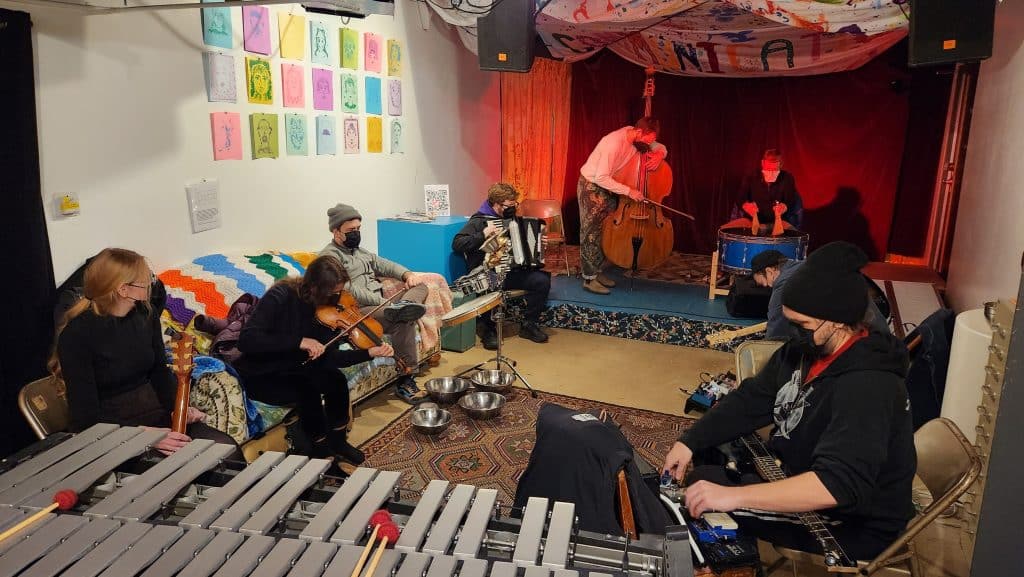
Sensitive and intrepid players have come to gather at Communication for the community music jam since summer 2023.
A die is cast. Names folded on Post-It notes are drawn from a small bucket. Those who are chosen, gathered and seated in a rectangle formation, attentively lock eyes before gently starting to perform and cross paths on a menagerie of instruments—from unamplified acoustic guitar, electric guitar with a smorgasbord of pedals, accordion, violin, vibraphone, singing bowls, bass drum, and more.
Since July 2023, this has been the scene at All The Sounds Are Done (ATSAD), an improvised music meetup, held at Communication (2645 Milwaukee St.) the fourth Sunday of each month between 4 and 6 p.m. For the remainder of 2024, co-founders and co-hosts Sahada Buckley, Jakob Heinemann, and Tim Russell are moving that forward one week and bumping it back one hour to third Sundays, between 3 and 5 p.m., with the next one set for February 18.
The inspiration for this experimental community jam, its name a slanted riff on the 2008 Dub Trio album Another Sound Is Dying, was pretty straightforward, in the organizers’ shared but perhaps unspoken enthusiasm for the creative spark of jam sessions. “I feel like we kinda all wanted to do this separately,” Heinemann explains. “Tim knew both Sahada and I, and then I got us together and we jammed [in the Common Sage cellar, Russell’s house venue], discussed it, and decided it’d be fun to do.”
Russell, though, ardently gets further into the weeds about the origins of the series name. “[It] has two meanings, really, probably more,” he says. “One, every sound has already been created. Nothing is original, and [we] might as well make something up. And two, we play all of the sound: every sound is welcome to be used in performance. Dance with what you brought.”
The more deeply rooted genesis stems from the trio’s work and education in regional spots like Milwaukee and Chicago but also cities as far-flung as Oakland, California, and Athens, Georgia. Russell, Heinemann, and Buckley bring distinctive musical experiences and styles to collective hosting duties.
Russell, a percussionist who frequently crosses over into electronic music and contemporary dance as Avoidance Policy, borrowed from the cultures in both Milwaukee and Oakland. “I was bringing in energy from Milwaukee with Unrehearsed MKE,” he elaborates. “That series was more curated, whereas [ours] is more like, people who know about it will show up and make it happen. When I was in the Bay Area [from 2017-2019], there was an improvisation series called Doors That Only Open In Silence. People in the community would get together and pull names [from a hat] so you’d get to know who was out there and what they did.”
A bassist hailing from a jazz background in the Chicago scene in the late 2010s and early 2020s, Heinemann gives credit to the now-defunct Impro Jam that used to appear at Chicago venues like Slate Arts and Cafe Mustache, where he first encountered the die system for choosing groups of improvisers. Anticipating a greater turnout for 2024, Buckley jokingly interjects in Heinemann’s explanation. “We should get a D20 in there,” she says, offering to throw one in that she’s accumulated from her days playing D&D and Magic: The Gathering.
Buckley, a violinist who arrived in Madison in May 2021, brought her experience from Athens, Georgia, which has a “long history of indie rock and alternative music thriving there,” she says. Of the ample amount of experimental bills and jams that exist throughout the city, Buckley set up “a weekly show for like three years at this little place called Go Bar, which has now closed, sadly,” she recalls. “[Owner] Thomas Hedger made a space for everyone to do their act and share their art, which often meant giving up a wildly filled bar with eager college students a couple nights out of the month,” she adds.
When Buckley was trying to find her scene in our fair city, she was “really confused that there was not more happening here.” Part of that disconnect could be due to the live music shutdown in 2020, which slowly began to lift in the last couple years, but it may also be attributed to the distinctive nature of Athens and Madison underground histories. Further, there’s the X factor among experimental artists themselves, local or not, Buckley contends. “I feel like experimental musicians are little hermits in our houses, and some of us don’t have the opportunity often to play with other people,” she says. That’s where Communication came in as the destined spot to congregate, which Buckley views as “down to just host for the sake of hosting and give a space for experimentation.”
“We were trying to find a place that could feel informal, that doesn’t have to feel like a performance or have those kinds of pressures,” Russell says. “When we were talking to [Events Manager] Michael Wojtasiak [at Communication], we were like, ‘It’s not really a show, but it could be like a show, I guess? It’s more like a community get-together for sharing.'”
Russell continues to describe the process in flux. “We had talked about being very pilot about it,” he says. “We wanted to see if Communication was going to be the spot. What’s the energy, and who’s gonna come out? What’s the format going to be?’ So it really was making the space to happen, and then just going, ‘What happened?’ It’s also kinda improvisational in nature. We’re still feeling it out every time. It changes depending on who’s [there] and how many people are there.”
At the inaugural meetup, Buckley recalls, every participant got up on the slightly-raised Communication stage (which is basically a king-sized box spring). But during the second ATSAD installment in September, the players spread out to face each other on the floor, in the traditional audience space. They continued that arrangement at the most recent and successful jam on January 28, which rallied 14 folks. And it was true for the 10-person one on December 17 of last year as well—even if it lacked some of the wild instruments of the first couple, like a berimbau (musical bow), and Russell’s own living-room auxiliary percussion setup, which Heinemann jovially praises as “the coolest thing he’s ever seen.” Russell simply brought sticks and leaves wrapped in a rag (the essence of fall), a couple singing bowls, and a tiny snare drum, which mingled so mellifluously with the vibraphone of community participant Abe Sorber (of Lovely Socialite).
As an observer of the December meetup, it was subtly thrilling to see the personalities of the co-hosts and musicians mingle as the afternoon turned to early evening. A sense of playfulness eased any air of self-consciousness. In Russell’s initial die-rolling, the number five kept landing face up, and it became a bit of a running joke about the “dreaded number.” So the group of seven, which became 10 as others filtered in by 5 p.m., collectively agreed to banish it and try other configurations, like three or six. At the end of the evening, everyone joined in unison with Russell in the lead. Buoyed by their steady crescendo, he summoned and molded the in-joke of the day into a spoken-word chant: “The number is five. Roll as you might, chance is an illusion.”

The trio’s efforts have sparked further interest in Communication events through Andrieu Todd, who’s been attending ATSAD since the beginning. A comedian and performer under the name Battalion Of Cloudships, Todd is also an accomplished graphic artist who’s designed several handbills for Common Sage events and this very series. Just recently, he began booking “an ever-evolving” variety show called Amalgam that’s intended to follow many of the All The Sounds Are Done Sundays at 7 p.m., with the goal of having some of the afternoon local and touring musicians stick around the space to forge connections.
The inaugural episode of Amalgam, held January 28, served as a sort of test run for Todd’s duties as the formally dressed host, pacing about the space asking for pitches and drolly doling out personal anecdotes between the acts. John Birner, known as local craftsman SoaringTortoise and one half of Basidium, opened the night with some handmade string-instrument and analog electronic drones. Chicago-based drummer Alexander Adams and Dubuque-based saxophonist/guitarist Bob Bucko Jr. improvised as a duo with an ear for more noise-rock and free-jazz forms. Chicago-based comedians Aaron Naylor and Evan Hull closed the night, honing their stand-up with an abundance of confidently composed witticisms and self-deprecating works in progress.
Reflecting on his approach to these shows, which are in tune with the spirit of ATSAD jam sessions, Todd says he wants “the performers to feel safe to take creative risks and stretch their artistic muscles. I want the audience to be moved by that vulnerability. There is a certain flavor of magic that occurs in a room when everyone has the shared experience of knowing what they’re participating in is truly special.”
The same could absolutely be said of All The Sounds Are Done. Given the community’s taking to it, the recurring Sunday event has taken on a different form from what Heinemann originally conceived as a jazz jam. “I was envisioning that people would go up on stage and do their piece. But then after the first one, it became immediately clear that everyone was bringing their own instruments, their own crazy setup [with] their own amplification situation. So, moving people to and from the stage was not practical,” Heinemann says.
“Another thing that surprised me is that everyone who comes wants to play,” he continues, as a point of pride. “Even if people come just to listen, they’ll be like, ‘Oh, okay, I’ll try playing vibraphone, or piano, or whatever.’ It evolved into this circle sort of concept that’s a totally different thing than a traditional jam session. It’s more of a communal workshop. Everyone has equal space to do what they want.”
Russell immediately follows Heinemann’s impressions. “One of the things I like about it, specifically, is how much you play. […] It’s cool that people are sensitive to [others not playing], too. We have the die; we have the names; but there’s always veto power. You can opt out or opt in,” he says.
On future outlook for the series, Buckley says that it’s gotten “better every time. People are becoming more comfortable. I was hoping and praying that this jam is giving people the opportunity to have that experience” in a scene where she perceives it had been lacking.
“The experimental scene can change easily with a little more visibility and a little more help from venues giving us the space and time,” Buckley says. “Because of that, we’re having better jams. We’re able to communicate better as musicians. It’s one thing knowing your gear really well, and it’s another thing being able to communicate with it.” Seems like they’ve found the ideal space and partnership with Communication.
We can publish more
“only on Tone Madison” stories —
but only with your support.
Author
Related Articles
Madison acts rivetingly ring in 2026
Five local bands offer new songs and projects, and capture a hopeful feeling in the new year.
Achieving a broader focus through music photojournalism in 2025
The fourth installment of our live music photo essay series centers a more personal vantage point.
Tone Madison’s favorite records of 2025
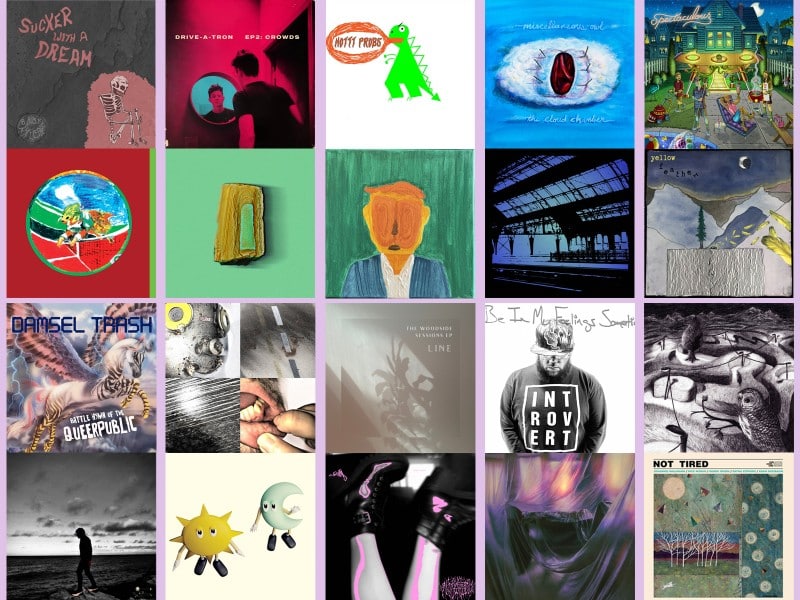
A celebration of 20 local releases that defined the year.