

The formerly Madison-based musician catches up with us from North Carolina.
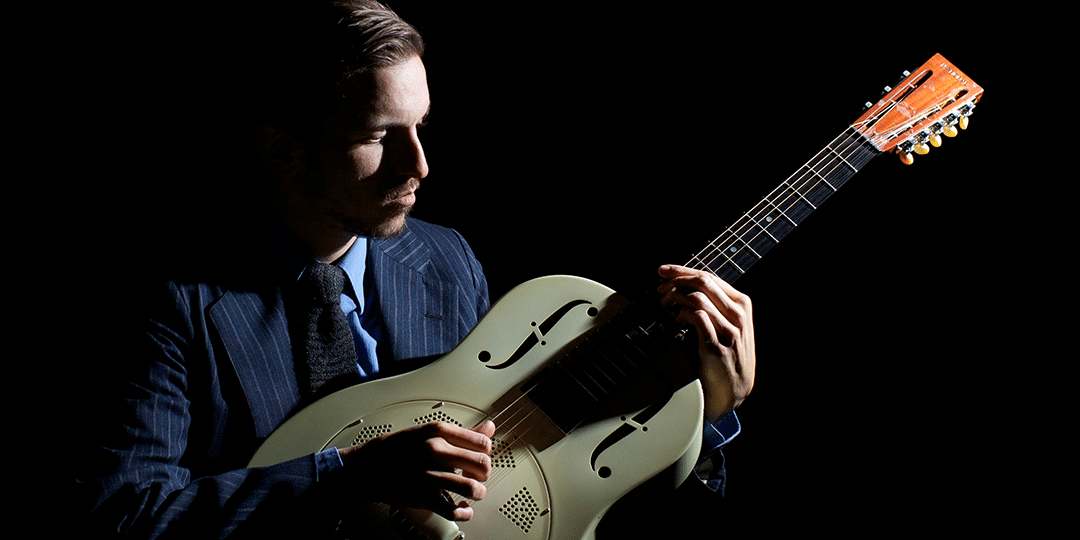
Madison native Benjamin Bill spent many years as a fixture in the music community here, particularly in his solo project William Z. Villain, before moving away this fall and settling in the Blue Ridge Mountains town of Sodom Laurel, North Carolina. (“It’s much nicer than it sounds,” he says.) His other roles in Madison music included hosting open mics at the Memorial Union and The Fountain, booking shows, and playing bass and keyboards in bizarro instrumental-rock trio Myrmidons. But William Z. Villain is Benjamin Bill’s most singular creation, a project contorting gypsy jazz into a simultaneously playful and mencing persona. It’s had many live and recorded lineups, with collaborators including multi-instrumentalist Ramon Gooden, who plays as a touring member of Digital Underground and randomly met Benjamin Bill a few years ago at a bus stop.
Last week, William Z. Villain put out a new self-titled release. Benjamin Bill isn’t particularly interested in recording and sees his releases more as just companions to his live shows, but this EP is the first to really vividly capture the sheer unpredictability and strangeness of the project, especially in its variety of rhythms and vocal styles. (One way to sum up the guy’s vocal style is that he’s the only person I’ve ever seen attempt an acoustic cover of a Mr. Bungle song.) On “Ef-ta (Aunt Becky Smiles When She Talks About The Apocalypse),” Benjamin Bill sings in a rapid patter over uneasy Latin grooves. His voice slides across octaves and abrupt time changes on the sweetly warped “Seven Recent Break-Ins” and gets a little more low and somber (but with eerie falsetto harmonies) on “Her Song.” He’s also releasing the EP as a limited-edition cassette that will include a few bonus tracks.
William Z. Villain likely won’t play in Madison again until his spring tour, but Benjamin Bill caught up with me recently by phone.
<a href=”http://williamzvillain.bandcamp.com/album/william-z-villain”>William Z. Villain by William Z. Villain</a>
Tone Madison: While you’ve been in North Carolina, have you been striking up any new collaborations?
Benjamin Bill: There’s a lot of musicians down here, some people playing old-time music, like real old-time music, mountain music, and that’s pretty interesting. I’ve been playing by myself a lot. The new solo set that I just got together is a new and improved looping set where I loop a bunch of percussion, but I figured out how to do time changes. If anyone’s seen me play live, we do all these time changes and style changes and feel changes. I figured how to do that with the one-man looping scenario and that’s kind of neat. I also got two strings added to my guitar by a dude named Garrett of Old Country Strings in Milwaukee, and then Todd Cambio from Wisconsin, who’s a guitar builder at Fraulini Guitars. That dude is like a legendary guitar builder. They’ve added two strings to my guitar so now the high two strings are doubled like a mandolin. For a long time people have taken 12-string guitars and then taken off the doubled strings on the bass strings so that you have a pure bass tone, and then the jingle and grinding of the out-of-tune notes on the high strings.
Tone Madison: You’re about 35 miles outside of Asheville. Do you ever get down there?
Benjamin Bill: Yeah, I go there and get food sometimes. I know there’s bluegrass music and stuff, and I met a guy that claimed—no, wait, I’m not gonna tell you about that guy. But yeah, I’ve been to Asheville.
Tone Madison: With the new self-titled release, was there any particular impetus behind it or anything in particular that you wanted to accomplish with it?
Benjamin Bill: Yeah. I was trying to get it recorded before I started to play shows out this season, and I cranked them out in about a weekend at the converted dairy coolers on South Park Street. I did it how it’s performed live, except that a couple tracks have overdubbed bass, and I think one track has overdubbed vocals. Otherwise, it’s all just my live rig recorded. Most of it’s just one take and I stacked everything up right before I recorded it. It’s pretty much the same [as the live set] except I don’t think there’s gonna be anybody playing bass. I’m going to be doing solo for this tour, before I feel comfortable dragging more musicians along with me.
<a href=”http://williamzvillain.bandcamp.com/album/william-z-villain”>William Z. Villain by William Z. Villain</a>
Tone Madison: Do you still collaborate or keep in touch with people you’ve played with in Madison, like Ramon Gooden?
Benjamin Bill: Oh yeah, I still keep up with him. He just sent me something the other day. I’m gonna see that dude around Christmastime. He still lives in Wisconsin. I’m still gonna try to collaborate with these peeps. They’re awesome musicians. Louka Patenaude’s really awesome. I’ve gotta harass him some more to play with him more. And Courtney Jarman from Dharmonic Deluxe [and Myrmidons], she’s played bass and keys and drums on tours and on a cassette. There’s three other songs on the cassette that are only going to be on the cassette. There’s a bunch of new stuff coming too that’s going to be more produced. I really like the idea of having a little physical release with the tour set so that it’s something similar to what you’re touring with.
Tone Madison: Was there anything you wanted to do differently in terms of the songwriting on this release?
Benjamin Bill: Some of these songs have been kicking around for a while. Ever heard that quote that “a piece of art is never finished, it’s only abandoned”? I think that’s totally true. I never will get anything done unless I give myself a deadline. I just won’t finish it. I’ll just goof around until oblivion. I’m working on this stuff at all times, and then when I try to get recordings done, it’s like, OK, I’ve got to polish up versions of however many songs.
Tone Madison: So for you it’s not an effort to create the definitive version of a song or whatever, but more like, “Here’s where these songs are at at this particular moment”?
Benjamin Bill: Yeah, recording is kind of a chore for me. I don’t really like recording, but I like playing a lot. Recordings are weird. Ever since a little less than 100 years ago when record sales started really picking up, music has been such a strange thing because every civilization has had music, but music and money is obviously that whole deal, with making music for money versus making music for personal entertainment like they used to do back in the day. I heard a really interesting interview with R. Crumb, the comic-book artist, on Red Bull Music Academy, his first interview in a long time, and he was like, “Yeah, you can interview me, but we can only talk about vernacular music. You can’t ask me about comics at all, or any of my celebrity run-ins.” So he just went and talked about how in the 1930s, there used to be about 40,000 jukeboxes in the United States, and then by the ‘40s there were hundreds and hundreds of thousands of jukeboxes in the U.S., and how music did this big pivot from a thing that everybody liked and did after work, or you played music for yourself if you wanted to in the day, before we had records and record players and iPods and stuff—so he talks about this big shift of music from a very personal, community thing to music as something that’s done by professionals on a stage. It’s a really interesting interview. Also, Mike Seeger, the folk-revival dude, he was Pete Seeger’s [brother], on his website, there’s a little page that’s about old-time music, and it’s kind of what Crumb was talking about with vernacular music, but he had a really nice explanation of that whole idea. I’m going to print it out or something because it’s kind of a neat explanation of what old-time music is.
Tone Madison: Have you seen any of the blues reissues that Crumb has done art for?
Benjamin Bill: Oh yeah. He’s done portraits for dozens and dozens of really influential and incredible songwriters and performers. There was the whole Paramount Records thing that they did recently. Paramount Records is a really interesting story in Wisconsin. Peeps should look that up. I heard that people were looking for records in a river near Milwaukee or something like that, because they think that some masters from Paramount were dumped in the freakin’ river after the Great Depression. I hope those people are finding stuff. That would be so amazing, to find a record that’s never been heard before, especially by some of these artists.
Tone Madison: Getting back to what you were saying about a piece of art never being finished, one of the tracks on this new release is “Anybody Gonna Move?” You’ve recorded that a few times before and it’s been in your live set for a long time. Why did you revisit that this time around?
Benjamin Bill: Ideally, I’d like to have a children’s choir in that song. I guess I redid it because—I don’t know why I redid it. I haven’t listened to those in a long time, actually. [Laughs] Oh yeah, I know what the answer is—I wanted to do it how I’m going to do it on the tour. Part of it’s for me to see what it sounds like.
<a href=”http://williamzvillain.bandcamp.com/album/william-z-villain”>William Z. Villain by William Z. Villain</a>
Tone Madison: One of the really distinctive things about William Z. Villain is the range of vocal sounds that you do. How did you develop your approach to vocals?
Benjamin Bill: I think I end up writing a lot of melodies first, and I guess my melodies are a little out of control, so I have to sing high. I like the layers of voices, I guess. I think if money wasn’t an issue, I would have at least two or three other musicians who could sing really well on the road. There’s this dude Oscar Alemán who was an Argentine jazz guitar player from the ’30s. He was around when Django Reinhardt was around. Supposedly he subbed for Django Reinhardt in Paris when Django was in Paris, and he would show up and play when Django was too drunk or on heroin or some shit. Oscar Alemán was really goofy, a really awesome guitar player. A lot of people think he was as good as Django was. But he danced while he played and sang in goofy voices and stuff. He helped me relax, I think, that guy, because he’s like the coolest guy. He just starts dancing with somebody while the band is finishing up a tune and stuff. He was someone that made me think about being a little goofier.
Tone Madison: How did you conceive of this William Z. Villain character in the first place, and how has your conception of it changed over time?
Benjamin Bill: I mean, a lot of these songs I wrote before we started calling it William Z. Villain, and, I don’t know, I guess it’s just a name.
Tone Madison: OK, but there are songs where there’s clearly a story going on, and in the song you’re referring to yourself as Bill Villian and stuff like that. So at times there’s at least vaguely a character at work.
Benjamin Bill: Yeah, mean, I’m glad you listened to those. [Laughs]
Tone Madison: Getting back to the vocals, I was listening to this and I realized that you do a lot of different vocal things, but I don’t think of any one of them as being just your standard voice.
Benjamin Bill: Mmm. Yeah. I guess I don’t want to settle. I don’t want to settle for anything, Scott Gordon. I’m slowly trying to drift this project into an R&B thing, maybe, and then hopefully have another project be a really thrashy, heavy project. That’s gonna happen. Maybe with Ramon. Ramon showed me a demo the other day that was kinda thrashy. People don’t know that he’s down to thrash.