
Small Bites: How I make bread
Meditating on the process, flour, flavor, time, and place.

This is our newsletter-first column, Microtones. It runs on the site on Fridays, but you can get it in your inbox on Thursdays by signing up for our email newsletter.
“Small Bites” is about exploring the broader world of food and drink in Madison through approachable and specific experiences.
If I want bread, I’ll have to want it at least three days before I can have it. On most days out of the month, my sourdough starter is hibernating in a small mason jar in the back of the fridge. If I’m planning to bake soon, I’ll store it on the top shelf, where it’s a little warmer, and the yeast and bacteria in my starter stay more active. I prepare a stiff starter for fridge storage, because it takes longer to mature.
A starter is a funny little thing. No starter is the same, but mostly, they’re all the same. The natural yeast and bacteria fermenting in my little jar are supremely unique to my house, and therefore, my starter is supremely unique. But the lifecycle of the yeast and bacteria fermenting in my little jar is short: maybe 24 to 48 hours, really. That means every time I feed my starter, it’s an entirely new ecosystem ready to power the rise in my bread dough.
There are also limited yeast and bacteria strains that can survive over time in a properly maintained starter. Zoom in, and you’ll see a perfect microcosm of my home represented in microorganisms feeding on starches and sugars and farting out gas. Zoom out, and the makeup of my starter is likely 99% the same as everyone else’s starter. That’s why it doesn’t really matter if you snag a bit of some bakery’s 200-year-old starter to build your own: within 48 hours, none of the yeast and bacteria from that starter will have survived. That starter will be your starter, and reflective of your home. And yet, it won’t be so functionally different from the starter from that established bakery when they baked their first loaves a century ago. It’s like staring out at a broad sea that flows into the ocean via a small tributary—where does the ocean end and the sea begin? Does it matter? It’s all water.
Yeast makes the bread rise, but the thing that makes sourdough sour is the lactobacillus. I can encourage a higher or lower percentage of lactobacillus in my starter by adjusting the feeding ratio or the fermentation time. If I were a professional baker, I’d tweak this more intentionally to deliver the flavor profile I want. As a home baker, however, I don’t have the benefit of baking every day. Any tweaks to my process only show results once a week, during my regular bake schedule. I also fear that tweaking the formulas I use will result in an underpowered starter, leaving my bread flat and gummy. And like I said before, if I want bread, I’ll have to want bread at least three days before I can have it. A failed bake just restarts the cycle.
When I’m ready to store it after mixing my dough, I dollop two to three grams of ripe, mature starter at the bottom of the jar, add 25 grams of water, and mix in eight grams of whole wheat flour and 12 grams of malted white flour. The mixture, after a bit of stirring, forms a tight ball that rolls around the bottom of the jar, picking up any stray bits of flour and water, until it’s neatly shaped. It’s called a “stiff” starter because it’s actually stiff. Its main alternative, for the most part, is called a “liquid” starter due to the 1:1 ratio of flour to water, which creates more of a slurry than a paste. That five-gram difference of water added to my starter might make it ripen twice as fast. Of course, that also depends on how active the starter is and what ratio of ripe starter to flour and water you use.
Once out of the fridge, I need to warm the starter to encourage quicker fermentation. The fridge slows down growth, but even at 38ºF to 40ºF, all those little guys are still eating away. That’s why the ratio is so low: two grams of ripe starter to 20 grams of flour is a 1:10 ratio. Once the starter has 12 hours of fermentation outside of the fridge, I’ll feed it again, only at a 1:5 ratio to encourage a faster growth cycle. Most starters don’t love this type of switch. They get used to a certain amount of food at a certain time, and they eat based on that schedule. I get it. I don’t like to miss lunch either. But again, I only bake once a week; I need an efficient schedule, and when it works, it works.
In the winter, when the house has a rough chill seeping through the exterior walls, pushing back against the furnace trying to fill each room, I set my starter jar in the countertop oven at 80ºF. I’m glad it has a customizable “proof” setting; it’s saved me a lot of annoyance over sluggish starters through the last few years. If I pull my starter from the fridge in the morning at 6 a.m., it’ll be ready to be fed at 6 p.m.
In the morning, I’ll peel off two to three grams and feed my stiff starter with a 1:10 ratio while building my levain for my bread at a 1:2 ratio: 80 grams of mature starter, 160 grams of water, 60 grams of whole wheat flour, and 100 grams of white flour. Functionally, there’s no difference between my starter and the levain except intention: the starter is what perpetually fuels all my baking, the levain is the part that goes into the bread dough to make it rise. Functionally, there’s little difference between the starter and the bread, too. It’s the same flour, the same water, and the same microbial makeup, just expressed through different ratios and a different technique. I suppose the bread has salt, too.
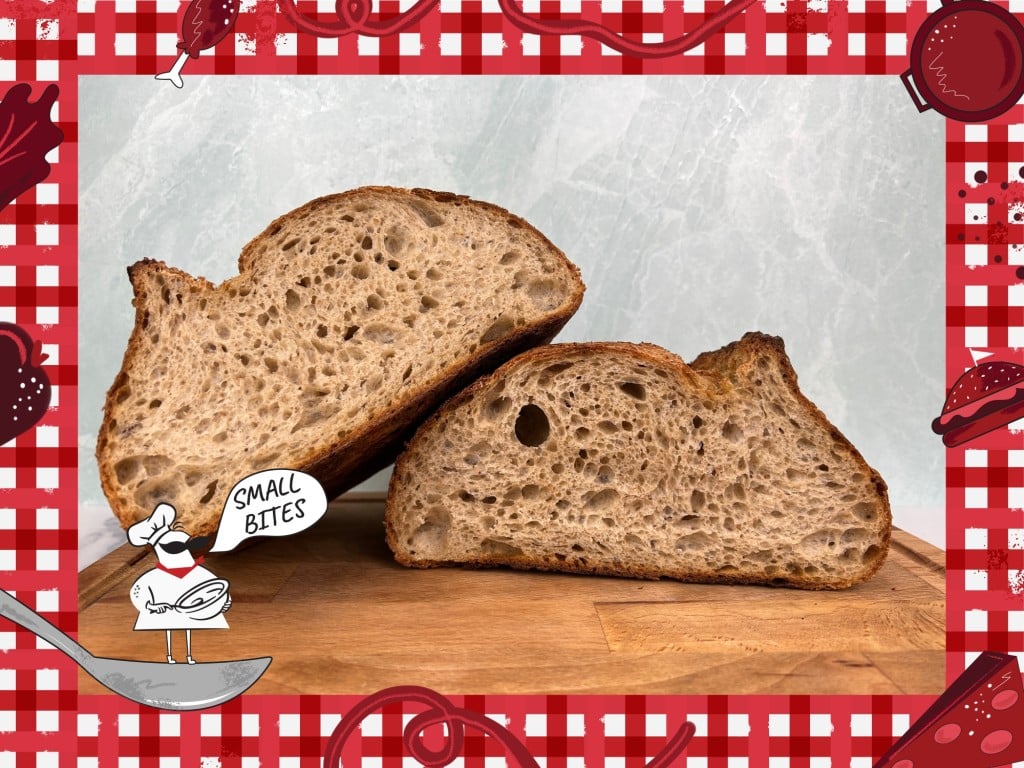
The levain will inoculate over five hours until it’s doubled or tripled in size. If it grows too fast, that’s a good indicator that the bread will rise too quickly; too early, and it won’t achieve its full height. If the levain has large visible bubbles through the side of the jar, that tells me it has a healthy growth and will meet my schedule. I make four loaves at a time, and they need to proof in the fridge for around 12 to 14 hours. Any shorter and the breads will be underdeveloped; any longer and they risk over-proofing, and their height will collapse during baking. That means I’m working backwards from my bake time to the dough proofing time, to the levain building time, to the evening feed time, to the morning when I remove the starter from the fridge. It’s a lot of time management, but it’s also meditative: I can’t change what the bread is going to do while it’s baking. All I can do is try and set the best environment for it to grow to its best potential. Then, it’s into the oven where the yeast’s screaming death expands the dough into an open, light, and airy crumb structure.
My bread is 50% flour from Meadowlark Organics and 50% malted white bread flour I order in 50-pound bags from a well-known mill in Utah. I like to use around 10% whole wheat flour for its nutty flavor and extra nutrients that the yeast feeds on, and 40% high-extraction flour to round out a lightly sweet and grassy flavor and spongy light texture.
The malted white bread flour has a medium-high protein content of around 12% that assists in stronger gluten bonds, which gives my bread more height and a more open interior structure. The added malt helps feed the yeast and bacteria as well. When the levain is ripe, it goes into the water, and flour is added while the mixer runs to ensure it’s evenly hydrated. I bake with an 80% ratio of water to flour, which means that if I were making two loaves, I’d start with 1000 grams of flour and 800 grams of water. For four loaves, I use 2000 grams of flour and 1600 grams of water.
Sometimes I don’t do that math right, and my dough is either too stiff or flows like a liquid batter. The only way to fix it is to add more water or add more flour. How much? Who knows. At this point, precision goes out the window. Better to pay attention during the mix. Typically, I hold back 100 grams of water so the dough can build more strength before it reaches total hydration. It also lets me dissolve the salt into the held-back water, so it’s easy to mix in later. After a 30-minute rest, which allows the gluten strands to form stronger bonds and the microbes to inoculate the dough, I add in my salt slurry and run the mixer until it’s incorporated.
From there, it’s just time and temperature, and folds. The dough will rise over the next three to four hours, typically in the oven with the oven light on. That helps bring the dough temperature up to 78ºF, the ideal environment for steady yeast growth. Over that bulk rise period, I’ll stretch the dough and fold it over itself three or four times, strengthening the gluten and giving the bread more structure. Once it’s grown 50%-60% in size, I split the dough equally into four, pre-shape it into rounds, let it rest for 30 minutes, and then fold and roll the dough into the long oblong shapes that’ll proof overnight in the fridge in wicker baskets. If the levain was healthy and the ratios were correct, the second part doesn’t need to be scientific. The bread’s going to grow, and experience will help you know when to shape and when to let it grow even more. Bake the next morning in a covered cast-iron pan for steam and heat retention.
It’s not an efficient way to get bread. The more efficient way would be to simply pick up a loaf from Madison Sourdough, Origin Breads, or Bloom Bake Shop. At this point, I’d rank the bread I make on par with these bakeries, and if I step back enough, that’s an extremely flattering remark about my own bread. These bakeries make incredible bread. They also make incredible bread at scale. While I bake four loaves per week, they’re making dozens of multiple loaf styles a day. I have all day long to obsess over the details, to plan out the process, and babysit the dough. It’s taken me five years of intentional baking to get to this point; I don’t recommend people get into naturally leavened bread-making if they’re hoping for tasty bread anytime soon.
But there’s something about making bread that helps me stay grounded. I can’t rush the process. I have to pay attention when I’m mixing. I love the process as much as I love the results, but I also love that my bread represents a time and a place. It’s a snapshot of locally grown and milled flour, of the microbes in my house, of the time of year. Each batch is unique, yet the same. It’s the same flour, the same starter, the same formula and process. And still the bread will look different, taste different, be different in some existential way that’s impossible to describe. It’s a challenge I present to myself to sort out what I want my bread to be, and how to make that intentional.
And when I’m ready to take up that next challenge, I’ll have to think about it three days ahead of time.
We can publish more
“only on Tone Madison” stories —
but only with your support.
Author

Related Articles

Small Bites: How I would fix Madison dining
Going out on Sundays and other thoughts on building a more sustainable food city.

Small Bites: The moral cost of meat
How a bad dream prompted more intentional eating in the new year.
Small Bites: How much garlic is too much garlic?
With “double the garlic” dominating social media, it’s time to reevaluate your recipes.