
Madison needs a wake-up call
The longer we pretend this City is a progressive haven, the more people will be harmed.

This is our newsletter-first column, Microtones. It runs on the site on Fridays, but you can get it in your inbox on Thursdays by signing up for our email newsletter.
Quite a few recent news stories in Madison need to be unpacked, so choosing one to focus on has been no picnic. As I dug into a few stories, a theme emerged: Madison is not as progressive as it likes to believe, and the evidence is in how we treat the most vulnerable in our community.
We see it in the lack of accountability in the fallout from CAYA Clinic’s proposal for a drug treatment center, especially when compared to the unsubstantiated allegations against Urban Triage; in the City’s push to remove a little free food pantry and benches to target unhoused people; and in the complete lack of assurance that our local cops will actually protect our community, especially immigrants, if we experience an ICE surge similar to the Twin Cities. These stories illustrate the gap between Madison’s purported values and how it actually treats its most vulnerable. If you have power, money, and privilege in this City, you could have a great life and get away with skirting responsibility. But for people holding the short end of the stick, Madison’s claims of support and allyship increasingly ring hollow.
Faith in the city’s progressive-ness was always planted on shaky ground. Is Madison progressive compared to the rest of the state? Sure, I guess, but Wisconsin’s Republican party has moved so unreasonably far right under the leadership of Assembly Speaker Robin Vos (R-Rochester) that that bar is in hell. More importantly, that progressive identity, which allows us to paint ourselves as the “good guys,” has led too many people to become oblivious to the ways we are regressing and the real harm caused. Madison needs a wake-up call. We need to take a long, hard look at the disconnect between that identity and recent actions (or lack of action), because we simply are not acting like the community we believe ourselves to be.
CAYA accountability
People struggling with addiction on Madison’s east side will continue to have limited access to harm reduction treatment as a result of CAYA Clinic founder and clinical director Skye Boughman submitting false information in a proposal to the county to provide those services. The Board of Health for Madison and Dane County rejected CAYA’s proposal, but the $2.4 million is still available for Public Health Madison and Dane County (PHMDC) to use for other similar projects in the future. However, that means that the allocation of those resources will be delayed, and it does not mitigate all the harm that was done. Boughman and County Supervisor Rick Rose need to be held accountable.
Alder Sabrina Madison was the first to bring some of the issues with the proposal to light. For starters, there was a complete absence of communication or coordination with Madison, even though the proposed location for CAYA’s drop-in center was in her district. As a result, the Board in December delayed a final decision until January. In the interim, more issues with the proposal came to light.
CAYA’s proposal claimed the organization is led “by BIPOC leaders who understand their community,” even though CAYA’s staff is entirely white. Boughman blamed the error on AI. I know I’m a purist when it comes to generative AI (I avoid it whenever possible) but people or organizations who choose to use it need to recognize the risk of it inserting errors into a document. If you’re not putting in the time and energy to write it yourself, do you really think you’ll have the energy to catch any and all of the AI’s mistakes? Take responsibility for what you put out into the world, especially something as important as a proposal for $2.4 million in funding.
During a public comment period at the January 14 Board of Health meeting, Alder Madison raised these concerns. Rose and members of the Board of Health responded by trying to shut down and publicly shame her in a way that was, frankly, disturbing and racist.
The ethical way for Rose to have handled this situation was to openly disclose that he was working part-time for CAYA at the very beginning of the process. He then should have stayed away. Instead, he took advantage of his position as a supervisor to advocate for the clinic in the media, and then tried to take control of the Board of Health meeting even though he was not on the board and had no business being involved due to his conflict of interest.
If all this weren’t enough, Madison365 (shout out for its coverage of this story) reported that many of the partners or subcontractors listed in CAYA’s RFP had no idea they were included in the proposal. Some were even misnamed, and the proposal claimed they would provide services they do not actually provide.
Dana Pellebon, who has experienced this process both as a former county supervisor and as a leader at nonprofits, says that so much of the process for requests for proposals (RFPs) relies on good faith. Local governments do not have the resources to fact-check the hundreds of applications they receive for some projects. While CAYA may not be officially marked as ineligible for public funds after this, county officials will have every reason to be skeptical of the organization moving forward.
However, there’s a stark difference between the “lack of social consequences,” as Pellebon says, for Boughman and CAYA, and Urban Triage CEO Brandi Grayson. (Pellebon chairs Urban Triage’s board of directors.) The contrast is especially galling considering that Boughman’s and Rose’s misbehavior is well-documented, and the charges against Grayson are unsubstantiated and put forward in a harassment campaign from fewer than a handful of white men.
“Every grant [Grayson] had had to come under review. The amount of money we’ve had to spend on personnel and accountants,” Pellebon says. “The amount of consequences for one person has been out of control.”
Priorities, priorities
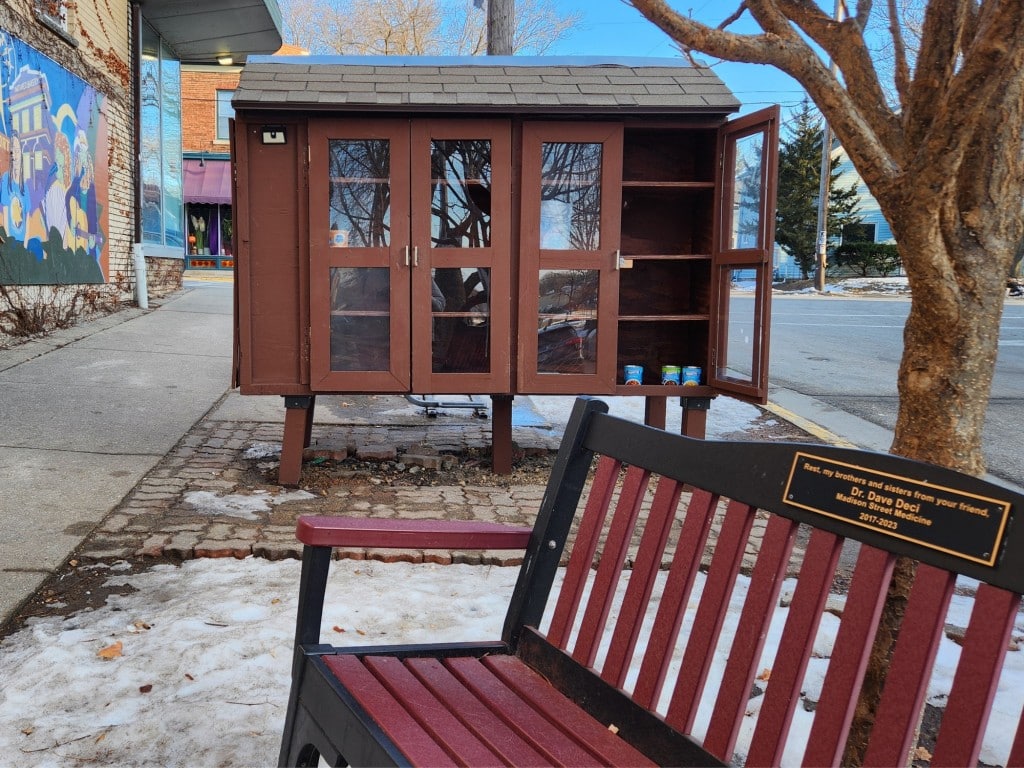
Unhoused people are struggling to survive the winter, but instead of providing support for those people or the organizations that serve them, the City has decided to weaponize the permitting process to force the Social Justice Center at 1202 Williamson St. to remove its food pantry and benches. (Full disclosure, Tone Madison’s mailing address and fiscal sponsor, MadWorC, has its office in the Social Justice Center.) This is just the latest in a series of regressive actions against unhoused people where neighbors and the City have chosen hostility—arrests, fines, physically moving people, confiscating their possessions, and cutting off access to resources—instead of addressing the root problem: these people have nowhere to go. There is not enough space in the shelters. Some people have experienced unsafe situations in shelters and do not want to put themselves at risk. So, where are unhoused people supposed to go, and how are they supposed to access basic needs—water, food, shelter, warmth, and even basic hygiene?
This is also an example of our society removing social goods because they don’t want the wrong people to access them. No one would care about the food pantry or benches if they were being used by people who have stable housing. But instead of fixing the actual problem, the City is focusing its time and resources on enforcing a technicality that has been overlooked during all the years the benches and food pantry have been in place. And everyone will lose access to these resources, whether they someday need something to eat or just a place to sit.
It’s bad enough that the City is avoiding the problem, but it’s also punishing people who are providing aid to people in their community. A common refrain these days is that “no one is going to save us but ourselves.” Apparently we can only do that with City approval.
Who’s going to protect us from ICE?
As we watch swarms of masked, unidentified ICE agents arrest people without warrants (essentially kidnapping), arrest journalists, and execute people in the street, I am not reassured by the responses our local law enforcement gave to the question of what they’ll do if ICE comes to Madison.
Madison Police Department (MPD) Chief John Patterson told The Cap Times, “[i]f someone calls to report a crime as a victim or as a witness, or you know, just as a concerned member of our community, we’re not going to ask for immigration documents.” OK, fine, but what if the crime reported involves someone in a mask claiming to be a federal agent kicking in someone’s door without a warrant? Or breaking someone’s car window and dragging them out of the vehicle? Or deploying tear gas outside a school? What about scouting Target for brown people?
More disturbing, MPD says it will cooperate with ICE if someone is “engaged in or is suspected of terrorism or espionage.” According to the feds, that’s every volunteer or journalist monitoring ICE activity.
So much of our diminishing municipal budgets goes to our local law enforcement agencies, and they actually have the authority to stop ICE. One Minnesota police chief has already done so. It’s fair to ask whether our local cops are going to let ICE wreak havoc or actually protect the community they’re supposed to serve. If not, we need a plan for how to protect our community, especially Black and brown immigrants. And if police aren’t going to help, we should reallocate resources towards those ends.
Who has power in Madison,
and what are they doing with it?
Help us create fiercely independent politics coverage that tracks power and policy.
Author
Related Articles

The meanings of Tone Madison
Current and former editors reflect on the publication’s life and legacy.

Tone Madison is saying goodbye
We are sad, but grateful too.

Police surveillance technology needs proper accountability
Grassroots resistance against Flock cameras are writing the blueprint for comprehensive reform.