
“Resurrection” explores human perceptions through the historical labyrinth of cinema
Bi Gan’s latest art-house epic premieres locally at UW Cinematheque on February 5.
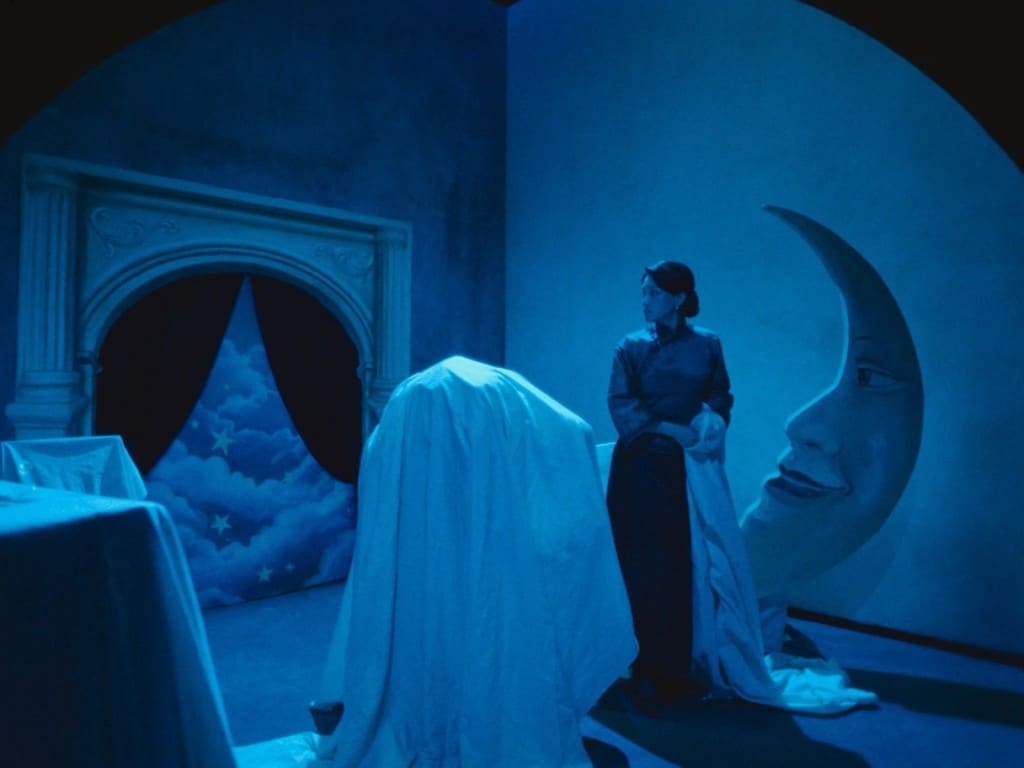
Bi Gan’s Resurrection is, ostensibly, a six-part meditation on the history of film from perspectives both personal and historical. It’s also a science-fiction tale about a future where humanity has found that the secret to eternal life is giving up on dreaming. But either of those summaries is a bit like saying Mad Max: Fury Road (2015) is about driving in the desert. While they’re technically true, descriptions also fail to convey anything meaningful about the experience of actually watching these films—which, after all, is the point of cinema.
Perhaps more than any other contemporary director, Bi Gan pushes movies beyond what filmmaker Peter Greenaway has (dismissively) called “illustrated texts.” Recounting the narrative of a Bi film is like talking about a dream—the essential essence is lost in translation. There are traditional narrative arcs in (some) of Resurrection‘s six chapters, but as a whole, this film is more concerned with the experience of viewing, and in particular with exploring the visual: what it means to see, what it means to intentionally look (or consider where one may point a camera), and what it means to be the object of that gaze.
Bi himself has noted that the film’s multipart structure is meant to reflect the six senses of Buddhist thought (sight, hearing, smell, taste, touch, and mind). But it is unavoidable, given the medium, that Resurrection feels primarily like a meditation on the visual. Some of the first images in the film are of an audience in a turn-of-the-20th century theater looking out through a burning screen. Viewers who are about to stare at Bi Gan’s vision for some 160 minutes, begin the act of looking by being looked at.
Of course, this is an illusion—the film itself is not really looking at us—but film is inherently a medium of illusions (and in a sense we, the world, have been watched by the medium of film since its invention). Shortly after this opening, in which we are the object of a depicted audience’s gaze, Bi stages a mise-en-scène in an opium den that explicitly evokes the practical visual effects from the early days in the birth of the film medium. That is, we are shown in no uncertain terms, the ways that the supposedly indexical medium of photography has been employed by the earliest filmmakers to trick their viewers.
Notions of vision and images and illusions abound, as Bi focuses on eyes and mirrors and reflections. But the film’s latter half, largely filled with a storyline about a con artist and another about a duo in a Chinese port town on New Year’s Eve 1999, makes these explorations even more explicit. These are, in my view, the film’s strongest segments. The emotional resonance in the con artist story—in which the main character works with an orphan girl—feels far more earned than might be expected for what is essentially just one chapter of a movie.
And I don’t think it’s a coincidence that Bi has chosen to focus on a profession that’s all about illusions, trickery, and misdirection—the hallmarks of cinema. The story that the con artist has invented is, of course, a fiction that nevertheless profoundly impacts its audience. This premise can be said of the segment itself and indeed of movies writ large: we watch people pretend to be other people and create fictions that move us emotionally. But in the sequence, and in the very best movies, the illusion somehow becomes real. Not incidentally, the very best movies create emotional responses that somehow mimic our responses to “real” events.
Few directors, if any, know just how well cinema can pull off this kind of magic trick. The NYE 1999 chapter of Resurrection showcases the power of movies to recreate the most ineffable and personal of experiences: the dream. In this regard, Bi Gan truly deserves to be considered alongside someone like David Lynch, whose style gave rise to its own term to describe the often dreamlike qualities of his films: “Lynchian.”
Bi’s films are not Lynchian; they are uniquely his own, even if he, like Lynch, is interested in exploring dreams and the dreamlike nature of cinema. The extended 50-minute oner in Long Day’s Journey Into Night (2018) did this to an exceptional degree, and the NYE sequence in Resurrection accomplishes it as well. Before you know what’s unfolding, you are being carried along by the current of the scene’s momentum, as so often happens in a dream. And just when you think Bi can’t possibly bring the weight of so much expectation to a satisfying conclusion, he not only meets but exceeds those expectations. All of Resurrection has much to offer, but this segment and the con artist one are worth the price of admission—free, at the UW Cinematheque on Thursday, February 5, at 7 p.m.—on their own.
Movies about movies, or about the magic that is cinema, is a well-trodden theme. There are few things Hollywood likes more than lovingly gazing at its own reflection and affirming the beauty and importance of its art form. As a cinephile, I get it—I love movies! And as a historian, I can also appreciate a certain reverence for the past. But so much of “important” moviemaking and film discourse today is about nostalgia for a past that never existed or wasn’t really all that great.
(The allure of an idealized past is strong enough that tyrants like Donald Trump can exploit it for purposes far beyond the world of film. Though it’s no accident that he’s drawing from a playbook first used by Ronald Reagan—a product of Hollywood—who promised a return to better times during his 1980 presidential campaign.)
The recent trend of shooting on actual film stock feels less about a love for the photochemical process and more about an obsession with a time when movies were “better.” Ironically, it is a form of gatekeeping—who can afford to shoot on film?—that calls back to eras when movies themselves were gatekept out of the upper echelons of “high art.”
Bi Gan, for all his apparent love for movies—a love that is truly on display in Resurrection—is a filmmaker and film historian with no such illusions or unmerited nostalgia about his medium’s history. His two previous films, Kaili Blues (2015) and Long Day’s Journey Into Night, both explored the unique affordances of digital filmmaking—each with extremely long single-take sequences that would be impossible with reels of film, and the latter with the added effect of 3D. (The long take in Resurrection was shot with a DJI Ronin 4D, a further example of Bi and his cinematographer, Jingsong Dong, embracing the possibilities of new filmmaking tools.) Bi, like the best contemporary filmmakers, is an artist whose work is only possible thanks to the rise of digital cinema.
Resurrection is similarly forward-looking. Whatever unevenness it has across its 160-minute runtime is overshadowed by the ambition of its vision and the beauty and craft of its execution. It is a film to be watched and rewatched, which looks back at us and the world in return.
We can publish more
“only on Tone Madison” stories —
but only with your support.
Author

Related Articles
“Limerent Pittsburgh” intricately constructs a folkloric affection of place
Artist Anne Ciecko’s 2025 videopoem is a highlight among the 30 selections of this year’s Midwest Video Poetry Fest at ALL on April 4.
Lea Jacobs sheds new light on an old master in “John Ford At Work”
The UW Professor Emeritus’ new book on the storied American director coincides with a five-film UW Cinematheque series this spring.
Inspiriting radical communal aspirations: an interview with Ben Balcom on “The Phalanx”
The Milwaukee filmmaker’s latest experimental short premieres locally at the Chazen Museum during the 2026 Wisconsin Film Festival on April 12.