
What do we owe each other?
Reggie and Anne navigate life without housing after the closure of Dairy Drive.
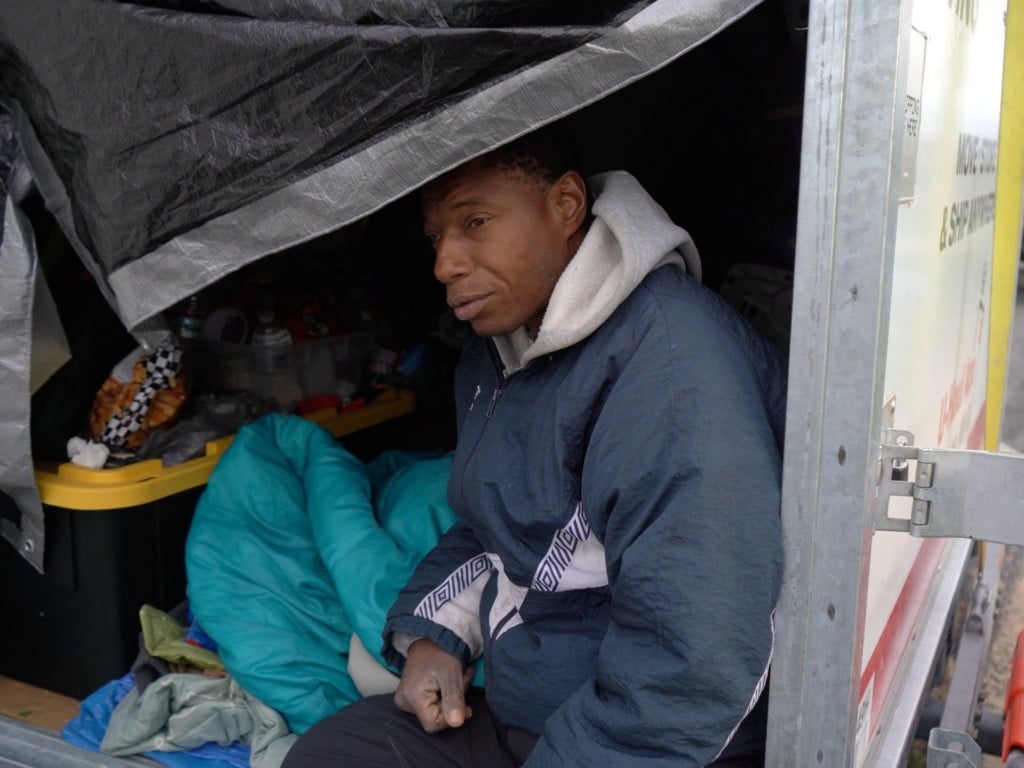
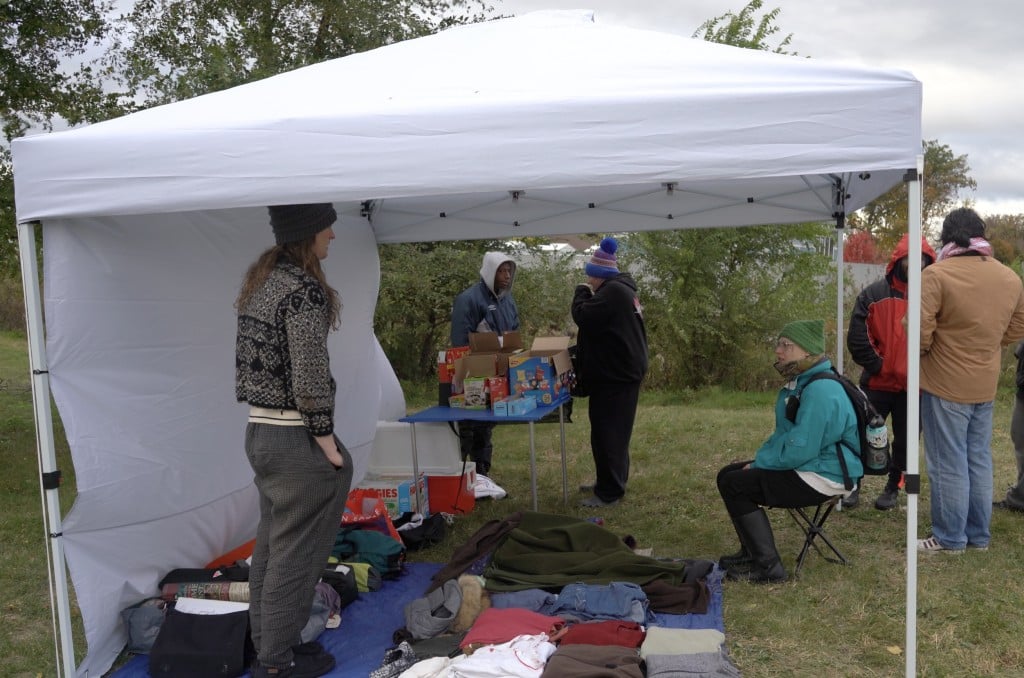
The wind blew hard and cold on a late October afternoon east of Monona. Young volunteers, many of them college students like myself, were handing out donations and snacks in front of the rows of tiny makeshift homes which now stood empty behind a locked fence.
This was where I first met Reggie and his girlfriend Anne, two of the former residents of the city-sanctioned homeless encampment at Dairy Drive that closed on September 30, 2025, after alders voted not to extend the City’s contract with Madison Street Medicine (MSM), the nonprofit that ran Dairy Drive.
The Dairy Drive encampment was set up in 2021 with COVID-relief funds and housed 97 people over four years, providing them with health care, private tiny-homes to live in, and connecting them with long-term housing and medical resources. According to Brenda Konkel, executive director at MSM, the program housed the most vulnerable people in Madison’s homeless population based on criteria like length of homelessness, mental and physical health, time spent in jail, and substance abuse.
As Konkel puts it, these are the people who are “literally most likely to die on the street.”
As a young reporter, I’ve pursued stories related to the unhoused, because it seems to be one of the most obvious and yet unchanging inhumanities in so many of our country’s wealthiest and most progressive cities. Here in Madison, the homeless population has grown to around 800 in the last few years, according to a count done by the Homeless Services Consortium in January of 2025.
As I followed Reggie into the winter, the questions that I kept asking myself were “what do we owe each other as people?” and “who in this city is supposed to help?”
Reggie and Anne were gathering snacks and water in their baskets when I met them down at the donation table. Reggie is a shorter Black guy, about 5 feet 7 inches tall. He’s got a lazy eye, and often mumbles, seemingly to himself, when he speaks. Anne is white, about the same height as Reggie, and she smiled bashfully while she talked to me. The couple was happy to have people who at least cared enough to help out—but they certainly weren’t looking forward to having to brave another winter.
Reggie got animated when he started talking about the city’s decision to shut down Dairy Drive, getting up from the U-Haul truck he was sitting on and pointing at all of the different construction projects going up around us.
“Why not destroy [Dairy Drive],” he said. “We have other projects. Why not destroy this, because it’s easier to destroy than that.”
After seeing for myself how much Dairy Drive had meant to its residents, I needed to speak to some of the alders to understand why the City had voted to shut it down.
Budgets and priorities
Council President Regina Vidaver from District 5 and Derek Field from District 3 both pointed to the state’s Expenditure Restraint Incentive Program, which provides the city with $7 million if it spends less than $380.4 million on all non-debt related expenditures. Field and Vidaver explained that the city relies on that $7 million and had only $1.6 million to spare on top of what was required to continue the City’s existing services, according to estimates at the time of the vote.
Field estimated a total cost of $420,000 to $490,000 to fund the encampment through April. MSM proposed a plan in which they would have covered $300,000 themselves with federal and county funds, and any additional costs through private fundraising. In this proposal, the cost to the city was to be $0.
But Field and Vidaver worried that the city would still be liable for utility management and the $220,000 cost to tear down the site, which had already been budgeted for in 2025.
In the end, they chose to prioritize a new public library at Reindahl Park, funding for a new ambulance and more paramedics, and additional funding for the Bartillon men’s homeless shelter, which is set to open next spring.
“Ultimately, everything is movable,” Vidaver said, when asked if the Common Council could have taken money from other areas in the $452.5 million budget. “Different people are going to put priorities differently. I’m going to prioritize the majority of the population over 20 people, and you can call me cold and calculating for that and that’s OK.”
The new Bartillon shelter will operate 24/7 and house up to 250 men. However, it will mean the end of the current overnight emergency shelter on Zeier Road, which has held up to 350 men.
But what did all of this really mean for the residents who lost their homes?
According to Konkel, about half of the 14 people released without housing have been arrested. The other half are surviving outside as temperatures drop below zero.
MSM has stayed in contact with the residents and provided them with phones, medical equipment, bus passes, and camping gear—but there is only so much they can do now that their contract has expired.
Staff members say the biggest thing that a lot of the former residents need is consistent support from people, reminding them about medical appointments, and guiding them along the way. That’s much harder to do now that people are on their own.
“You can see the detriments in health just interacting with them over the weeks it’s been since the closing,” Tim Jones, a program coordinator with MSM, says.
“I find myself getting calls over the weekend, late at night,” says Stacy Williams, one of the case managers with MSM. “I should be turning my phone off because I’m done with work that day, but you’re thinking about folks that are sleeping in the woods. They’re cold. They’re wet. They’re hungry. And these are folks that you’ve made relationships with, so you genuinely care about them.”
In order to really tell this story though, I needed to see it through the eyes of the people most affected. What was life like now that they were back on the streets, and who was there to help?
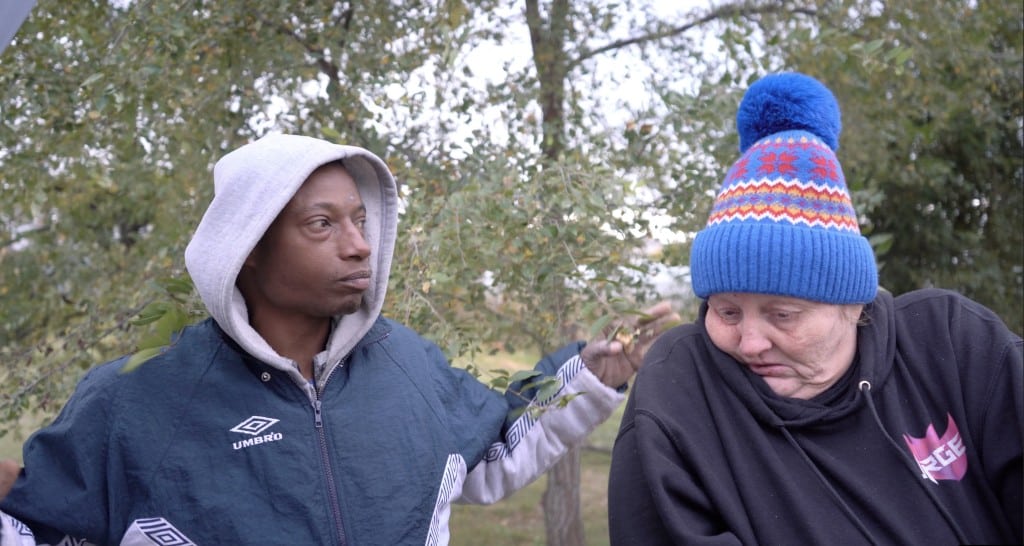
Reggie’s story
Daylight savings time ended, and the winter was creeping in. Every day I went to the donation table at four in the afternoon, but the volunteers were becoming fewer and many of the people had moved away. Some had been arrested.
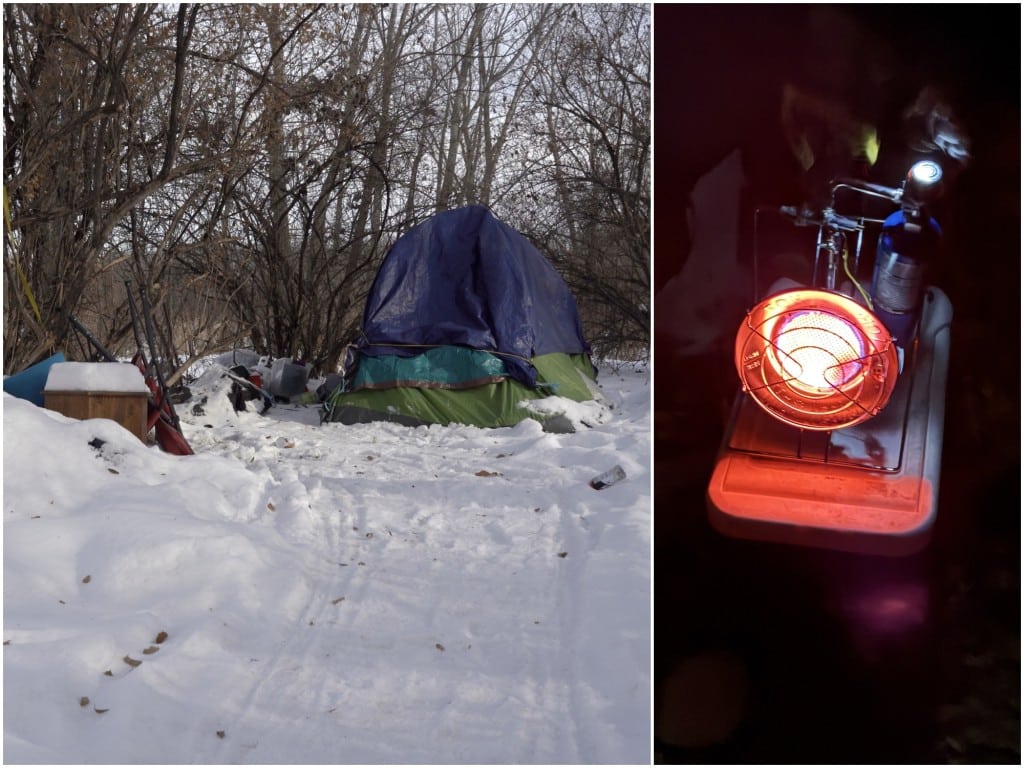
One night, I found Reggie standing in the cold alone. He remembered me from our earlier interview and told me that he and Anne were staying in a tent just a few blocks away. Their tent had been sliced open by somebody. He was waiting to get a new one, along with more propane for his small heater.
I told him I was trying to write a story about the residents who had lost their homes. “It helps to a degree,” he said. “But most people don’t care.”
Reggie said that he and Anne had a housing voucher, but were having to go through paperwork again with a new caseworker and hadn’t yet been placed in an apartment. Over the years he’s been able to get some work with a construction and landscaping company nearby but only for days at a time and for very little pay. The Alcoholics Anonymous group at Monona Serenity Group had kicked him out because he relapsed.
Eventually, it was clear that nobody was coming. Anne had already gone back to the tent pissed off. I told him that I wished I could help. He gave me an unimposing but inquisitive look.
What was I talking about? Of course I could help. Who was going to if I didn’t? I told him I’d go get him some propane and be back.
I came back and gave him the canisters.
“Oh no, not those,” he said at first, in more of a tone of worry than one of blame. “Well, maybe these could work,” he said after examining them.
I told him we should go try.
So we got in my car and he directed me to the side of a busy road, where there was a small forest. We got out, and I followed him in the dark through the trees, my expensive Sony camera slung over my shoulder and our feet crunching on the fallen leaves as we trekked on.
There were a few other tents around, but Reggie’s was the first. He went up to the tent and told Anne that the journalist from a few weeks ago was here with propane.
“The heater’s not in here, Reggie,” she said, clearly stressed.
“Mama, it’s in the cart, remember?” he replied.
She remembered and told him she took it apart.
“Mama, why would you take it apart?” he cried, exasperated.
“It wouldn’t fit in the box,” she replied. “It takes three seconds to put it back together.”
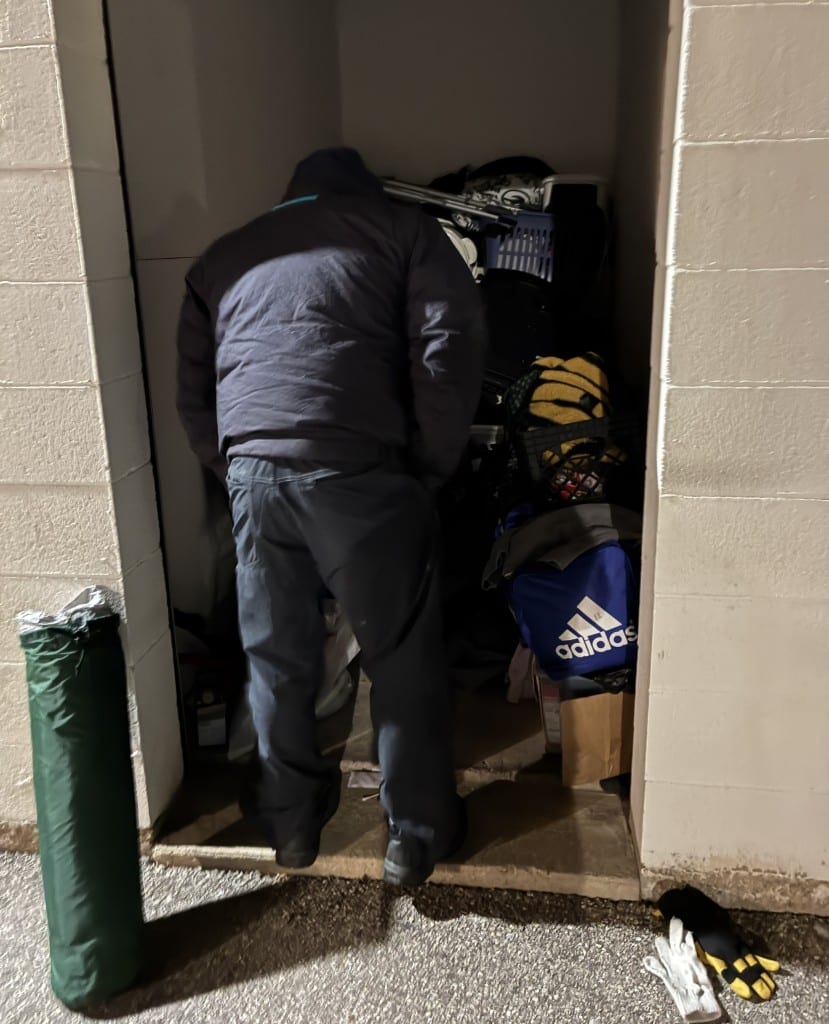
Anne got out of the tent to help. I had been standing in the dark listening to their conversation from outside. I moved to help them get it set up and lit. Once it was working, Reggie got it set up for Anne in the tent and asked if she wanted to retrieve more clothes from the storage unit. She said yes, and so I agreed to drive Reggie over.
As we were walking away, Anne told Reggie she’d bring the heater over to neighbor Angie’s tent as well. I asked if that was normal to help each other out.
“If people get along,” Reggie said. “Most people are cool.”
He told me that, at Dairy Drive, people often helped each other out with little things like bread or peanut butter, but that now people were more on their own. Some still asked, and he seemed to be struggling with setting boundaries.
He told me about an underage girl who had been working as a prostitute, who continued to ask Reggie for money and rides even now that she had housing.
“I get it,” he said. “But you already have your housing. I’m trying to get mine. There’s other people you can ask.”
He told me he’d given her $30 two months ago. She probably asks Reggie because she knows he might actually help, I thought to myself. As we drove over to the storage unit, he talked to me about his former friend who he thinks sliced open the tent. According to Reggie, the guy is addicted to crack and sometimes punches people or commits crimes in exchange for drugs or money.
“I probably helped him more than I should have,” Reggie reflected, telling me about the times he let him use his shower.
“He thinks he’s like Madison’s most wanted, like, ‘Yeah, dude I’m out here,'” Reggie said. “There’s so much more to life than that. It’s one thing to have hallucinations, but eventually reality does set in. This is not The Matrix.”
Reggie and I got the materials, and I drove him back. He thanked me and returned to his tent. I drove home and offered my friend one of the canisters of propane that hadn’t worked with Reggie’s heater. He laughed at the absurdity of the gift while I told him the story.
As I climbed into bed that night, I thought about how much propane we could buy for everybody living outside if my whole shared household pitched in.
Who is supposed to help?
It was about two weeks before I spoke to Reggie again. I went down to his tent a few times but couldn’t find him.
The volunteers who had been offering donations in the Dairy Drive area had largely dispersed and so had many of the former residents.
I was beginning to think that Reggie and Anne had found housing. I had his number but he didn’t answer my calls. Until one day, he did.
“Hey Reggie, how are you?” I asked.
“We got housing,” he told me.
“That’s great!” I replied.
“They said they only have one inspector in all of Dane County (excluding Madison), so we’re waiting for them to do the inspection,” he said.
I offered to get him more propane. He agreed. So I went back down to meet him at the public library near their new camping site, still in the Dairy Drive area. When I arrived, Reggie was standing in the lobby and stressed about getting to the hotel in time, where Madison Street Medicine was getting the former residents rooms for the holidays.
He said he used to go on bike rides when he was at Dairy Drive to clear his mind from time to time, but that now Anne wanted him to stay focused on getting them into housing. They were taking the lead from another couple who had been friends with them at Dairy Drive and recently got housing. They had told each other, “You keep me grounded and I’ll keep you grounded.” Reggie and Anne were trying to do the same.
When we got to their new camping spot just down the road behind Hoffman Manufacturing—whose owner had let them stay there according to Reggie—Anne was gone. We figured she must have gone ahead to the hotel, but Reggie was visibly worried. She had no phone to contact him. I agreed to drive him to the hotel.
At this point, I was helping Reggie as a person. I had almost forgotten about my role as a journalist. But wasn’t that, in itself, telling? Why was I, a college journalist who happened to stumble into him at the right time, providing him with fuel for heat and water for him to survive? In a city with 300,000 people and plenty of luxury to go around, whose job was it to keep Madison’s most struggling residents alive?
I wanted to understand how Reggie had become homeless. From our conversations, I had gathered that his family had money and asked him if they ever helped out. He told me his brother did sometimes but was in Ohio now. Reggie’s nephew had connected him with some resources. He had been to his nephew’s football games before and laughed about his niece’s birthday party and her exuberant personality. She sat in her dad’s lap, he remembered, and got three cakes after putting her face in the first and her hands in the second.
“Man, this is cool,” Reggie said, remembering the party. But most of the family’s money went to their many kids and a church back home, he explained.
Eventually, I asked him directly how he had become homeless. He told me a long story about an ex-girlfriend who had been pregnant and lied about the child being his, and about some roommates who hadn’t paid the rent. I didn’t really get a straight answer. But maybe I was asking the wrong questions.
He told me that he was classified as a mental health patient at Dairy Drive. He’s a recovering alcoholic. His unusual way of speaking is not going to make him the obvious hire at any institution, especially not with a history of shoplifting arrests on his record. He’s got physical health limitations in his legs and his back.
How had he become homeless, I had asked, as if there was one point when somebody went from human to homeless. Reggie had a long story of ups and downs. There was no one incident.
When we got to the hotel, I dropped Reggie off, and he got out of the car quickly, moving on to his next task. A few minutes later he texted me “thank you” and told me that he’d gotten into the hotel. I felt touched that he’d taken the time to do that. He had other important things to worry about.
What do we value?
Another week went by when I didn’t talk to Reggie. I flew home to California for holiday break, at the expense of my parents, hung out with my friends and caught up with them about college and future careers. When I got back to Wisconsin, snow covered the ground and the temperature had dipped below zero. I hoped that Reggie and Anne had found housing.
They had not.
They were still waiting on the housing inspector to get around to their case. I offered to bring them more propane. Anne got on the phone and told me they needed water, too.
Reggie came out and met me in the parking lot as the snow fell lightly on our layers of jackets. We carried the stuff over to Anne, crunching through the snow and maneuvering under tree branches as we made our way to the tent.
I told him I wanted to do an update interview and pulled out my camera, which I hadn’t done since the first time I had talked to him. He was kind of excited by the prospect, but Anne decided to stay in the tent.
He updated me on his life. Going out to get food took up a lot of their day. They had meetings with people from Social Security and housing services from time to time. The nights were cold, but they were getting through it. Reggie was really grateful for the young volunteers who had been the most consistent with helping them out.
I looked around at the glistening snow on the ground and the bright yellow leaves still hanging onto the trees and felt compelled to ask if he and Anne celebrated the holidays at all.
“I don’t know, we’re focused on getting this apartment,” Reggie said. “If we get an apartment, yeah, maybe.”
“How did you two start dating?” I suddenly blurted out. “Did you ask her to be your girlfriend first or…?”
Reggie held back a smile and started dragging his feet around in the snow. Anne giggled from inside the tent. She’d been silent up until then.
“Yeah, I think that was the way it went,” Reggie said. “Was it?”
“Somebody asked if we were together, and I said ‘I don’t know, are we?,'” Anne said laughing.
“And then he was like ‘yeah?'” I asked, laughing along.
“Yeah,” she said. I could hear her smile from inside the tent. “We both had a tiny home, but we were staying in just one.”
I put down the camera and we said goodbye, a little warmer. Reggie said he’d keep me updated. I told him to call me if they needed anything else.
Walking back through the snow, I asked the same questions over again in my head, about why anyone has to go unhoused in a wealthy city like Madison. Reggie is kind, honest, forgiving, and absolutely dedicated to the woman he loves. If that is the kind of person that we value least, something about our relationship to each other is upside-down.
Konkel of Madison Street Medicine has dedicated the past 30 years of her life to homeless justice in Dane County, through the city council, non-profits, and local activism. When I asked her why, in her mind, Madison’s most vulnerable people weren’t being cared for, her answer was simple: people don’t see them as human.
“A lot of folks say things like, ‘people don’t even look me in the eyes. They don’t even recognize that I’m here. They walk by me and don’t see me,'” she says. “These are people’s brothers and sisters and aunts and uncles and moms and dads and kids. They’re just humans, just like everybody else.”
On December 15, 2025, Reggie and Anne finally found housing in Sun Prairie through their Section 8 voucher. Anne sounded healthy and overjoyed over the phone. She’d also just found out that she was going to be the grandma of another child.
Anne and Reggie didn’t know the whereabouts of most of the other residents, only that their good friends Angie and Derrick were still outside.
Who has power in Madison,
and what are they doing with it?
Help us create fiercely independent politics coverage that tracks power and policy.
Author

Related Articles
Wisconsin communities face scrutiny over data center secrecy
The town of Beloit is the fifth Wisconsin community with an NDA for a possible data center.
Eyeing voting rights, liberals aim to secure Wisconsin Supreme Court through 2030
In the April election, Wisconsin liberals are hoping to expand their majority on a body that could be a critical backstop for voting rights during the next presidential race.

Police surveillance technology needs proper accountability
Grassroots resistance against Flock cameras are writing the blueprint for comprehensive reform.