
“Liking This Angle” finds artistic inspiration in degrees of the edit
Nicholas R. Wootton’s experimental short, featuring sculptor Christina A. West, premieres at Art Lit Lab as part of Project Projection on January 21.
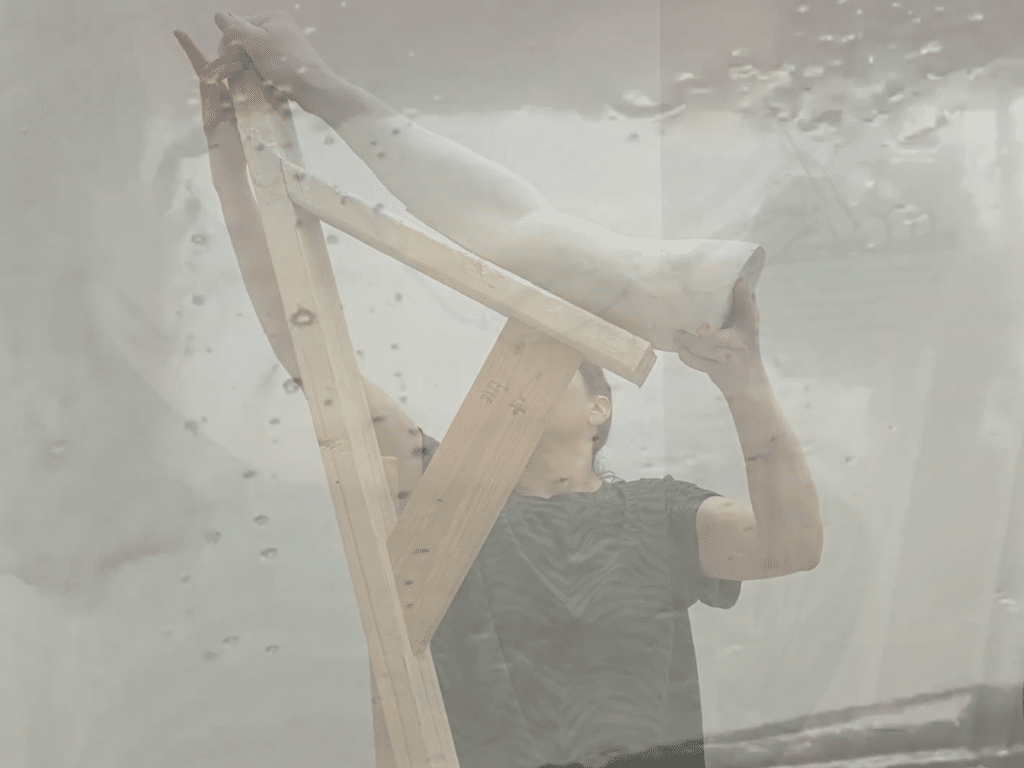
When you’ve watched 4,000 films, the role of a film editor takes on heightened significance, and can often become the reason why a film of any duration clicks with a sense of immediacy or why it may feel like it’s still adrift in the concept stage, flailing to find a convincing presentation. The true test of an effective editor lays in their ability to toggle between different modes, and how one approach can inform another.
This is relevant for the latest six-and-a-half-minute experimental film, Liking This Angle (two by four), by local artist Nicholas R. Wootton. For this project, he’s taken simple vérité documentary footage of a sculpture artist at work, and shaped it into a surreal, psychological film with his own imprint. Its world premiere is part of the local seasonal showcase for experimental film and video art, Project Projection, at Arts + Literature Laboratory on Wednesday, January 21, at 7 p.m.
Wootton, who is a producer of WORT-FM’s 8 O’Clock Buzz and occasionally fills in for host Brian Standing on Mondays, has been dabbling with experimental cinema as a hobbyist for a while. This decade, he’s submitted a few things to Project Projection (a separate arm of Mills Folly Microcinema, where, full disclosure, I assist with programming); those include Grand Yoke (2020), co-directed with sound designer Will Fry, as well as The Affinity Room (2024), and Why Physical Therapy Matters (2024). Liking This Angle is his best and most subtextually rich work to date, effectively capturing the mindset of a video editor who’s been laboring and poring over a particular section of footage so meticulously that it’s taken on a life of its own and transformed from the subconscious eye.
It was Wootton’s work at WORT that originally led him to sculpture artist and UW–Madison associate professor Christina A. West’s studio in the Art Lofts (111 North Frances Street), where he recorded an October 2025 segment for his ongoing “Audio Menagerie” series. At the time, West was unwrapping a plaster cast of a model’s entire right arm that was to become part of her solo ReVision exhibition. Wootton wanted to be present for this moment—to record all the sounds of her cracking, thumping, scraping, tapping, and sawing hardened plaster, before positioning the mold upon an angled wooden structure. That can be heard in an edited format and viewed in full as supplementary material for what became Liking This Angle.
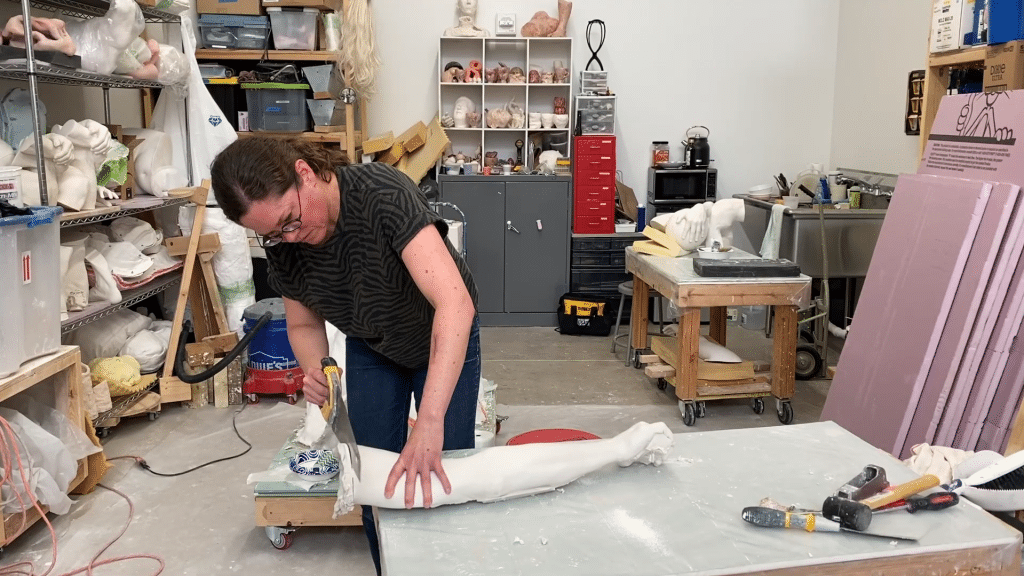
What makes Wootton’s reconfiguration resonate profoundly is how he allows West’s artistic fixations to guide his own; and, in that way, the film is a kind of spiritual collaboration. The short film communicates something ineffable about the process of making art, whether that’s a tactile, fragile sculpture or a digital video. With West, it was sawing and smoothing the end joint of the arm sculpture with a handsaw to achieve a flat plane, and her subtle epiphany and favorable response to that gradual process. In talking via phone with Tone Madison about reworking the audio menagerie into what ultimately became Liking This Angle, Wootton says, “What was interesting to me is how some little feature of something that we’re working on as artists can catch our attention. We’re not really sure why, but they affect us, and they inspire us.”
Though, Wootton is not wholly following West’s lead; he progressively guides the tone and abstraction of Liking This Angle, which is peppered with his own playful personality, juxtaposing distinctly separate portions of the original interview. And so, recontextualized, West’s notes on process (“jump around to different spots,” “hyperfocus in one area”) become an amusing meta commentary on Wootton’s own hand as an editor.
Wootton also implements footage taken from inside a car wash, superimposing it in fluctuating opacities over clips of West in her element. The sloping angle of the windshield not only reflects West’s sentiments about the angled cut to the plaster, but further evokes the sight of flowing plaster—in the wash’s soap suds and water jets—in a prior (and unseen) stage of West’s art-making. It wasn’t Wootton’s precise aim, but the overall mood gradually turns Lynchian; intense slowing of the video speed and disorienting zooms make the replayed interview feel like it’s filtered through the distortion of a dream.
Rather, on the use of the car-wash footage as it relates to theme, Wootton is quite clear-eyed about it: “What we end up with by going through this creative process is a clear vision. The very, very best art enables us to see things that ordinary people can’t see.” He then clarifies, modestly, “And when I say ‘ordinary people,’ I mean people like myself.” Wootton’s words serendipitously relate to West’s own statements in the original menagerie video about the significance of the arm sculpture—establishing a full-bodied figurative presence in the absence of the model. Despite the separation of their crafts, both West and Wootton converge in their ways of seeing. They harmonize in the stirring changes, both minute and significant, that artists make—some premeditated and others happenstance—to focus attention.
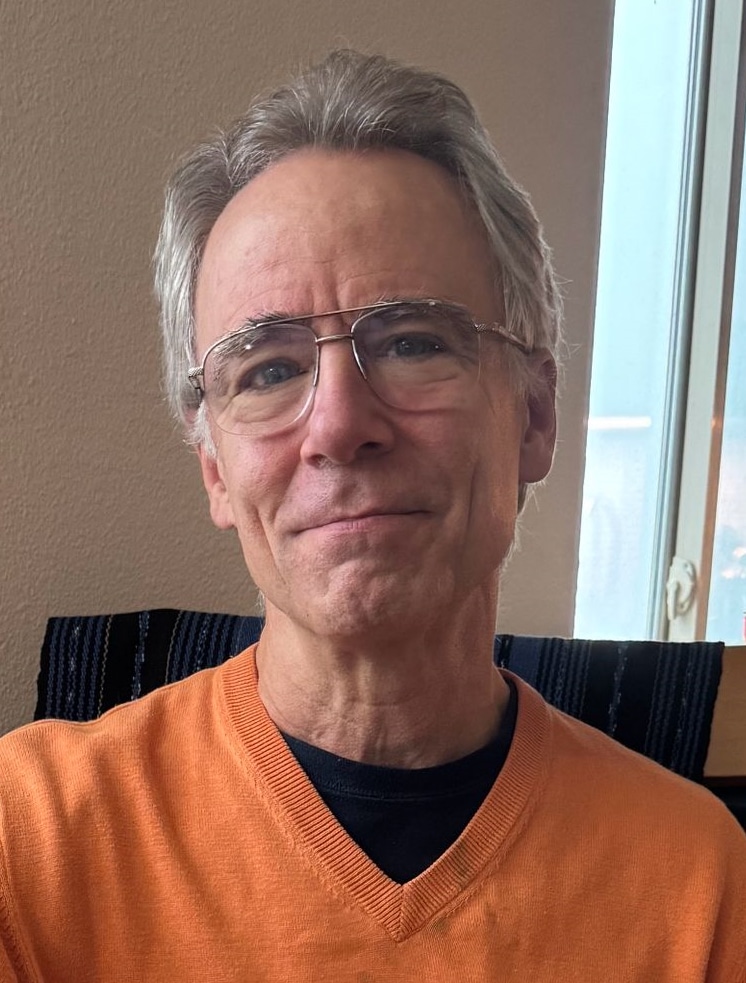
In his development as an experimental filmmaker this decade, Wootton credits Bruce A. Block’s The Visual Story, a book that “opened his mind and eyes to how films are imagined and how the best films are planned, and how they develop visual motifs,” he says. Though, he admits that his debut, Grand Yoke, didn’t have one, and mainly involved “thr[owing] shit at the wall.” For the subsequent projects from 2024 onward, Wootton applied what he had learned in that text to follow a singular idea. Liking This Angle didn’t really have a motif, Wootton admits, but he was “trying to look at the material and see ‘What is the material telling me? What is the message here?'”
His thoughtfulness is discernible and transparent in the final cut; and that’s a feeling I wish I could take away from every viewing experience (all 4,000 of them)—knowing editors studied footage conscientiously to communicate their intentions, and asked cutting questions of themselves and their collaborators to find, appropriately, the right angle.
Wootton considers the project a success, and has already begun to brainstorm what he hopes will become an ambitious follow-up. “I look forward to the next opportunity to make another film… to develop these ideas even further, trying to take the planned motif [of contrasting pairs] I had for The Affinity Room and a message [of little features stealing attention in a creative act] that I had for Liking This Angle and really make it into a cohesive film that will really move people.”
We can publish more
“only on Tone Madison” stories —
but only with your support.
Author
Related Articles
Continuity and expressive experimentation in the 2026 Wisconsin Film Festival
Eight writers share their initial insights on the eight-day extravaganza, April 9 through 16, across UW campus and Madison.
The Cardinal Bar’s Cuban film series invites local support for Madison sister city
Cine Cubano bridges interest in Cuban cinema with the cultural exchange and aid mission of the Madison-Camagüey Sister City Association.
Three video artists tap into personal histories in the 150 Artists x 150 Years exhibition
Chele Isaac, Toby Kaufmann-Buhler, and Aaron Granat reveal the creative depths of their works, which are on display through February 28 at Central Library.