
UWPD’s careless assault on student protest
Police records from the encampment crackdown in May 2024 show enforcement inconsistency and the “obstructing or resisting” trap.
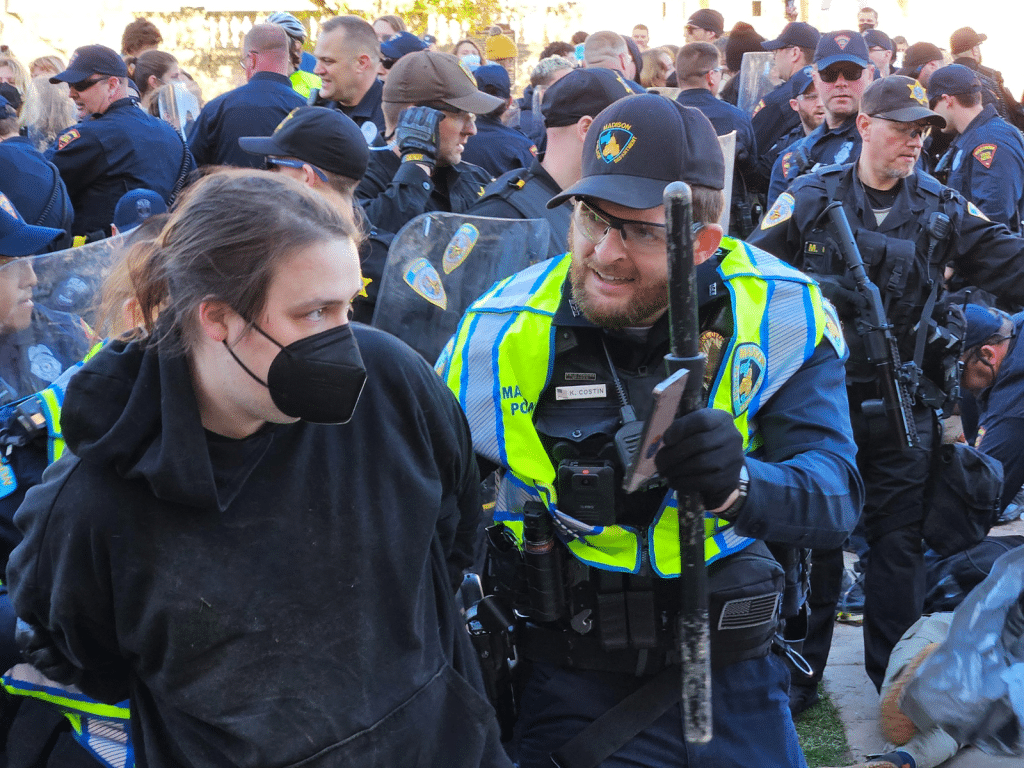
A year and a half after the University of Wisconsin–Madison Police Department (UWPD) assaulted the pro-Palestine encampment on Library Mall, 230 pages of previously private police documents acquired through an open records request reveal a pattern of inconsistencies in enforcement and arrest justifications. The files paint a grim picture of an agency reinforcing the status quo through unchecked punishment and excessive force.
On May 1, 2024, UW–Madison community members peacefully established an encampment in protest of the university’s financial complicity in Israel’s ongoing apartheid and genocide of Palestinians. Around 7 a.m., UWPD, led by then-interim chief Brent Plisch and acting with authorization from UW–Madison Chancellor Jennifer Mnookin, surrounded protestors in their sleep. According to the records, police played a prerecorded message that repeated:
“Any supplies used for camping must be removed immediately. Any equipment or supplies not removed will be removed by public safety personnel. Attempts to interfere with the removal of camping equipment may result in law enforcement action.”
Based on the files, about 120 police officers approached, many of whom wielded riot shields. Students locked arms and formed a nonviolent line around the tents. After 15 minutes, the police moved to break through the line with their shields, based on their accusation that protesters were “resisting or obstructing.” Community members held on tight as the illusion of free speech was crushed right before their eyes. Officers described “pulling” or “decentralizing” students, jargon that masked the brutality of the force they used. They were throwing peaceful protesters to the ground.
“Resisting or obstructing” as a catchall
Professor Sami Schalk stood peacefully in the line but was grabbed and handcuffed for “resisting or obstructing.”
“I can not articulate into more detail the direct actions of why… [she] was brought through the protest line by law enforcement other than the fact of standing in front of [the] tent encampment as law enforcement was approaching,” says Andy Nielsen, an officer who reviewed body camera footage of Schalk’s arrest.
According to Scott Gordon’s reporting for Tone Madison, officers were “grabbing Schalk’s neck from behind” while she was prone. Recalling the incident, Schalk says, “What happened to me, my colleagues and our students was unnecessary and wrong.”
According to records, of the 26 people arrested in the protest line, nearly half were released without any citation, suggesting that many arrests wouldn’t have held up in court.
Police grabbed a student who was also peacefully in the line and forced her to the ground. We are calling her Talia to protect her privacy. While handcuffed, she claimed officers hit her head and ribs. Officer Heather Banuelos explained in official files that Talia “did not do anything that would raise to [the] level of resisting or obstructing in my presence,” yet Talia’s arrest file stated the reason for her arrest was “resisting or obstructing.” Officers did not issue a citation or offer her medical attention.
Officers also used “resisting or obstructing” as an excuse for another student we are calling Leila. UWPD Officer Nielsen, reviewing camera footage, described Leila as “standing… away from the encampment,” then walking closer to the police. She pulled her phone out “as if she is recording and approaches an unidentified [Dane County Deputy].” Leila was next seen sitting in handcuffs. UWPD chose to arrest her on the recurring suspicion of “resisting or obstructing,” but released her immediately after with no citation.
Pamela Oliver, a professor emerita at UW–Madison who studies social movements and protest policing, says that for police, “One way to execute the command to break up a protest is just to arrest people.” She explained that arresting protesters on an arbitrary basis is often used to disperse a protest, even if charges are dropped. (Oliver emphasized she was describing general patterns rather than UWPD’s specific decisions on May 1.)
In the case of Professor Samer Alatout, the police line pushed up on him with their shields. Files allege he pushed back. Officers used his reaction to justify tackling him, leaving him with a bleeding cut on his head, and carrying him away. UWPD Officer Vinson Mulvey stated in an official report that the 65-year-old Alatout was injured because he was “intentionally striking shields with his head.” Alatout’s file also stated he was arrested for “resisting or obstructing.” In 2024, Alatout told Tone Madison he “[advised] Students for Justice in Palestine,… [and officers] targeted me specifically for violence. They did not come to me and say, ‘Come with me.’ They pushed me to the ground.” Students for Justice in Palestine at UW–Madison organized the 2024 encampment.
UWPD’s May 1 press release listed 34 arrests of protesters, while the records they sent to Tone Madison only listed 32. Tone Madison followed up with a request for the missing files and, days later, received the remaining records along with an apology from UWPD. Those files were informationally sparse, and officers’ names were listed as “outside agency.” UWPD Executive Director of Communications Marc Lovicott says the term is used to refer to police departments other than campus police, including the Dane County Sheriff or the Madison Police Department.
In one file, an officer described a struggle over a baton, ending with the student on the ground and the officer elbowing them several times. In the use-of-force narrative, the officer was only listed as “outside agency.” The officer’s name didn’t appear in the official documentation of the force that was used. UWPD’s stated policy to use the title “Outside Agency” instead of different agencies’ names prevents the public from knowing the agency involved and the identity of the officers abusing the use of force.
Records also show that officers destroyed much of the tents and equipment they seized from the encampment. Oliver compared this practice to homeless encampment sweeps in many cities, where police often discard or damage property to clear the area. Oliver says that police behavior in these situations is often interpreted as “meanness,” but police may further be signaling that people are not welcome in an area.
I don’t see these similarities as a coincidence: the goal of both clearing protest and homeless encampments is for authority to make invisible the crises they want ignored. Campus administrations are more comfortable with simply arresting people out of sight and mind than confronting the reminders that their system is built to fail students and marginalized people.
Inconsistent enforcement
Files indicate that two days before the encampment siege, a 37-year-old non-student wore a red bandana on his arm. From outside the encampment, he approached a group of Jewish students. The man began to harass them, then walked away and performed the Sieg Heil, the Nazi salute. The Jewish students told the police that they were shaken and horrified.
Immediately afterward, UWPD Officer Seth Wahl pursued the man down the street. Wahl asked the man’s name, and the man “refused, told me he was leaving, and walked away.” According to Wahl, “Due to the circumstances… within Library Mall and the potential of an unsafe situation developing, I choose to let… [him] leave.” A week after the encampment ended, Wahl was able to reach the man by phone to issue him a fine of $295. The man apologized, and Wahl thanked him for “taking responsibility.” While UWPD focused heavily on attacking student protesters, their response to the antisemitic harassment was notably restrained. While defending the encampment crackdown, Chancellor Mnookin claimed the university believes in enforcing policies consistently, whether protesters were in support of Palestinian human rights or neo-Nazism. The evidence suggests otherwise.
UWPD chief Brent Plisch, who led the response, stated to The Cap Times that police actions on May 1 were justified because the encampment “was not a safe environment.” In use-of-force records, Officer Beth Lopez also defended police action by saying “100+ people… displayed violence,” but officers showed internal disagreement about whether students were resisting. Adding to this complication, according to the files, of 34 people arrested in total, only 21 were cited or charged. Perhaps the encampment was not all the police and administrators chalked it up to be. When asked about their protest response, UWPD referred to their prior statements.
Students involved in the encampment offered a different perspective. Students for Justice in Palestine at UW–Madison described a broader struggle over university power and complicity, saying:
“The university has no desire to be held accountable to its students or faculty; administration would rather call in the police as its attack dogs to brutalize student protestors than meet their demands for divestment from the deathmakers that have been profiting off the genocide in Gaza for over two years now.”
The scar of police actions on May 1 might never heal. As officers beat and shackled peaceful advocates for human rights, they arrested a student who was not even involved in the protest. Days earlier, UWPD failed to act promptly on the taunting of Jewish students. Instead, UWPD focused on the peaceful encampment. Officers made contradictory statements and pushed claims of “resisting” to their limit, aggressively defending power and administration, not students or free expression. If this is how campus police react to student speech, no UW–Madison student is safe from repression.
Who has power in Madison,
and what are they doing with it?
Help us create fiercely independent politics coverage that tracks power and policy.
Author

Related Articles
Wisconsin communities face scrutiny over data center secrecy
The town of Beloit is the fifth Wisconsin community with an NDA for a possible data center.
Eyeing voting rights, liberals aim to secure Wisconsin Supreme Court through 2030
In the April election, Wisconsin liberals are hoping to expand their majority on a body that could be a critical backstop for voting rights during the next presidential race.

Police surveillance technology needs proper accountability
Grassroots resistance against Flock cameras are writing the blueprint for comprehensive reform.