
Amid industry tumult, the 2025 MDEV conference captured Madison as an impending game-development hotspot
On the ground with indie developers and industry representatives at the annual, bustling, two-day showcase of video games.
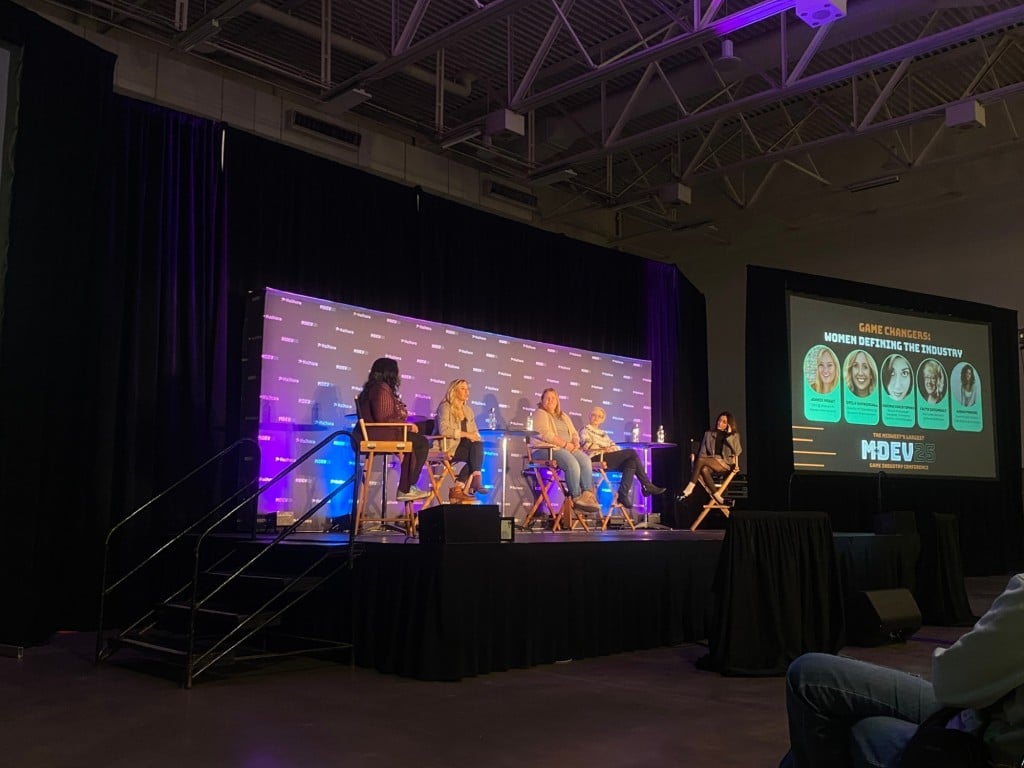
Over the past few years, the games industry has struggled with generative AI, the collapse of a pandemic-fueled surge in investment, game cancellations, studio closures used as tax write-offs, consolidation, and a market saturated with more games being released than ever before, causing developers to face layoff after layoff after layoff. To put it mildly, late-stage capitalism has not been kind.
These layoffs have primarily impacted developers in California, Texas, and Washington, the three biggest states for game development. In California alone, there were over 44,000 game developers employed in 2024, according to the Entertainment Software Association. But in a state like Wisconsin, where the industry is just barely burgeoning, losses are seemingly magnified. According to the Wisconsin Economic Development Corporation, in 2022, there were roughly just 1,700 employed developers in Wisconsin, so just a handful of employees can make up an entire percentage point of the Wisconsin industry. Yet a lot more than a percentage point of the state’s employees have been laid off in the past year or so.
Apex Legends developer Respawn, which opened a branch in Madison just two years ago, laid off roughly 100 employees company-wide and canceled two projects in April. Raven, the Middleton-based studio known for its work on the Call Of Duty franchise, let go of “less than 20” employees in July. Last fall, Wisconsin-based studio Lost Boys Interactive laid off 139 employees across 28 states. And smaller, more localized companies have faced extreme difficulty as well: the Madison-based developer Flippfly parted with all its employees except its lead after the release of its latest game.
After a devastating few years, most of Wisconsin’s remaining studios now face heavily reduced workforces, leaving remaining employees overworked and often underpaid and leaving those who were laid off to struggle with health hardships and difficulty staying in an industry that continues to grow less accessible.
But you’d guess the reality was anything else if you stepped into the 2025 iteration of MDEV, a games industry conference held annually in Madison (this year, on November 7 and 8). Despite the disastrous state of the industry, MDEV is optimistically expanding. MDEV was created by the Wisconsin Games Alliance in 2017 after local game developers realized that Midwestern devs didn’t have a reliable way to show off their games or forge connections without traveling hundreds of miles (and spending thousands of dollars) to attend larger conferences like GDC (Game Developers Conference) in San Francisco. Since then, the more affordable and centralized MDEV has steadily grown from just 300 attendees in 2017 to nearly 1,400 in 2025, a number that warranted the conference gaining a second day for the first time ever.
MDEV, now billed as the “Midwest’s largest games industry-focused event,” also expanded into an entirely new area of the Alliant Energy Center this year, taking up a much larger hallway for its indie-game showcase. It featured over 100 speakers hosting panels and talks on everything from supporting developers’ mental health to designing games with voiceovers to the state of the games industry. MDEV even began with a November 6 kick-off event that packed the bottom floor of the Orpheum Theater, where a red carpet was rolled out for developers. (Full disclosure: I showcased a game at MDEV in 2024, which appeared in a promotional video for the conference.)
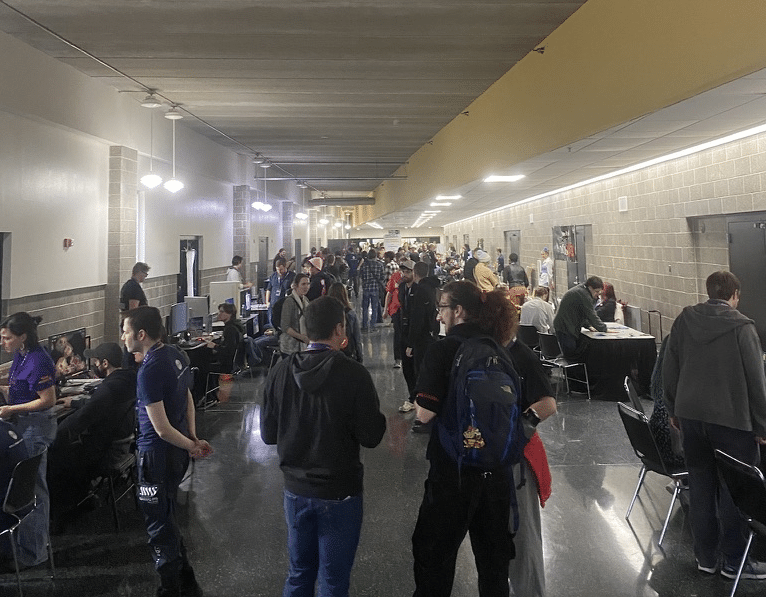
While it might seem overly ambitious for a conference to expect game developers to keep showing up in a landscape paved with layoffs, MDEV’s expansion precedes a vote on a bill poised to create a 30% tax incentive for video game development in Wisconsin. AB 204, which was introduced in April, would be the first state bill in the United States to specifically incentivize game development if passed.
AB 204 would drastically boost game development in Wisconsin. In fact, it’s so significant that Midwest Games CEO and Wisconsin Games Alliance President Ben Kvalo, who’s taken on a role as the face of MDEV over the past few years, thinks that Wisconsin could see itself positioned next to Washington, California, and Texas, which currently comprise 62% of the games industry. At MDEV, Kvalo tells Tone Madison that there are at least 10 AAA studios that would open branches in Wisconsin almost immediately if this bill were to pass.
“There’s not a single major studio that would not consider Wisconsin as a next place to go or to move a studio or to add a studio,” Kvalo says. “There’s not a single one in the industry that won’t consider it if [AB 204 is passed] because that’s how beneficial it is for their business.”
Madison is especially primed to become a game-development hotspot thanks to its strong, largely Epic-centered tech ecosystem as well as its vibrant community of artists, musicians, and writers. As a whole, Wisconsin is also much more affordable than the states where the majority of the industry is located, which would create more stability for developers in an industry known for its financial risk.
The promise of AB 204 created quite a bit of buzz during the conference. However, MDEV happening during such a pivotal point for the industry also meant that the dissonance between seniors/executives and developers was occasionally amplified, especially during discussions about generative AI in game development. During a panel on the state of the games industry, Respawn Studio Director Ryan Burnett referred to AI as “the greatest thing we have,” while former Lost Boys Interactive COO Timothy Gerritsen stated that “every artist should learn AI.”
For a few audience members, it hurt to hear higher-ranked developers, many of whom have the job security to guarantee they’ll never lose their jobs due to generative AI, promoting it to a room full of those who could (and several who already have, as one audience member related about themselves during the Q&A). The panelists’ pro-AI discussion also came at a sensitive time when generative AI is becoming an increasingly localized issue: currently, a data center proposed for Vienna in response to increased AI use threatens to use roughly two and a half times the energy used by the entirety of Dane County.
Expanding MDEV’s entanglement with AI was MDEV’s highest-tiered sponsor this year: Hathora, a cloud-hosting platform founded by a former Palantir development team lead. Hathora has invested in teams working on “AI native games,” or games where core mechanics are shaped by generative AI. It has also published content encouraging developers to AI-generate trailers and “vibe code” (a term for entirely relying on AI to code) prototypes to negate financial risk. As this decade moves on, games industry conferences are increasingly co-opted by large gaming and AI companies that are eager to invest but fail to understand the uniquely human appeal of games; and so, as MDEV grows, it has also presented evidence that puts it on the precipice of falling prey to that ethos, too.
But games made by and for people were still, thankfully, at the heart of MDEV this year, and Kvalo wants to support the humans behind the games at the growing conference.
“Ultimately, we need to set up our developers for success, and there’s a core belief overall in the true industry—that AI’s not going to make games for you,” Kvalo says. “It takes humans. And, yes, there are tools out there, but we’re here to support the humans that are making games.”
And the humanity of games was indeed a principal focus during this year’s MDEV. While the area’s largest companies like Raven, Respawn, and Midwest Games (Kvalo’s own publisher) had the biggest booths, the panels, talks, and tables run by smaller developers seemed to draw the warmest receptions.
In one panel, game designers from both PBS Wisconsin and Nebraska Public Media showcased Powwow Bound: A Menominee Homecoming, a narrative game that follows a young girl who helps her mother reconnect with her Menominee culture at the tribe’s annual contest powwow. Its collaborative team aimed to produce accurate and meaningful Indigenous representation by enlisting the help of numerous advisers to craft in-game dances, beadwork, and appliqué designs.
Powwow Bound‘s designers, including co-producer Jacob Schwitzer, also drew from their own experiences as members of the Menominee tribe while designing the game. In August, they debuted it at the 57th annual Menominee Nation Contest Powwow, which took place on the grounds the developers faithfully recreated to build the game’s setting.
“We had lots of young players come up to our booth and excitedly hop on the laptops to play the game,” Schwitzer says about the game’s debut. “While playing, we heard kids say, ‘That character looks like me!,’ ‘That looks like my auntie!,’ or ‘Hey, my family sits there!.’ The fact that they could see themselves and their family members in our characters and recognize the environment meant we had succeeded in our goal of creating an authentic experience.”
While most of the showcase’s games centered players in less poignant ways than Powwow Bound’s heartfelt representation, games built with players in mind were the heart of the conference’s indie showcase hall. During a talk on co-op game design, designer Jane Tilly showed off their upcoming game Skijoring and encouraged designers to find the fun in their games, even if it means leaving certain features intentionally unpolished (like Skijoring’s comically broken ragdolling physics). Especially in a time when audiences expect mechanically and visually flawless games due to AAA technology creeping over into indie spaces, “spontaneity and a sense of personality take on new meaning,” Tilly says.
Alongside Skijoring, MDEV’s indie showcase was packed with inventive indie games like the roguelite, dice-based platformer Dice Tower, the Super Mario Maker and Zelda crossover Super Dungeon Designer, and the hybrid time management/rhythm game/rockstar simulator Take That Mainstage!
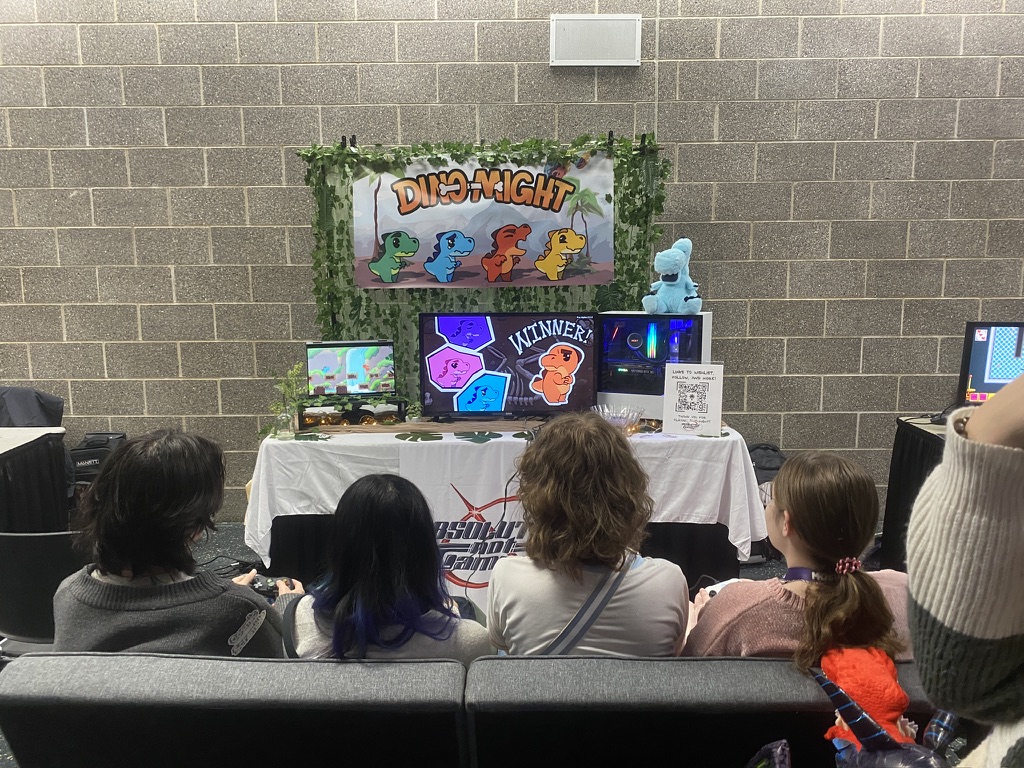
Across the board, local indie developers seemed to get even more creative with their booths this year, which featured leaderboards with prizes for top demo scores, developers dressed in cosplays of characters from their games, sticker sheet giveaways, and even cardboard cutouts of characters. (Of course, the developers of the upcoming couch co-op brawler Dino-Might dressed up in a giant inflatable dinosaur suit, which has become a welcome sight at Midwestern games industry events over the past few years.)
MDEV’s indie hallway has become an exciting portal for players to discover what’s new in local gaming. In turn, developers earn valuable feedback and exposure for their games.
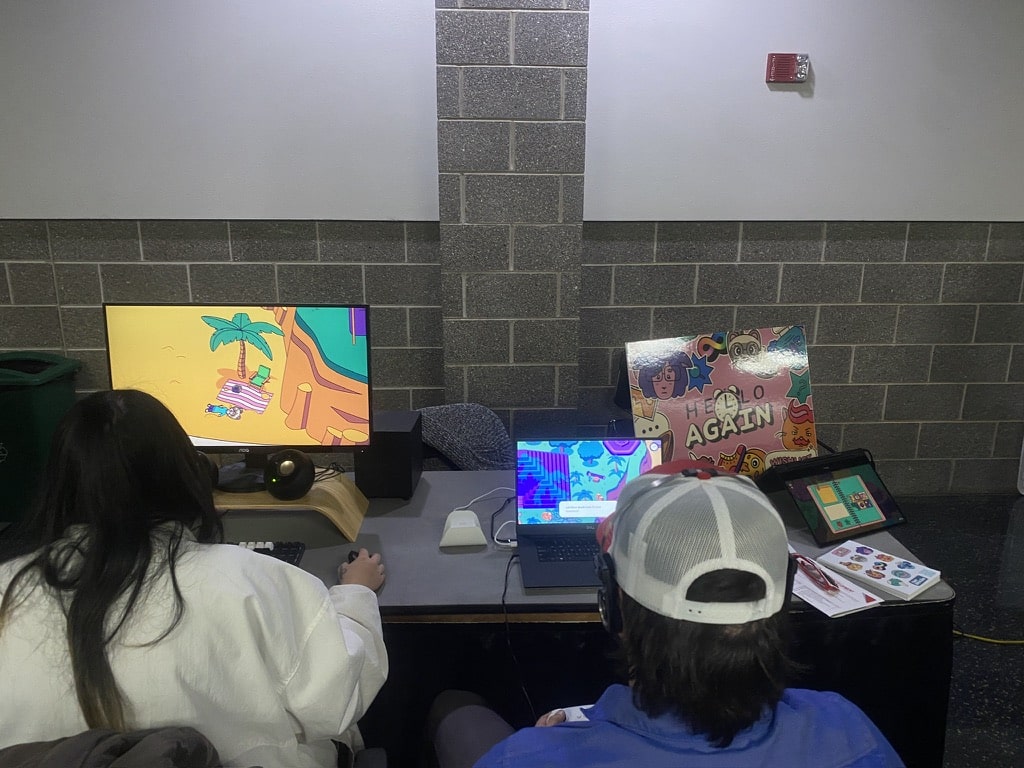
“The overall tone of the event was very supportive, positive, and communal—I’m blown away at how complimentary and gracious people were about my silly little game,” says Dwight Davis, Madison-based developer of Hello Again, a cozy puzzle game loop set in a time loop.
This year, it became especially clear that MDEV really does care about its indie games when, at the kickoff event at the Orpheum, a reel of trailers for games released this year positioned indies like Dino-Might and the pixel art tea-making simulator Ghoulong Tea next to titans like Call Of Duty and Apex Legends. Even as MDEV expands, making the industry accessible to newer indie developers remains a key focus of the conference.
MDEV has especially prioritized accessibility by partnering with schools. While MDEV was sparsely attended by students several years ago, this year had a larger student presence than ever before, in no small part due to the conference’s offering of discounted tickets for students. Higher-ed schools have also partnered with MDEV to buy tickets in bulk to allow students to showcase their games, and some have even bussed students in from the Chicago area. This year, MDEV’s agenda increasingly featured talks on relevant concepts like hiring, team building, and even running studios as students.
“Most of the speakers addressed us students and made sure we understood what they were talking about as we are not professionals in the industry,” says Cristiana Vlagali, President of UW-Madison’s Game Design and Development Club and first-time MDEV attendee, said. “The environment was extremely welcoming toward curiosity and discovery.” (Full disclosure: I was a member of this club’s board that appointed Vlagali.)
MDEV certainly fostered curiosity, which attendees like Tilly praised for not “having the air of deadly seriousness and cutthroat biz” of other conferences like GDC. Whether from students, recent college graduates, or laid-off professionals, MDEV speakers who opened their talks up to questions constantly received the classics: “How do I break into the industry?” and “When will the industry improve?” and “Is it even worth attempting to get a game dev job right now?” None of these speakers had answers that were anywhere near definite. The consensus seemed to be that, while developers understand the many causes of the industry’s tumultuous state, nobody knows where it might be headed next.
But while MDEV’s organizers predict that the industry will remain turbulent and difficult to break into for a while, the indie developers who attended seem to remain hopeful for the future of game development in Wisconsin and beyond.
“I have great confidence that, no matter how difficult the industry may be, people who love games will continue to make games, simply because we love making games,” Davis says. “I hope that younger and older developers alike can find ways to maintain healthy expectations and take excellent care of ourselves so that we can preserve that youthful, passionate piece of ourselves, no matter [what] storms lie ahead.”
We can publish more
“only on Tone Madison” stories —
but only with your support.
Author

Related Articles

Creating a music community on the isthmus with “Evan’s style”
Musician and arts organizer Evan Fernandez discusses the importance of managing the HQ practice space for local bands and his own ensemble, The Porch Flowers.
“Limerent Pittsburgh” intricately constructs a folkloric affection of place
Artist Anne Ciecko’s 2025 videopoem is a highlight among the 30 selections of this year’s Midwest Video Poetry Fest at ALL on April 4.
Good birding in all seasons with the storied Charles “Chuck” Henrikson
The retired lecturer and winsome ornithologist has been coordinating Tuesday birder hikes at the Arboretum for well over a decade.