
“One Battle After Another” reclaims hope in its cluttered, unpretentious, momentous rhythms
Paul Thomas Anderson’s latest epic satire is currently screening at all theaters in the Madison area.
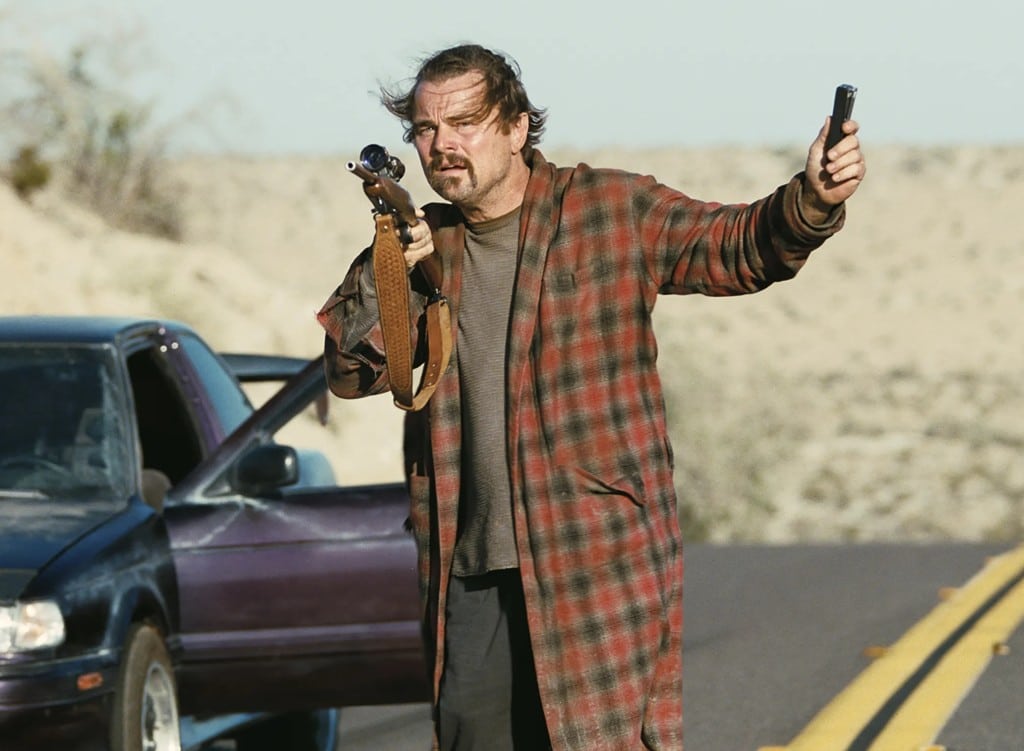
Sean Penn the mousey bantam, furrowed in peanut-shell texture, waddles his quick uneven steps around everyone’s turf like he’d rather limp from a leaden pelvis than a lame leg. Stuck in an elevator on his way up to a life-changing meeting with the Big Boys Club, he gobs something in his palm and combs his slimy hair with it. Screwing his throat raspy and tight, he duck-growls in poor old Leo DiCaprio’s face, “You like Black girls? I love ’em!” The man is all peacock postures. He pitches his gravelly voice at a low that seems inhuman. You sense the cold chills being breathed down your neck and through your spine the moment that craggy mumble of his reaches your ears, only for some shrilling guffaws to be jerked out of your nervous muscle twitches not half a moment later.
Writer-director Paul Thomas Anderson (PTA) has a name for him: Colonel Steven J. Lockjaw. It’s a thoroughly lurid part: the name “Lockjaw” is the only credible thing about him. Of all the majors and heavyweights in One Battle After Another—screening at all Madison area theaters—Penn is the only one who knows exactly what his role called for, and somehow manages to transcend even that in every direction you weren’t looking. He surfs in uncontrolled facial spasms, sudden knee-jerk pouts, psychopathic inexpressions, and off-balance emphatic reflexes. If you feed all the movie stereotypes of military men—those big, tough balls of muscle and hair—into a machine and make it puke out a clammy old Jeff MacNelly caricature, you might come away with something like this.
The whole hustle-bustle of Battle is set off by Lockjaw’s oddball sexual kink: being kicked around and led by the “nose” arouses him. Perfidia Beverly Hills (Teyana Taylor) of the radical militia French 75, cuffs him and throws him into teargas as they raid his federal detention facility. She has just the leonine fierceness of his desire, which is to be dominated. This spurs one slip-up—the Black revolutionary getting caught, forced to rat on her fellow comrades—after another—her baby girl sent into hiding with her lover and partner-in-crime “Ghetto” Pat (Leonardo DiCaprio), stashed in the woods under new identities: Bob and Willa Ferguson.
A decade and a half elapsed, the world barely changed one bit. Bob is now a roach-clipping pothead in his ragged bathrobe, a would-be hermit if not for Willa (Chase Infiniti), his teenage daughter whom he lives away with in the woods. Having eliminated much of French 75’s network and risen in rank, Lockjaw now sets his eyes on getting in with the top-secret white supremacist cabal “Christmas Adventurers,” the Big Boys Club I told you about. Entanglement with a Black woman and a biracial child who may or may not be his, these Big Boys will have none of it. One thing leads to another, Lockjaw tries to intercept Bob and Willa before the Big Boys can get their hands on them. Before long, we have on our hands a lopsided three-way-chase suspense comedy.
Paul Thomas Anderson works best in the moment. He can’t make a preordained arc as sparkling as the operatic neuroses that pile into a comic traffic jam of the present tense. With more somber works like The Master (2012), there always seemed to be something missing that he brought to the fore in the successive forward lunges of Magnolia (1999) or the topsy-turvy medleys in Punch-Drunk Love (2002)—a distinctively American filmmaking giddiness and excitement that’s rarely found in American films today. He’s a filmmaker who tends to fall flat on his face whenever he’s in his artsy element. He’s more at home with the likes of Boogie Nights (1997) and Magnolia, because he’s found the most natural command of film rhythm there—sandwiched between Robert Altman’s syncopation of wild elements, Jonathan Demme’s euphony and pop vitality, and Martin Scorsese’s kinetic visual flow and love of brittleness. For him, a set-up isn’t nearly as titillating to plan and execute as breaking open the gates of Hell. It takes pondering, coordination, technical focus, and it dilutes his energy.
DiCaprio’s old Bob, along with most of the cast, is never very believable and identifiable except in the heat of the action, which takes up most of the show: the sense of danger frees them back to life. In uphill battles, their identities take on new meanings. We respond to Bob’s struggles between tottering in panic and raging in despair, not the pedestrian family hokum. PTA seems to know this. He doesn’t beat around the bush once everything falls into place, and doesn’t wait for the drama to take shape before plunging right in. He just whips his characters into nervy motion and high-octane bravura, not only so their shallowness never has the chance to rub you the wrong way, but so we share more totally in PTA’s giddiness with his playthings: the car doors that slam themselves shut, the farewelling rug that rolls itself flat, drapes that don’t work, a sky full of surreal neon indigo, and those stupid referential jokes—Alana Haim’s “Mae West,” D.W. Moffett’s “Bill Desmond,” etc.
Lockjaw doesn’t even pretend to care about law and order; there’s an undeniably Trumpian sliminess about the mere idea of him. The corrupt baddies in authority are just this side of campy and just that edge of natural to switch between utterly intimidating and pathologically laughable at will. PTA brought in the big guns for this: James Raterman, as Lockjaw’s second-in-command and interrogation chief, is a former HSI Special Agent. When we see him within confined space, forcing his will on the dissidents, on the students, on the helpless nuns, we’re backed into the corner. We’re made to feel risks at their most tangible, and our whole sense of self was left dangling in the air with his venomous imperiousness. What One Battle After Another lacks in substance as a loose riff on a Thomas Pynchon novella, Vineland (1990)— it has barely anything to say about politics beyond the obvious — it makes up for in its vividly heightened sense of untidiness, of mess, of awkward physicalities and verbal hiccups in the midst of suspense.
After two decades of decrescendos, PTA had reassembled the gears of Magnolia that gave Battle its pulse, with a new slant. Johnny Greenwood’s uncanny score moves everything along on its discordant percussive off-beats, keeping the melodic flourishes at a modest ratio, highlighting just what needed the highlight—tensions and movements, the sense of hodgepodge unpredictability—without either melodramatic chicken fat or Christopher Nolan-esque toneless booms and bangs. The weirdness of it all doesn’t wear you down, because it’s all of a piece.
The film makes no mistake about its pulpiness. We don’t question how Bob manages to escape at the mercy of a nurse and the freewheelingly fearless Sensei Sergio (Benicio del Toro), or why Bob carried his rifle to the rendezvous point like he knew something else was up, or how the manager on the phone just happens to be who he needed (though we do feel puzzled at why Perfidia doesn’t reverse-blackmail Lockjaw or anything to shake him off her tail). These considerations are trifles. It doesn’t claim for itself anything it can’t handle. The result is refreshingly unpretentious, not unlike Darren Aronofsky’s unusually unobtrusive, yet fun Caught Stealing earlier this year, and it has the best no-nonsense qualities of Howard Hawks’ action melodramas in the ’30s like Only Angels Have Wings.
Yet it’s an unmistakably modern work, maybe a new landmark of sorts. No other film has yet to capture the mood of the country at this moment in time as piercingly, and for that we have PTA to thank. If the film is saying anything, it’s that haggard old-timers like Bob—and maybe like PTA—still have it in them to make a comeback. Or so they hope. One Battle After Another is about hope reclaimed, passed on in one half-full glass at a time.
We can publish more
“only on Tone Madison” stories —
but only with your support.
Author

Related Articles
Evaluating tenderness and depth of family dynamics in “Sentimental Value”
Grant Phipps and Lance Li argue in favor of and against the artistic framework of Joachim Trier’s latest psychological family drama.

Movie tee envy
Pondering a shirt collection, and stumbling upon Cosmic Cabin, which has the goods—at least niche ones for cinephiles.
“The Annihilation Of Fish” wholeheartedly renders the enchanting eccentricities of a senior romance
Charles Burnett’s long-lost love story from 1999 screens on 35mm at UW Cinematheque on December 5.