
Juliana Bennett announces run for Francesca Hong’s Assembly seat
Bennett promises to be “a real agitator in a space that tries to constrict innovation.”
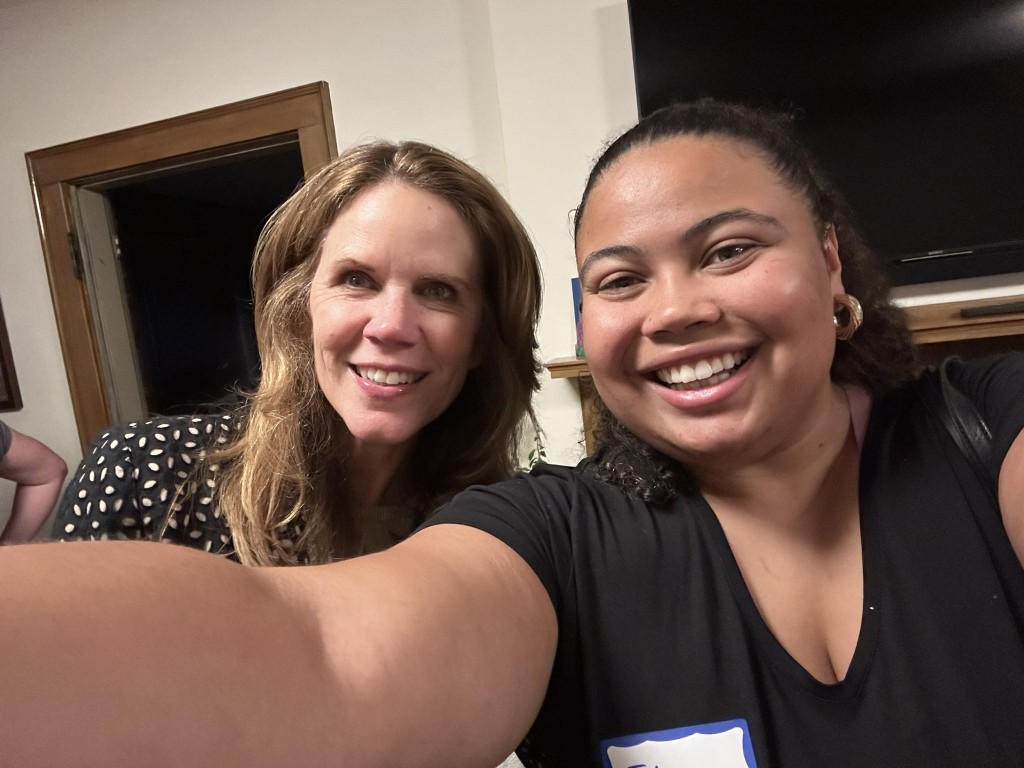
Earlier today, former Madison City Council Alder Juliana Bennett announced that she is running for the Wisconsin State Assembly in the 76th District. The 76th District is currently represented by Francesca Hong, who announced on September 17 that she was running for governor.
Bennett served on the Madison Common Council for two terms, representing District 8 and—after redistricting—District 2, until she stepped down in April this year. She spoke with Tone Madison on September 26, ahead of her announcement. This conversation has been edited for clarity.
Tone Madison: What made you decide to run for the assembly seat?
Juliana Bennett: When I look back, when I look at my decision to run, it comes down to the simple thing that we need fighters and we need doers. And I’m someone that knows what it’s like for the system to fail, and I know the difference between having leaders that actually give a shit and leaders that are going to play petty partisan games with people’s lives.
Really, all of what I just said drills down to a specific story or a specific instance: Three years ago, my dad survived an episode of cardiac arrest. He survived with a six-in-100 odds of living thanks to the healthcare workers and first responders at the Meriter Hospital. But his life came at the significant cost of a $500,000 medical bill. (It’s actually more than that.) But $500,000 and an eviction from a greedy landlord.
Now, at this time, I was an alder, I had just graduated from UW[–Madison] with degrees in real estate and political science. I was just starting off working as a federal legislative liaison at WHEDA [Wisconsin Housing and Economic Development Authority] so I had what felt like all of the things, all the cards in my corner to be able to help him. And I couldn’t do anything, because at the end of the day, everything that we need to do to solve a majority of the affordability crises that we’re facing right now drills down to state and federal level [laws]. And I want to be the one that repeals and undoes the over 100 pro-landlord laws that the Legislature has passed in the past several years, and be the person that’s out here fighting for our needs.
Tone Madison: You had a pretty difficult last few months in your term at the City Council. I don’t think anyone would blame you for deciding not to be in the public eye or not wanting to go back into public life. Did you hesitate about this decision at all?
Juliana Bennett: I wouldn’t say I necessarily hesitated. I would say I took a genuine beat and took this decision—that I did not take this decision lightly. This wasn’t just like a spur-of-the moment, “Fuck it. Let’s do it,” or something that’s like, “I’ve been dreaming my entire life of being President.” This is something that came about after many, many people asked me to run. And honestly, just seeing the political environment that we are in right now. Honestly, the last few months left out at [Madison Common] Council revealed how effed up our systems are, and our systems do not serve working class people. I’m not saying anything there that we don’t know, but this bullshit watered-down politics that has corrupted our state is not going to help us. We need to light the fire under our asses and actually come to the building with a backbone ready to fight for people’s needs.
Tone Madison: Can you talk about specific policies that you want to change?
Juliana Bennett: Absolutely. All of my platform drills down to resolving the affordability crisis that we’re in right now. My top issues are guaranteeing an affordable home for everyone, delivering no-cost, universal child care and health care, passing healthy school meals for all, fully funding public education, and raising the minimum wage to $23 an hour by 2030.
Tone Madison: Unless there’s a major change in the makeup of the Legislature in 2026, it’s gonna get—I don’t see any Republicans signing on to that agenda. If you’re in the minority party, how do you plan to handle that?
Juliana Bennett: I currently am a staffer in the Capitol [Chief of Staff for Rep. Angelito Tenorio, Democrat from West Allis]. And having worked as a federal legislative liaison with [WHEDA], I have a little bit of experience of working with Republicans. What I have learned is that… Honestly, it’s quite shocking how many Democratic bills Republicans take and make their own. There’s bills even that have been introduced by the [Democratic] Socialist Caucus and the Legislature that are based in socialist ideology that Republicans [put forward]. I’m not stating that to say that I anticipate that the Republicans are going to bill-jack me, but I say that to mean that there is more buy-in from the other side of the aisle than one may expect.
I actually believe that the more pressing problem with advancing the platform that I just stated is within our own party. I think that we have a lot of very well-meaning people that, in efforts to build a compromise, have become compromised themselves in our party’s values and in the needs that working families are asking of us to deliver. So if we can’t have conversations within our own party about raising the minimum wage, fully funding public education, delivering universal health care—these are just quite literally conversations we don’t have full Democratic support on. So before we start thinking about how we get the other side of the aisle to support it, we need to get our own side of the aisle to be supportive of these very core legislative ideas.
That’s why I find the 76 Assembly District specifically to be a very important district to get there. This is the most progressive district in the state. And also it’s quite interesting, because it’s situated as one of the wealthiest districts in the state, with also a very deeply working class hold within the district, especially if you look towards the north side and further out on the east side. The person that’s in this seat cannot be someone that is going to waver in times of duress. This needs to be a progressive stronghold, and that’s why I’m very committed to running both as a progressive and as a Democratic Socialist like Rep. Francesca Hong.
Tone Madison: Are you going to be part of the Democratic Socialist caucus?
Juliana Bennett: That is the intent.
Tone Madison: I was also going to ask about Francesca Hong, because [if elected] you are going to be following in her footsteps. What have you learned from her? What do you hope to continue?
Juliana Bennett: I want to start off by saying that [Hong] is my queen, my goddess, my empress, and my dear leader. She is truly someone that, since I got my start in electoral politics when I was 21 years old, I’ve really looked up to. And the thing that I would say I’ve learned from [Hong] is how to care—and not just care when it’s easy to care, but care when it’s really hard to care, and bring a deep level of empathy and compassion to every aspect of what I do and what I say.
Also, [Hong] has been that really strong, vocal voice that we’ve needed within the state. I’m really grateful that she’s shaking things up on a statewide level.
I think the potential key difference between the two of us is the time and the space that we’re going to be occupying. Both [Hong] and I were elected in our respective positions, her as a state representative and me as the City Council member during 2020, during Black Lives Matter. This is also right around the time where the first Trump administration was ending, and we were all grappling with a global pandemic and a racial uprising. Now the time that we are in has slightly changed. Republicans and the GOP have completely abandoned any sort of respectability politics that the Democrats are still holding themselves to. We are entering a new era of fascism, of all the phobias, and the key difference there is that we are facing an enemy that has no soul or truly no empathy or care. So I, in this position, want to embody that deep level of empathy that I’ve learned from Representative Hong while also launching us into a new era of politics that is needed to fight fascism and the oligarchy. So I see myself as a real agitator in a space that tries to constrict innovation.
Tone Madison: Is there anything else you want to add that I didn’t ask?
Juliana Bennett: The other thing I wanted to say is that—I mentioned this during my interview—but I started off in the electoral space when I was 21 years old. And I know exactly what it’s like to face the chance and “don’t do this, don’t do that,” and that we can do something different, and it can work out. And I bring to this election a really diverse and unique and well-rounded experience, having worked at all levels of government. Being young and having that experience has taught me that young people are literally leading our country. And they are, in a way, hamstrung by geriatric politicians that lack imagination. This campaign is about empowering young people, about empowering communities of color, communities that have been just generally underserved. And my commitment in this campaign is not just to be someone that’s going to be out there asking for people’s votes or showing up once, now, in two years, and then disappear. This is going to be a long-ranging thing. However the primary ends up, we’re going to funnel that into electing Francesca Hong for the general [election for governor], and then after that, in a long haul for helping working class people.
I really want to articulate that this campaign that we’re running is because I genuinely care about Madison. As someone that has been here for the majority of my life—I graduated from Madison West—we are in here for the long haul, for our city and our community. And then the very last thing I wanted to say is that some of my qualifiers in this race is that I am a caregiver, I’m a community organizer, a West alum, Capitol staffer, and proud Democratic Socialist running for the seat. Also when elected, I will be the first young queer black woman elected to a state position, which is pretty cool in terms of bringing a diverse voice to this space.
Who has power in Madison,
and what are they doing with it?
Help us create fiercely independent politics coverage that tracks power and policy.
Author
Related Articles

Coliseum renovations should proceed with caution
Dane County should apply strict scrutiny of its partnership proposal with FPC Live, even if it’s the only bidder.

Could an exhibition like “Guiding Ethos” find a home in Madison?
A group show at Appleton’s Trout Museum stands up for “political” art in an era of cowardice and compliance.
Beltline expansion proposals suggest dead-end logic
“Another lane will fix it” still reigns at WisDOT, but the public is pushing back.