
Slick swings for the fences
The emergent indie-punk quartet prizes the power of impact.
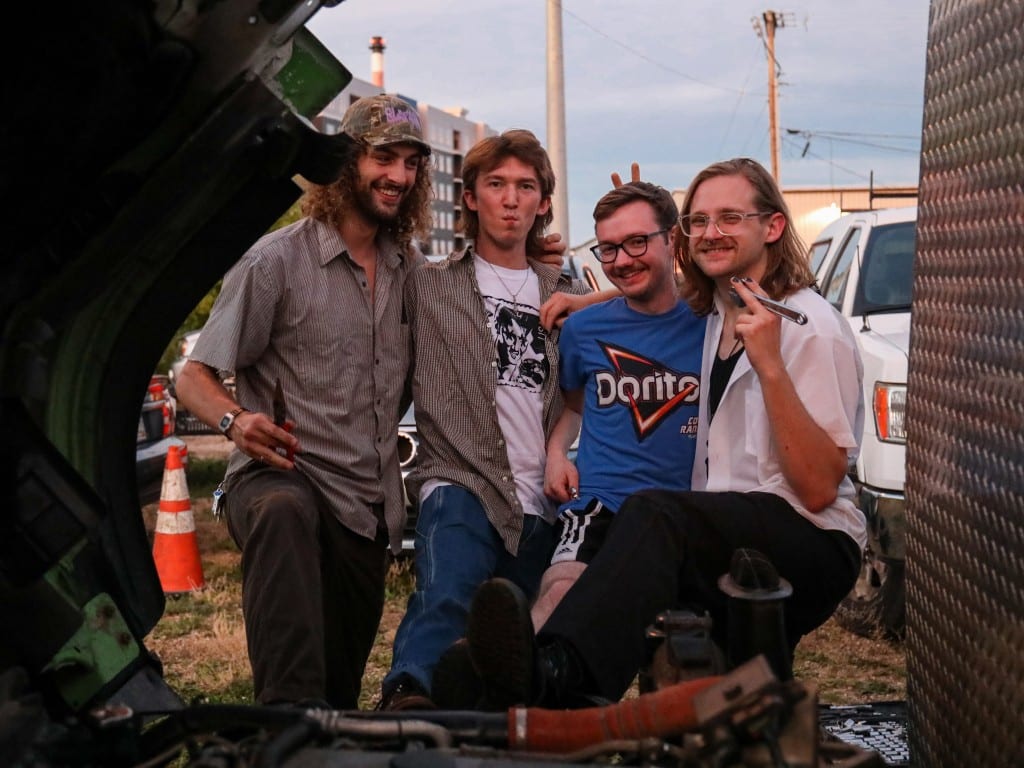
Every few years, a Madison artist comes along to fill a niche void in the city’s musical landscape. Even in a genre as relatively saturated as indie-rock, certain instincts and sensibilities go largely unmet by the city’s local bands. For example: Madison hasn’t had a band that could realistically be likened to an oddball mix of Guided By Voices, Archers of Loaf, and Times New Viking in ages. Slick, an emergent quartet, is taking up the mantle.
The Perfect Pop Song, the band’s latest EP, is a scrappy, sticky four-track affair. Guitarist/vocalist Nate Opperman delivers a deliciously wry opening line in the EP’s opening segment: “The perfect pop song / Lasts less than one minute / I don’t think Paul McCartney would write it.” A crushed, compressed mix around Opperman’s vocals imbues the song with both character and punch, and the introductory line is enlivened further still by the off-kilter recorder solo that hits immediately after. Over in under a minute and a half, the track nonetheless feels resoundingly complete.
The song’s aesthetic presentation lends weight to its impact, but also suffuses it with a nostalgic familiarity for anyone who grew up listening to acts like The Replacements, Built To Spill, or Dinosaur Jr. A bit of Pavement’s sensibility is thrown in for good measure, expanding on a ’90s indie-rock palette without coming across as tepid revivalism.
Slick‘s approach to structure brings to mind the 2010s NYC indie-rock act LVL UP, another ’90s-tipped, grunge-leaning, riff-happy quartet who embraced micro-runtimes (while still making room for more traditional pop-minded song lengths). Sorely overlooked Athens, GA trio Hot New Mexicans constitutes another interesting aesthetic comparison point. The band’s guitarist, Calvin Childress, grew up around the greater Athens area, and it’s not hard to draw parallels between elements that connect Slick’s work to Athens’ unimpeachable legacy of outstanding indie-rock acts. Hot New Mexicans’ playful modesty, Elephant 6’s willingness for wild-eyed experimentation, and Vic Chesnutt’s acute sense of humanity all factor into Slick’s artistic fabric.
For all their unassuming resemblances to their stylistic forebears, Slick—only a few releases into a burgeoning career—are already well on their way to solidifying their own artistic voice. Opperman’s balance of acerbic, self-aware critique skews towards Cheekface‘s penchant for wry self-deprecation, but implements a focus that keys in on a more pronounced mundanity. “Notebook,” for example, is a hard-charging tune that largely seems to be about the struggle to find the right words to properly express or communicate anything.
Slick presents this in a relatively fresh musical context, with just a hint of classic, early emo tendencies. Other acts have achieved similar blends before—like the great, little-known Michigan trio Silence Dogood—but it’s a dynamic that has been all too absent from Madison’s musical landscape. Apart from Friendly Spectres—and even then, with a number of distinct caveats—not a lot of projects here are operating in a similar stratosphere.
Slick has brought all of this together emphatically, and in rapid order.
In August 2024, Opperman released the then-solo project’s debut single, “Wait And See,” which gave a spiky, modern bent to a classic slacker punk sound. Since that single, Slick has released three short EPs, a digital double-single, and expanded into a full band. Childress, bassist Morgen Nicodemus, and drummer Hance Throckmorton now make up Slick alongside Opperman. The band’s torrid pace doesn’t seem to be slowing either. During a long, in-person talk with Tone Madison, Opperman noted the band has already made significant headway on the writing and recording process for their next release.
Opperman—who moved to Madison from Rolla, Missouri, to pursue a masters in geological engineering—is still Slick’s leading force, but the band’s becoming more collaborative as it picks up steam. Each member of Slick is finding that degree of shared input to be liberating, in different senses. All of them trust each other’s instincts and visions, and their supportive, laid-back rapport with each other was evident during our hour-long talk at their rehearsal space on the Northside.
Every member of Slick has a personality that complements the music they’re making. All four possess forthrightness, a keen sense of awareness, and a steadfast determination that’s not overbearing. Even in conversation, there’s a natural ebb-and-flow to the way they operate, with members completing each other’s sentences and thoughts with regularity and well-placed conviction. Cohesion like that is relatively rare for younger acts, and it tends to serve them well. If Slick keeps their collective foot on the gas, chances are high they’ll end up at an enviable destination.
Slick’s next show is this Saturday, August 23, at The Rigby, with The Mail Manipulators, World’s End Highway, and c. halle.
Tone Madison: When you started Slick, the project was just solo, correct? And you were in Rolla, Missouri?
Nate Opperman: That was actually in Madison. I started the project last year in March when I was still playing in a band called Jaywalker, because I had a lot of songs I was writing that we weren’t getting to in practice. I wanted to record them and flesh them out on my own. That band ended up falling apart at the end of June last year, and then Slick filled that void. Morgen was the drummer in Jaywalker, and now he’s the bassist here. But the Rolla connection comes from me and Morgen going to school there. I recorded a lot of the initial demos for our first few releases down in Rolla—where we’re from—because I was back visiting my family.
Tone Madison: How did the other two come into the picture?
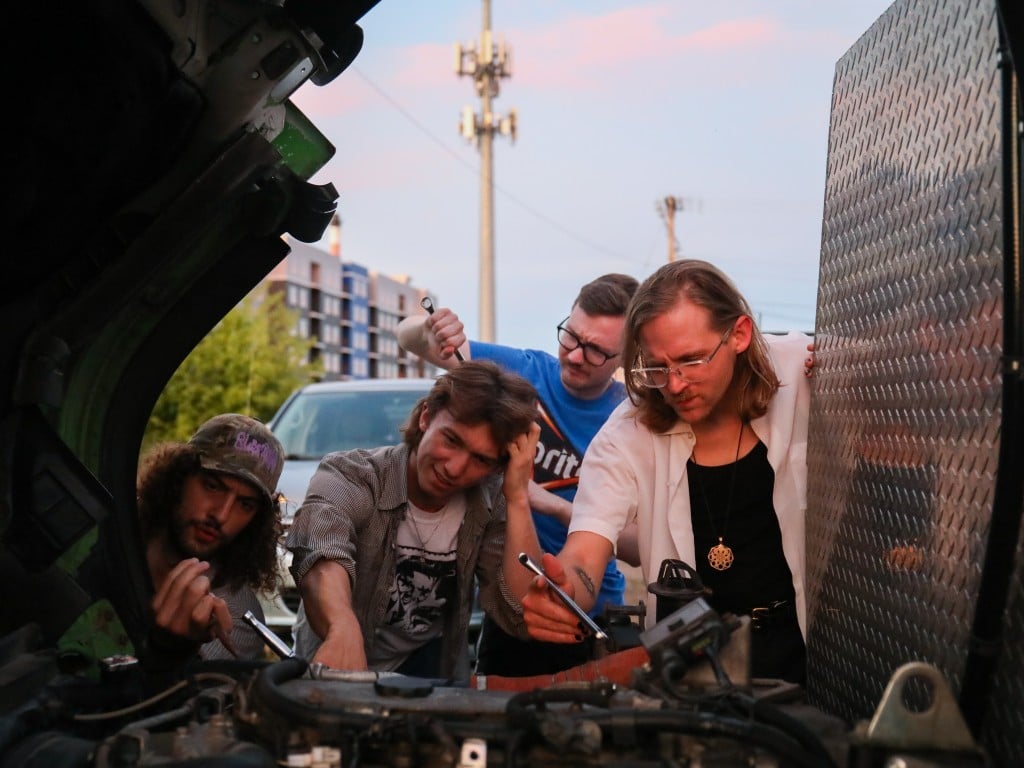
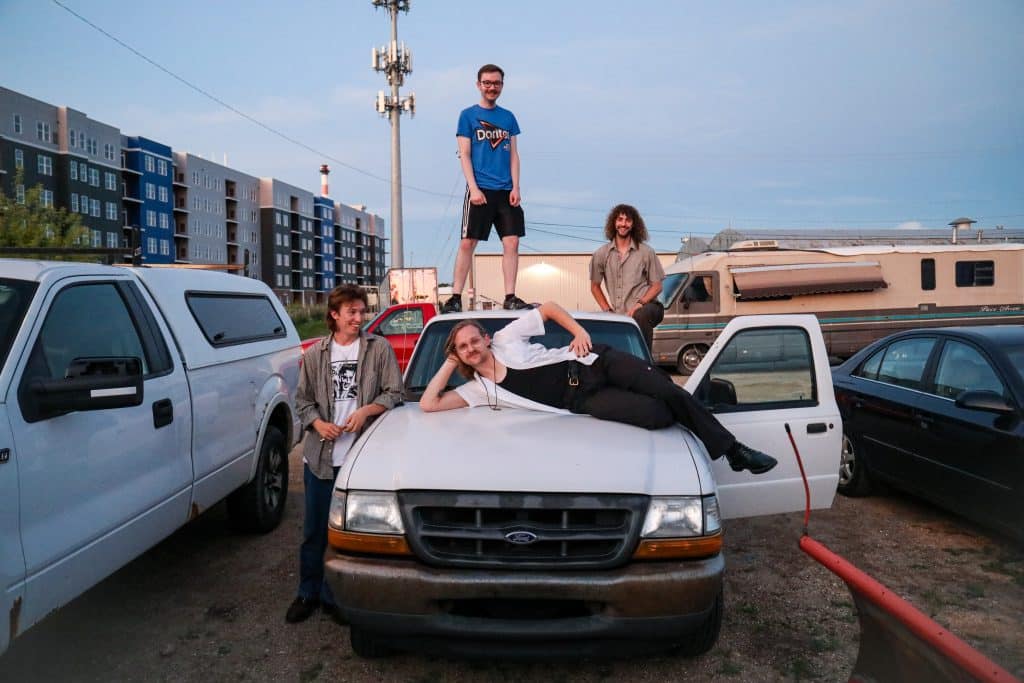
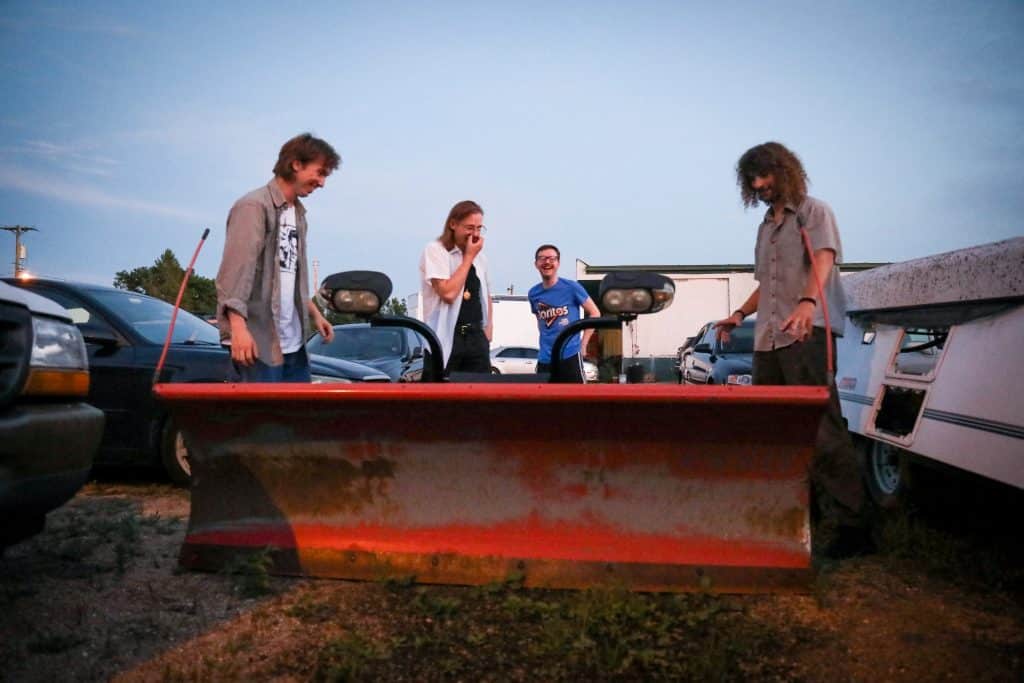
Calvin Childress: I answered an ad on Discord that Nate put out [that said], “Hey, I’m looking for another guitarist and a drummer. And I really like Built To Spill’s first couple of records, and Guided By Voices.” I was like, “Oh, I like them too. This guy seems cool.” So I hit up Nate. I was like, “Hey, man, I play guitar. Kind of. How’s it going? What else do you like? Are you gonna kill me?” Yeah, [and he was] like, “No, come to this weird towing yard with a bunch of cars out front. Come into this sweaty spot and see what’s up.”
I had another drummer friend prior to Hance, that I brought [with me], and he was the world’s busiest dude. [But] Hance and I used to work together when we were in a jam project back in the day—so we had played together a little bit—and he was just a natural fit once we started jamming more regularly.
Hance Throckmorton: Yeah, I didn’t even know what this was, originally. [It was just] “You want to come jam with some people?,” And I was like “Oh sick, we haven’t played together in a long time,” and then, like, a week before, he’s like, “Alright, so they got these songs that I think we’ll be playing.” And I was like, “Okay, cool.” I didn’t think anything of it. Then I got here, and I was like, “Oh, this is a band.”
Calvin Childress: Our last thing was not a band. [Laughing.]
Hance Throckmorton: “Project” was a very strong word for the previous [one]. There was really just a bunch of people getting together, hitting stuff. Playing stuff.
Calvin Childress: Finding somebody over the internet that has a lot of your same interests—is the same relative age stage of life—felt super unique.
Nate Opperman: I think we got lucky. Because it’s hard to build connections on the internet. I’ve tried [going] through Craigslist to find players for bands and I get a negative response rate almost. It’s impossible, in my experience.
I’ve always made bands with people I know before, typically. So it was also new to have two total strangers show up. “All right, I gotta figure out how to talk to these dudes and share music with them.” That’s something that I’d only done with friends before.
Tone Madison: Finding a bond in shared interests and experiences can be crucial. Do you think it’s fair to say that everyone clicked into the band’s vibe pretty quickly?
Nate Opperman: I think it took me a while. It took me at least six months to feel like I could work pretty fluidly.
[We started playing] the weekend after Labor Day in 2024. That whole first fall was just teaching everyone the songs I had written up to that point, and still writing some stuff on top of that. I was still learning how to communicate with people in bands. Giving people space to write a part, but also having an idea in mind to guide that part was really difficult for me. I was actually super stressed for a large part of that period. Getting ready for our first show was mad stressful for me. After that first show was out of the way, I felt a lot more comfortable working with them, but I was still super stressed about booking shows and getting ready for them. Over spring, I got a little bit more laid back with it as we played more and was a lot more comfortable with it.
It definitely took me a long time. I can’t speak for anyone else.
Morgen Nicodemus: I felt like it took a couple months, but having shared interests—and then just taking the time to learn how each of us learned [the music] best helped a lot. How we communicated, how we need to talk about the music. Because I know I learned in a very different way than Hance learns, from how Nate learns. And since Nate’s the one writing the song, how Nate expresses it. And I need to think about these things for how I learn it.
Hance Throckmorton: For me, once we started recording is [when] I was like, “Okay, I see things and I’m gonna say things.” If the tempo feels off, I’m gonna speak up, rather than letting that go. After the first show is when it felt like a real band. Because up to that point, I was like, this is a cool thing that we’re doing, but it didn’t feel real. Once we did our first show, it was like, “Okay, this is going somewhere. It feels like we’re actually where we can at least consider ourselves [a band].”
Calvin Childress: Yeah, it’s weird, being so into music and following so many different bands—and people that have led very successful bands—or whatever your own metric of success is, and then [suddenly going] “Oh shit, we’re now playing shows. We’re now releasing tapes. We’re a band now.”
Which, beforehand, it’s like a weird jam where people are kind of feeling each other out. Nate had all these songs written which was cool to just like, kind of jump in [and] latch on to. What made it, for me, so natural is [the] songs.
When Nate showed me all the demos that he records, they’re songs that I would have loved to hear from my city. It’s like, “Oh, somebody’s big into lo-fi pop music, and doesn’t care about how shitty the fidelity is. That’s my stuff. That’s cool.” Rather than trying to force taste into a direction of, like, “I don’t really like playing this music, but I’m going to do it because I want to be on stage.” [Instead it’s] cool music that I feel is expressive of all of us, in a way. But it’s nice that [it] was already kind of prepared. It’s just interesting finding somebody that’s kind of tapped into similar interests.
Nate Opperman: We have a running joke between me and Calvin, that we had the same media diet. It’s kind of uncanny. We’ll play that game where you just name like dudes, or name bands, and we have like a 90% hit rate. Like, “Yo, you like Bardo Pond, yeah?”
Just like “That one Thinking Fellers song?” “Oh. Yeah.” I just haven’t met another person—especially that [I met] through a mutual friend—just [randomly] that has enjoyed the same music that I have. And grew up listening to those things. It was crazy, which is weird, because that was, like, the idea of the internet. These similar people that are exactly in this same microcosm of interest as you. Which, in practice, is not how the internet works.
But, for some reason, it was this Madison DIY Discord that’s [about] 100 or so people across Madison and Milwaukee. They promote shows. There’s classified sections. They do show promotions, [it’s a] good way to get to know people. And that truly was a beacon. Like, “Okay. Finally.” There’s some like-minded people that you can’t get through the major social media outlets because it’s so exhausting. It’s hard to keep up with.
Tone Madison: It really is. But it speaks to the reality that these close-knit, like-minded communities aren’t overly populous, but are far-reaching. Once you make the right connection, it can open up a sweeping social structure in the blink of an eye.
Nate Opperman: Yeah. That’s pretty much the reality that I ran into over the past few months. I hadn’t really been in a real band. Before moving to Madison, Morgen and I played in a college band back in Rolla called Lake House, and it was just playing parties. I think that they played a show in St Louis. I didn’t go because I had nerves, and I didn’t want to play in front of people that I didn’t know. I had such an idea of what [that] was gonna be like, and then the reality has been way different. It’s been a lot less stressful, actually. I don’t have to treat it like a job, like I thought. It’s actually pretty good.
Calvin Childress: You also realize how small and interconnected the scene is. It really is, like, a core 20-30 people all kind of playing in each other’s bands. And I feel like Madison is really unique compared to Milwaukee, where there’s a limited amount [of bands], but the richness is there. It’s saturated.
I grew up in Athens, or around Athens, [and people] who were going to school out there. That was the pinnacle of college rock, at least back in the day. Going from like, Music City to, you know… I was familiar with Garbage and the big Madison bands. All the Butch Vigs, and the grunge scene. But you don’t have an idea of what it’s gonna be like to start swinging for the fences.
Tone Madison: It sounds like you had a collection of songs ready and launched Slick off the back of those. First they were solo, then the full band came about. Has playing with a full band adjusted your process when it comes to the songwriting phase?
Nate Opperman: Not as much as you think. I still will sketch out pretty much everything for the band to play. Calvin has written songs, though, and I’m very encouraging. I want him to finish his songs because they’re good. He writes good-ass shit. But I just come here after work or classes usually, and I’ll write something, start to finish. At least instrumentally. Lyrics are hard for me, but I [usually] have an idea of how I want it to sound fleshed out, and then I’ll track a rough demo on the tape machine, or my laptop, and then I’ll listen back to it a few times over the next few weeks and share it with the band.
If I get a positive response, that’s something we’ll add to the set. If it’s something that I still think about two or three weeks later, that song is something that we’ll also learn. That way, we still keep a degree of quality. But I don’t think my songwriting methods have really changed. Since I was 14, I’ve just been writing stuff, and I’ve always done it alone, just out of necessity. Mainly because I was either playing in someone else’s band, or this more personal war.
I grew up in the military, so I moved every two years, pretty much. I had to spend a lot of time on my own, especially in summers before I would start school. So I would play guitar, listen to music, and write stuff. Also played a lot of Civ 4, but that’s not as creative as making music. [Laughing.] Disq does have that song “Civilization Four,” which made me super happy. I said, “Finally, some cultural recognition.” [All laugh.] This childhood got represented.
But, yeah, we’ve been writing more collaboratively, too. In the past few months, we’ve stopped booking shows for a while. [We] wanted to take a break because we were all pretty tired from playing, like, three shows. But we’ve been jamming [at] the beginning of every practice. We’ve had some pretty decent ideas come out of that. And we had some ideas from whenever we were first learning the set of songs [from] the first Slick tape that we haven’t finished, that have been sitting in the background. Because I’m constantly writing stuff, and just do it for fun.
Calvin Childress: You’re not a real band if you don’t have 100 unwritten songs, or unfinished songs.
Nate Opperman: We’re up to [about] 60.
Tone Madison: When it comes to the writing phase, do you have a preference for order of operations? Are you going from drums on up? Or do guitar and vocals come first?
Nate Opperman: Vocals are always last. Vocals always last. I usually start with the guitar part, but sometimes, if I hear a drum beat that I think is interesting, I’ll take that drum beat and write something else over top of it. I find that the instrument I start writing with tends to really change the direction of the song. I’ve written a few songs with the bass first. “Bruh! Eagle” off in the first tape was written with the bass first, originally. And that’s a really old song too.
That one’s from, like, 2020, whenever I was still in school and I was living with Morgen. I was fucking around in the basement and never released anything. But I was playing bass, and that song, I think, feels very [different from] something I would write with the guitar, because it’s more bass-forward and [that] carries more of the song. Another song that’s bass-forward is “The Dirt.” I think those songs sound different than like the songs I’ll write without guitar, just bass. I think that the instrument I choose to write something with really determines the direction I want to take it. It just feels different to me.
Tone Madison: How has adapting to a more extensive and immediate collaborative process been coming along?
Nate Opperman: [Comfortably]. They put me in my place.
Calvin Childress: Hance likes to yell at us. [Laughing.]
Morgen Nicodemus: Hance yells at us about tempo all the time.
Calvin Childress: It’s good, I think because we’re all, at this point, comfortable with each other and we’ve hung out enough outside of the music context to where we all are just friends. I think that context creates such a comfortable, open space where a lot of creative ideas can be bounced off, but also a lot of correcting direction. And we can’t just keep dicking around with the same lick. Like, what do we want it to be? So I think it’s just openness and mutual respect with everybody.
Morgen Nicodemus: I like it a lot, because I feel like it helps drive the group input towards Nate’s vision. Because, again, Nate writes most of it. He generally has a pretty strong idea of what the chorus should be, what the verse should be. And generally, most of what we discuss is, like, how long the part should go. Or maybe we need a little bit of space somewhere, just a little thing added.
Calvin Childress: Should we do harsh noises [for] this part? Or for the beginning of the song?
Morgen Nicodemus: Do we do a big noise section here or there?
Hance Throckmorton: And I feel like we throw it out pretty early too. We’ll run a song once or twice, and it’ll be like, “Oh, wait, maybe we should try this here, or maybe we should try swapping this.”
Calvin Childress: Maybe that’s something established bands have already had [as an] epiphany, and it’s old to them. But I think as we’ve been playing more and more, we’re able to feel it out a whole lot quicker, learning new songs. Like, “Oh, this one’s really fun to play. Let’s speedrun this. Get it ready for a show.” “This feels sick. This sounds good to everybody.” And then we play another song. It’s like, “Oh, that one didn’t go good. Let’s just axe it. Let’s learn something else.” That constant, organic pull in a direction is kind of needed. Nate is kind of that beacon of keeping us on course.
Nate Opperman: Not by choice. I don’t like playing that role, for the record.
Calvin Childress: Yeah, which is awesome, because I think that mentality kind of allows the space to be open, where I’m sure a lot of other band leads are regimented. Very, you know, [coldly organized] to execute vision.
Morgen Nicodemus: I think having that sit-down to work on the songs and figure out what we all feel is best helps a lot on learning the songs. So it’s not just “this is written in the way that Nate hears it, and Nate feels it.” When we get to adjust things, I think we end up at what’s best for all of us if we’re feeling the song, which just makes it go so much faster to learn it. If there’s a part you do have to sit down and look at and actually count out, and the other part is [that] it just gives more investment. We’re not just players in Nate’s band, we’re part of it, which is nice, even if I’m not a songwriter. I don’t like writing songs, but I still feel like I have investment and care in this project.
Hance Throckmorton: I also feel like some of the stuff we do is unspoken. Like, there will be a bass part that Nate has in mind for Morgen, and then Morgen will kind of follow that form, but he’ll just start adding his lines on top of it. And then Nate will go “Oh, that’s so sick that you added that.” And I’ll do, like, similar things with the drums, where he’ll provide something to start with. And then I [go], “I think I like how this would go right here,” and I just start doing it. It’s like, “Ooh, that was cool.” Or sometimes, you know, you try something and it doesn’t work, and then it’s fine. Go back, or try something else.
Morgen Nicodemus: Yeah, I love having that freedom to add little bits and take little bits away as I maybe think fits, and then if Nate doesn’t like it, cool, I’ll just adjust it. And if Nate really likes it, then I contributed even more.
Tone Madison: Looking through the production notes, it seems like your releases have been split between being recorded here and recorded in Rolla.
Nate Opperman: Yeah, most of our output has been recorded in this [rehearsal space]. There’s a few demos that I put up on Bandcamp that were recorded in Rolla, Missouri, and a few interludes, but most of it was recorded here.
Tone Madison: Can you take us through your production process?
Nate Opperman: All of the EPs are recorded to tape. My demos I’ll record on a PC, sometimes just depending on what workflows I’m preferring at that time. But most everything we do is recorded on tape. And I’m moving away from this specifically, but the first few Slick releases, I would master and do some mixing through a DAW and would do vocal overdubs, just because I was still a little scared to ping-pong tracks. And then I want to erase things, but I’ve become more embracing of that lately.
Another big part of that is I’ve also just slowly accumulated more analog gear, and I just have a lot more fun working with it than I ever have working with digital gear. This process is really important. I have to enjoy what I’m doing for it to feel like it’s worth doing. So I slowly accumulated some [analog] stuff. Then I offload the mix from the four track tape, and I might do some normalization, so the levels are a little bit more balanced, but that’s that’s really about the extent of it.
For The Perfect Pop Song tape, that was totally analog. I didn’t use anything other than just literally offloading it to a file, so I could cut it up and put it on screen. I didn’t do any editing of that. I would just take my tape deck home and dump the cassette for the master at home and scooped it a bunch of times, just because I thought that would be fun. Because it’s something I’d always wanted to do.
Tone Madison: Earlier you said lyrics were hard. But the first line in “The Perfect Pop Song” struck me as one of the funnier—and sharper—lines I’ve heard from a Madison band this year.
Nate Opperman: That’s good. It was supposed to be funny.
Tone Madison: Have you found yourself favoring any distinct writing styles more than others as Slick picks up steam? Are you conscious of any development or emergent habits when it comes to your writing voice?
Nate Opperman: I feel like I haven’t written or finished lyrics enough to feel like I have a real voice. But I love, like you mentioned, “The Perfect Pop Song.” That song was directly inspired by “Wicker Park” by D.L.I.M.C.—Mark Winter is a huge influence of mine, because he’s able to write these really funny songs that still manage to say something that I think is important in a societal critique sort of manner. I think he’s really skilled at that. More than I am. But I liked the sense of humor in that song, particularly, and I was just really annoyed. I was at a coffee shop, and they kept playing fucking boring, like, Fleetwood Mac indie-rock stuff that I don’t like very much. I just wanted to make fun of that, so I wouldn’t complain about it to my friends for the next week.
As far as other songs or lyrical content, I don’t think it ends up being more retroactively personal to me. I don’t really go in wanting to cover a set topic, I just sit down and preassociate. Or I’ll just go in front of a microphone and say sentences that fit the song. Then I’ll go back and listen to it, like, “Okay, I was processing this emotion.” It’s really unconscious, and I know I’ve heard other songwriters say that, but it does feel like that’s how a lot of my lyrical output tends to be. It’s more like assigning me to it after I’ve already sketched something, and then filling the rest of the gaps in my head. And a lot of the first takes I end up keeping, or keeping mostly intact. I normally don’t do too much editing of lyrics once I get something done, just because it’s hard for me to be really intentional with it, like 90% of the time.
Tone Madison: Sticking to “The Perfect Pop Song,” what drives your instinct to create shorter, fully-formed songs? Is that a personal preference? A conscious reaction against anything? Or is it a balance of both?
Nate Opperman: It’s a lot of reverence. I just think it’s a cool tradition. Mostly it’s brain candy. It’s just good to write a short, hot song. And I really like bands that are able to bring an aggression in their sound to pop songwriting. Paul Westerberg is a pro at that. [A] huge influence on me in particular is, like, The Replacements and Paul Westerberg. Then, yeah, Guided By Voices, like Calvin touched on. There’s just something so good about taking two or three parts of a song—or two or three snippets—and then making something that’s so much bigger than the two riffs you came up with.
It’s almost a science, which [is] what I really like. I’m a total dork. I think about things really scientifically, because it’s what I go to school for. And it’s so fun to sit down with, like, “Oh, that was a cool riff.” And then know that I can chop off a repetition here, and it’ll have the effect I want it to. It’ll add some variety to the song, or I can insert a couple measure breaks there, so you’re never bored. It’s this game of keeping your interest for the whole song, while still keeping you familiar enough that you feel like you’re still on the same road.
I think there’s a lot of bands that are good at doing left turns and all these, hard cuts and stuff, but that’s just a type of songwriting that has never really come natural to me. And I fought it for years too, for fucking ever. I did not want to, like, enjoy writing short songs. I wanted to write really experimental noise rock, and really textural stuff. And I think I suck at that. I’m so bad at it, but I just stopped caring about how cheesy I thought some of the stuff I was writing would sound, and I was way happier with it. It just felt more natural, because I think it was probably a little bit more scientific. And I could use that part of my mind a little more to help make the song better.
Calvin Childress: It’s little brain candies. It’s the expectation that a piece of music has to be fully composed, or have all of these parts, [and] have a whole hero’s journey. It’s exhausting, But Guided By Voices, the Minutemen, all of these bands have been making bread and butter on their 30- or 45-second songs. It’s brute effort—the Nick Cave methodology does not necessarily make good or compelling art. Some of it can be the most exhausting music, just art in general, that you’ve listened to.
That’s what I like about Nate. It’s like, yeah, this song’s like 50 seconds long. It’s exactly what it needs to be, because it is effective. It says what it needs to say. And I think that is maybe where all media is going, with, like, the short-form content, right? But I don’t look at songs like that. Songs are his own encompassed experience, and that experience can be, you know, [half-]hour long Godspeed songs or whatever.
Nate Opperman: Which are still really good.
Calvin Childress: Or a two-second grindcore song, where they’re just like, “KILL!” and that’s it. [Laughing.]
Nate Opperman: And it’s awesome. Yeah, it’s really just: Are you doing what you set out to do effectively? I think it’s the best judgment if it’s good or not, and it’s subjective too. I think it’s more what the artist intended to say. And like, how great they were at saying it.
Calvin Childress: But it can’t be shit. It’s still got to be like, “Yes, this is something that is a brainworm.”
Nate Opperman: There’s got to be some catchiness to it. It has to get stuck in your head.
Morgen Nicodemus: I appreciate the songs [that] do their thing, and they do it really well, and they don’t drag on, because that’s something—especially over the last year—I’ve had a real pet peeve [with]. I’ll just be searching through music, and I’ll find a song, and I’ll really like it. I’ll be like, “Oh, this chorus is sick. The verses are nice.” And then it’ll hit the three-minute mark, and they’re still just doing the chorus a bunch of times. You could have ended like, a minute ago, and it would have been perfect. Stop dragging out the song longer than it needs to be.
Calvin Childress: I like that one 16-minute Jimmy Eat World song at the end of [Clarity]. I listened to that today.
Hance Throckmorton: We stop ourselves from doing that too. We’ve definitely… I don’t remember what song it is, [but] we’ve been crafting it, because we weren’t really sure where the song was gonna go. We’ve tried some things, and we’ve been like, “That’s too much, doing that over and over.” Like doing that thing two or three more times is like, “that many times?” Too many.
Tone Madison: With that habitual tendency to write riffs, ideas, songs, it doesn’t take long for those ideas to start stacking up. How long does it typically take for a Slick song to come together? Or does it vary?
Nate Opperman: If I’m working on it by myself, like three to four hours, probably. Teaching it to the band takes maybe a month, setting aside like half the practice to [finish] that song, if it’s collaborative. I mean, that’s still out for the jury. We haven’t finished something we started writing together yet. I’m trying to change that now.
Calvin Childress: Nate will be like, “Oh, I’m biking over to the studio,” and then four hours later, he’ll send some really [rough-sounding] demo. Like, “Yeah, dude, the riffs are there.” [Laughing.]
Hance Throckmorton: Sometimes stuff changes too, yeah? Like, I will learn it as a band. One week, we’re like, “Okay, we’re not sure if that’s it or we’re gonna make changes.” And sometimes that is it. Then sometimes, the next practice, we’re like, actually, we’re gonna change this.
Nate Opperman: Yeah, there’s a song I’m working on right now that the title was, unfortunately—[and] I came up with this totally independent of Jane Hobson—”Attic Days.” And I was looking through Bandcamp, and I was like, “Oh, fuck me.”
Calvin Childress: This is a unique thought. [All laughing.]
Nate Opperman: But sorry, this song title is changing. We’re not going to steal your title. Jane, I like your music. I’m sorry I did that. It wasn’t intentional, but when I brought that song to the band, they changed quite a lot. There were parts we moved around. It’s more collaborative. But for something to come to 90% fruition, I’ll just lock myself in here for an evening or an afternoon whenever I have stuff I want to work on. Normally, something that’s somewhat cool.
Tone Madison: You alluded to having a stockpile of half-finished songs or song ideas, which is generally riffs or a few lines of lyrics. Have you managed to rescue any of those and expand it into a full song?
Nate Opperman: Now I’m running through this list of computer files in my head. We have a song called “Fire Extinguisher.” I recorded the main riff on my phone last May or June. Then when I went to visit my family in Missouri, I finished it there, and that’s the demo that’s up right now.
That’s happened a few other times for things that I can’t remember, a lot of stuff that I haven’t finished or released yet. I’ll phone-demo it. Then next time I have the time to come into the studio, if I don’t feel inspired at that moment, I’ll listen back to my phone demos. Just like a guitar [demo]. Normally I can build something from there. But I don’t think I’ve ever consciously gone back and searched for a part to fit in another part of the song, collage style. I’ve never really done that. I normally would sit with an idea or come back to an idea, but really pull from different parts. That doesn’t really come naturally to me.
Calvin Childress: Have you ever dreamt a riff?
Nate Opperman: No, I don’t dream very often. Sometimes my meds make me have super weird dreams, but I can’t really remember them. It’s more… a feeling of terror. And then I wake up and drink coffee and it’s like, I don’t remember shit. That’s how it feels. Sometimes.
Calvin Childress: That’s too real. [Laughing.]
Tone Madison: Is there anything else you want people to know about Slick that we haven’t talked about, or is there anything we’ve already touched on that you’d like to continue expanding on?
Calvin Childress: We’re here for a good time, not a long time. [All laugh.]
Morgen Nicodemus: We’re friendly. We’re here to have fun making music and then have fun playing shows.
Calvin Childress: I think so many people take music so seriously, and we all have jobs. We all do this once a week, twice a week, because we like it and we like each other. And if that’s what’s driving the music, that’s what we have to maintain as a band. Because I don’t think any of us are really interested in the grind-set or the professionalism that a lot of bands kind of demand or expect.
We’re just friends in a band, but I think we’re also trying to stay true to our vision of a scene in Madison, and that’s not a scene that’s dominated by the hyper-trends. Or trying to make appealing TikTok reels so you get engagement. Our intention is the music, and if that’s what draws people in, great. If nobody finds us, because we release 10 tapes on Bandcamp and that’s it? That’s fine. That’s what we would like to do.
Nate Opperman: That’s still a success. I was surprised that people bought [any of our tapes].
Calvin Childress: But that’s all of our favorite bands. The dudes who are like, “Fuck you. We’re gonna do our own thing.” We’re gonna like, you know, not be assholes. Just stay true to ourselves. And if that is what other like-minded people are into, that’s just crazy. But you want to reflect the right values. And I think Nate does that, just as somebody on the outside with his lyrics, his kind of meta-critiques, are not in “these are all the things that are frustrating. Why does the world suck?”
Because we all feel that. We all know how bad everything is. It’s more the comedic approach of, “We gotta write the perfect pop song. It’s gonna be the number one hit. Paul McCartney is gonna call us up.” It’s the post-post-irony of dealing with the shit that’s going on right now.
Like, yeah, Madison has a really bad amount of unhoused people compared to other population density cities, but we got sick bike lanes. [Dry laughter.] It’s just those sprinkles, those passive observations, that we all feel that people in Madison are just not ready to confront. And it’s not our job as a band to [go], “These are all the problems, these are how you solve them: socialism, communism, anarchism is [the] way to go.”
We’re just like, “What do you want from us?” But you know, it’s bad. We feel it. This is what we see. This is how we’re gonna do it. And it’s not gonna be in trying to get you to come to our shows, or buy all of our shit, or make us big-famous.
Morgen Nicodemus: Yeah, one more thing I wanted to add there, at the core of it, just being us having fun and doing what we like. After the first show, things felt like they came together. And I can’t speak for them, but one of the things that helped it come together for me was we played music that we liked, and were having fun. That first show, I kind of expected to be like, people would stand there and our friends would tell us it was good. But people seemed to really enjoy it, and have fun.
Hance Throckmorton: That was sick.
Morgen Nicodemus: And that made it so much more rewarding. [Realizing] we’re having fun and now people are having fun seeing us play, that just made me want to go all the harder. [To be like] “Let’s have fun and keep doing what we like.”
Calvin Childress: We also try [to] come up with a shtick for every show. We got Hawaiian shirts coming up. We’ve worn sunglasses. Nate had a recorder during one part of a song.
I think just trying to not take yourself so seriously, but also stay earnest to like, trying to not be another diluted, exhausting Spotify band.
Tone Madison: I think not wanting to heavily engage in social media marketing is commendable, and better serves some acts in the long run. Not everyone benefits from frantic attempts at rung-climbing. Is there anything else you’ve noticed in the way that the Madison music community functions that has been a point of frustration?
Nate Opperman: Most of my gripes come with that, wanting to climb the rung. Because it seems like a lot of bands are doing it because they think that’s what they’re supposed to do.
Calvin Childress: It’s like they’re ready to outgrow Madison by the time they’re starting to play.
Nate Opperman: I’ll see a lot of artists, like, I’ll follow their Instagram. It’s just them promo’ing stuff. And it’s pictures of them, and they’ll learn the science of how to promote their band. I don’t think that’s healthy for a scene, because you’re chasing engagement, rather than actually working on your craft and learning what it is you want to create. And then finding the people who mess with that more. I don’t really like doing a shotgun approach to marketing. I think that’s just generally the advice that comes up whenever you Google search “how to start your band,” “how to get [more people] listening.” It’s always this SEO-optimized slop that I really dislike.
[When] I started the band, I’m not even gonna lie, I was sort of guilty of that. I thought that’s just what you did if you were in a band—and I felt gross doing it. I felt like I was a dancing monkey. And I don’t like that feeling. I eventually realized that a lot of the bands I like [or] want to emulate, they normally just share their flyers and maybe a recap of a tour, which I think is fine. They’re not necessarily chasing you to follow them or constantly like their posts.
I check the band Instagram [about] once a week, usually. I might share a flyer, but I’m not really checking for a while. I don’t know. I really wish that more people were focused on making something good, instead of trying to promote anything and everything.
Calvin Childress: I feel it’s slowly changing in Madison. I do feel like the collective subconscious in the Madison music scene is resisting that a little bit, especially in the strictly independent bands. They’re aware of how exhausting trying to tailor the algorithm is. They’re aware that this is not how things worked for the previous, you know, 100 years of trying to be a band. And I think [with] Madison and other smaller, more localized scenes, [that] there is a trend to getting back to seeing a flyer on Willy Street for a show that you [think might be] interesting, [and] going to that.
Or having a buddy be like, “Oh, there’s a show at Mickey’s going on. Do you want to come?” And escaping the internet requirement to be aware of what’s going on in a scene. Just meeting people at shows, and talking to the band members at merch tables—that’s what I feel like we see as a golden standard for a music scene. Interconnected people that are friendly. Everybody wants people to succeed, and nobody’s trying to out-compete the other through all of these incredibly insane technological things that have been given to us. We just want to bury a tape outside and hope somebody finds it. [Laughing.]
Nate Opperman: I think Madison’s very good at that too.
Calvin Childress: Like the Madison [DIY] Discord.
Nate Opperman: Even among the more established musicians here, I feel like I can talk to them at a bar and be like, “Yo, I bought your tape and it’s cool,” and they’ll engage with you. I think that was really nice. It just feels like they’re more friends than anything. I don’t think we’re a very established band yet, but it has been kind of cool to have more established people in the scene reach out to us to play a show and open for them, which is super cool to do that early on [as a] band. Everyone seems really friendly and down just to, like, play a show because it’s fun, and not really trying to think about draw as much as I thought they would. It’s more just like…
Calvin Childress: “I would want to be at this show.”
Nate Opperman: It’s like curating a bill that you would want to go see, right? You know, it’s not like you’re just playing a bill [just] to make money. And I think that’s cool.
Tone Madison: What’s next?
Nate Opperman: Right now we’re finishing up an EP. We have six songs, mostly recorded. We have to redo a couple of them, because I’m not too happy with how they’re turning out. And we just want to play more shows in the next few months, too. Through the end of the year, I’m going to be working on wrapping up school. After I’m done with school, I think we can do a lot more. I have a master plan of taking over the southeastern United States and doing a way-too-ambitious two-week stint, which will probably end up being, like, not as intense as I want it to be.
Because it’s hard for all the coordination, but I know you can do it. I’ve seen people do it.
Calvin Childress: A true independent band or underground band’s tour is just a very expensive vacation where you buy a lot of gas and you sleep in really shitty situations.
Nate Opperman: And you meet a lot of cool people. You meet a lot of cool people.
What made me realize that we could do it is [our recent] Communication gig. The touring bands hit us up. Blanky and Chaepter. They already knew each other, and they were looking for a spot to play in Madison. Anthony from Blankie reached out to me via our email, and was like, “Yo, what’s up? Want to play a show? We need to find a place to play. We like your music.” And just seeing that happen made me realize that, like, “Oh shit, you can just do that?” You can just send a cold email to someone who lives in, like, Hattiesburg, Mississippi, some college town in a far flung corner of the country, and say, “I have these dates. Who books in your town? What venues are there?” Then you can cobble together something, which made it seem so much more achievable. It’s a dream I’ve always had that I felt was always sort of out of reach. But now I’m realizing that it’s just emails. And going to grad school makes you really good at sending emails. So, I finally have the skill set to book a tour.
Calvin Childress: There’s a library or a fluorescent Community Center basement in most American cities that you go to, if you just ask. For someone who’s never asked: if you ask, you could probably do a really cobbled-together rock show there.
Nate Opperman: Like [we were talking about earlier], it’s just a matter of finding the people who are connected. These [connecting] threads. There’s almost a skill to it, trawling through Bandcamp and seeing what bands you like. Then just being like, “Oh, you guys are cool. Let’s play a show.” I don’t know why I was scared to do that for so long, I guess it’s because it’s like “They’re scary musicians and they’re talented.” I don’t even think I suck, but it’s like, dude, they have the same anxieties, I’m sure, and it’s really easy to just send an email. You get used to not hearing anything back. But that’s just like anything. I mean, think about all the job applications probably sent out and heard nothing back from. It’s just part of life. And eventually you get what you want, which is cool.
Calvin Childress: I love that anything is possible.
We can publish more
“only on Tone Madison” stories —
but only with your support.
Author
Related Articles
Creating a music community on the isthmus with “Evan’s style”
Musician and arts organizer Evan Fernandez discusses the importance of managing the HQ practice space for local bands and his own ensemble, The Porch Flowers.
Madison acts rivetingly ring in 2026
Five local bands offer new songs and projects, and capture a hopeful feeling in the new year.
Achieving a broader focus through music photojournalism in 2025
The fourth installment of our live music photo essay series centers a more personal vantage point.