
Small Bites: Pizza madness
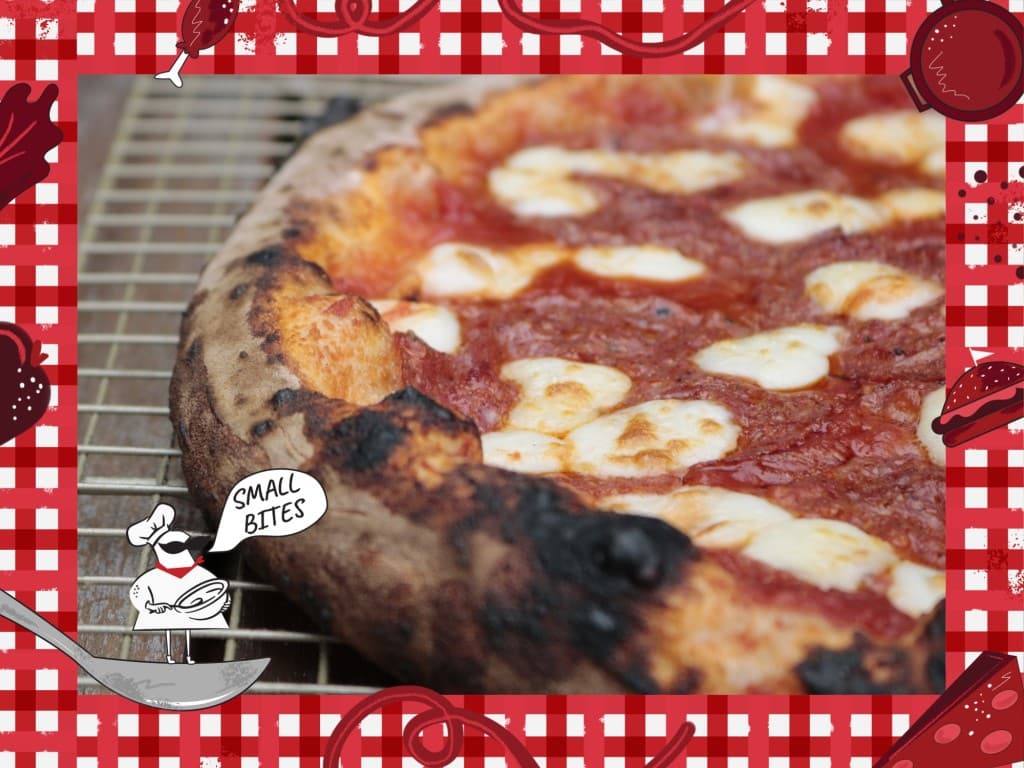
Squaring one man’s obsession with regional pizza styles against all social odds.
Squaring one man’s obsession with regional pizza styles against all social odds.

This is our newsletter-first column, Microtones. It runs on the site on Fridays, but you can get it in your inbox on Thursdays by signing up for our email newsletter.
“Small Bites” is about exploring the broader world of food and drink in Madison through approachable and specific experiences.
In our living room, my partner and I only have a handful of framed art pieces up on the wall. There’s a drawing of our dog; a watercolor of our first place together, featuring our dog on the front steps; a family portrait of our butts (including our dog’s) by Rachal Duggan; and two framed prints of classic Chicago-area tavern-style pizza restaurants. I’m not sure why the two vintage thin-crust joints felt family-level important, but there they are mounted above the couch all the same.
The tavern portraits came up in conversation the other day when friends were over. But what began as an innocent question about art on our walls quickly devolved into pedantic nonsense about delineations of regional pizza styles. The pedantic nonsense, of course, was entirely a monologue from me as our guests reached for another slice from the Salvatore’s box on our coffee table. Everyone politely nodded along while I attempted to break down how there were actually three versions of deep-dish pizza unique to Chicago, but it was clear that no one really cared. For most people, talking about pizza styles is part of a conversation when deciding which pizza to order. For most people, the point of the conversation is moot if there’s actual pizza already in the room with you. For me, well, obsessions with categorization can be a problem.
I contend that being able to identify the unique signifiers of pizza varieties is important for a functional society. One of my favorite things is being a repository of dining information. Tell me you’re travelling to Minneapolis for the weekend, and I’ll tell you to get the curry beef at Hai Hai. Headed to Osaka on vacation? I know a killer okonomiyaki spot in a residential alley. If you’re ever in Borgo, Italy, I can help you find a place to get a horse steak (La Quadratura also serves an excellent potato tortelloni in wild boar ragú if you’re not up for horse). For me, it’s a great joy to help people find exactly what they’re looking to eat—a big motivating factor for writing this column. What if a gas station rotisserie chicken sandwich could change your life?
Pizza is a problem, however. People’s concept of pizza is defined by regional styles, and each pizza outlet often prides itself on its specific take on that style. Take tavern pizza in Chicago, for example. Once a bar snack trotted out to keep beer drinkers glued to their stools, tavern pizza has become a true signifier of Chicago’s foodstuffs. When recipe maven J. Kenji Lopez-Alt wanted to develop a recipe for the New York Times Cooking section, he spent five months researching tavern-style pizza. Lopez-Alt hit local classics like Vito and Nick’s (featured on our living room wall) along with newcomers like the charity-focused, back-alley secret spot Crust Fund Pizza.
The hallmarks are always the same: cracker-style crust, party cut into little squares, and often topped with sausage. Each spot, however, has its minor tweaks to the formula. Grab a tavern-style pie from a chain in the suburbs, and you might find a slightly doughier crust with a heavier hand doling out the cheese. Stop by a classic spot in the city, and you’ll get well-done cheese browning with an impossibly crispy and cracker-like bottom. Telling someone, “Oh, if you’re heading to Chicago, try some tavern-style pizza” is insufficient. Identifying which style of tavern pizza that person is after is just as tantamount.
There’s a trade-off for all of this, of course. Being great at telling you exactly where to grab dinner also means I can be a drag at social gatherings. Yes, it’s important to me that people understand the difference between Chicago deep-dish pizza, Chicago stuffed pizza, and Chicago pan pizza. But for most people, that distinction isn’t worth bringing a jovial conversation to a screeching halt just to make the clarification. Still, I can’t help but feel compelled to point out that calling Pequod’s Chicago’s “best deep-dish pizza” is a misnomer, even if Pequod’s describes itself as “deep-dish pizza.”
For one, Pequod’s uses a fluffy, focaccia-style dough that is pressed into a cast iron pan instead of the buttery short crust you see at places like Giordano’s or Pizzeria Uno. Pequod’s also features a cheese ring pressed into the corner where the dough meets the pan, creating a halo of caramelized cheese that punches up every bite of the crust. But also: Who cares? This information about Chicago pizza specifics isn’t highly applicable to a group of four sitting in a living room in Madison, Wisconsin.
The reality is that Madison doesn’t really need its pizza cataloged as thoroughly as Chicago does. There’s no real “Madison-style” pizza that people are continuously trying to iterate on. Instead, Madison’s pizza offerings are diverse, and—I’ll come out and say it—excellent. The aforementioned Salvatore’s delivers something between New York- and New Haven-style crust with distinctly culinary specialty pies. State Street stalwart Ian’s Pizza brings a certain Midwestern flair to its slice joint offerings. And Greenbush Bar stays true to its party-cut tavern style that’s been on the menu since the early 1990s. You can also get nationally recognized Neapolitan-style pizza from Novanta and Pizza Brutta, or a slightly more modern wood-fired pie from It’s Good For You.
It’s harrowing to write 1,000 words only to land on some version of, “Hey—pizza’s pretty good, you know.” And yet, here we are. It’s a tough sentiment to argue with. Pizza is pretty good, you know. It captures all the flavors you could possibly ask for—complex fermentation from the dough, tangy and lightly sweet punchy notes from the tomato sauce, rich fattiness, and deep caramelization from the cheese. Great pizza showcases mastery of technique that takes humble ingredients and turns them into a true crowd-pleasing masterpiece. It’s hard to think of any other dish that chefs obsess over that can also be found littering college dorm rooms on a two-for-$20 deal. Maybe that helps justify my obsession; maybe that explains the pizzeria prints on my living room wall. And maybe, if I can make my case well enough in the room, I might also find some converts ready to lose their mind about pizza the way I have.
We can publish more
“only on Tone Madison” stories —
but only with your support.
Author

Related Articles
Small Bites: How much garlic is too much garlic?
With “double the garlic” dominating social media, it’s time to reevaluate your recipes.
Small Bites: To make it through the fall, roast your vegetables
A low-effort guide to bringing maximum flavor to your table when seasonal produce is limited.
Small Bites: How to make a cheeseboard
An informative guide to an affordable luxury while ICE terrorizes the United States.