
Roller derby’s beautiful radicalism
The subculture’s diversity, gender-inclusion, and democratic system offers a vision of the world we could live in.
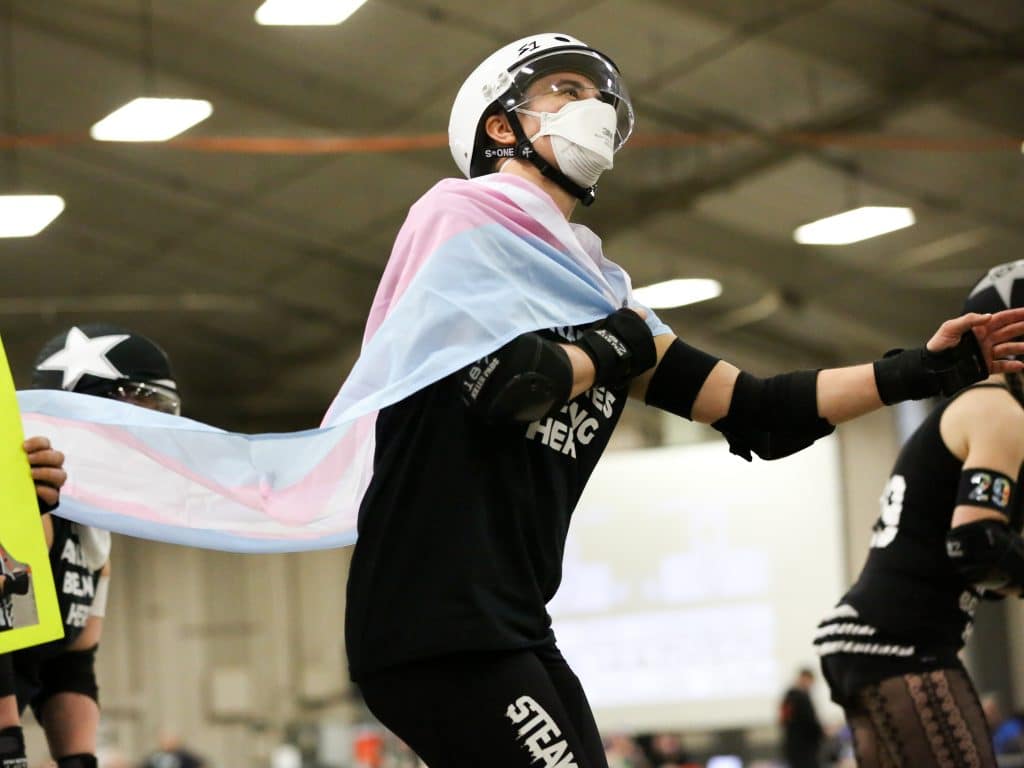
The subculture’s diversity, gender-inclusion, and democratic system offers a vision of the world we could live in.

This is our newsletter-first column, Microtones. It runs on the site on Fridays, but you can get it in your inbox on Thursdays by signing up for our email newsletter.
It’s a weird time to be a trans athlete. It’s a great time to be a trans athlete.
We’re out here just trying to play our games and suddenly a whole lot of people are obsessed with our very existence—all 1% of the population—and the alleged threat we pose to “fairness in sports.”
Thing is, if you’ve spent any time actually participating in sports, you know that there are a hundred other variables that impact how people and teams perform: How much money do you have access to? What kinds of facilities and equipment and training? Were you born with a super long torso and almost no lactic acid build-up? Do you live in a society that heavily prioritizes and funds one group over the other in basically everything, including sports?
All of these factors and more impact performance and “fairness,” but you won’t see the anti-trans crusaders out fighting for equal pay for women or meaningful protections against sexual assault. They’re too busy passing rules that allow them to inspect the genitals of children, police what are and aren’t “acceptable” ways to be a man or woman, and ban people from accessing life-saving care.
Meanwhile, I’ve been playing a full-contact sport alongside and against people of various genders and abilities for the past 12 years. And you know what? It’s freakin’ great. I’ve won against a team of all cisgender men while playing with a team of all cisgender women (and my non-binary ass). I’ve out-skated transgender women. I’ve been out-skated by transgender women and non-binary people. It’s FINE. It’s called sports! Everyone has to work hard and train to be any good at this thing we do on rollerskates, just like any other sport. No one walks in with a certain amount of a particular hormone in their system or certain set of chromosomes and just starts dominating everyone else. That’s not how any of this works!
Thankfully, despite some notable and terrible exceptions, roller derby has been at the forefront of trans and queer inclusion almost since its modern inception in 2000. Queer and trans people have been involved in creating and building the sport all along the way. In fact, I credit my exposure to the very concept of being non-binary to people met through roller derby. The first person I knew who used they/them pronouns was a (fantastic) skater from Ohio who went by the name “The Smacktivist.” The first trans women I got to really know and befriend were fellow skaters here in Madison. One of those women, Umm Kaboom, helped push me and the rest of Madison Roller Derby to write and then implement a radically gender-inclusive policy in 2014, before even our sports’ organizing body passed their own. It was in working on that policy, and having the sometimes-difficult conversations with other league members to help people understand its importance, that helped me really examine and come to terms with my own gender identity.
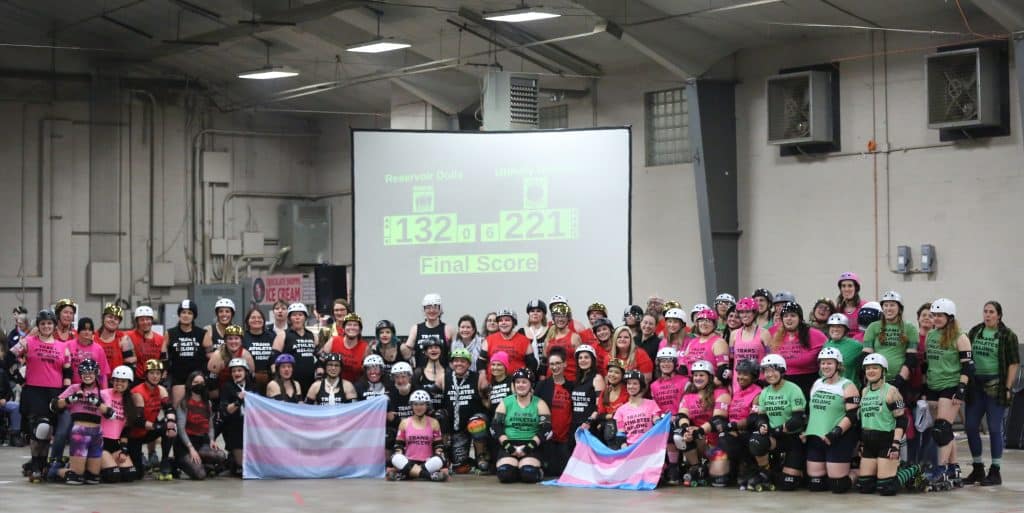
In essence, roller derby is a community that created a sport for itself. It was the freaks and weirdos and divorcees and punks and queers who were looking for a fun way to express themselves, build a home, and kick some ass. Roller derby has all the same problems as the societies in which it exists (now 400+ leagues on six continents). The sport and the people who make it can be messy, complicated, frustrating, and even damaging, like everywhere else. It’s also, despite all the challenges, one of the most radically inclusive spaces I’ve ever been in.
For a nerdy jock kid who loved sports but never felt like they fit in anywhere–and who was sometimes actively discriminated against, yelled at, disbelieved, etc. by grown-ass adults–being part of roller derby has been a revelation and a relief.
Like many subcultures, roller derby offers people the opportunity to dream, create, and then live in a version of the world we actually want, beyond what’s offered elsewhere. It’s almost entirely volunteer-run and grassroots. Everyone has to pitch in some amount of work to make it happen at all. You’re actively encouraged to have ideas and then run with them. We created and continue to update the rules of the game and the governance of the sport via a democratic process. Like I said, it gets messy, but it’s beautiful. There are no corporate overlords, no billionaire owners. We run our own international tournaments. We build our own businesses that, in turn, become sponsors. We’ve created our own damn ecosystem, and within that ecosystem, “diversity and inclusion” not only aren’t dirty words, they’re our guiding ethos. It’s what makes roller derby tick (and if you want to hear me talk more about it, I was a guest on WORT’s “Queery” last week to discuss this very topic alongside my teammate, Barb E. Bus).
I’ve been exceedingly lucky to be part of Madison Roller Derby, which was one of the first leagues in the world to form, back in 2004, and has one of the most robust and weirdly stable presences in all of Derbyland. It’s given me the opportunity to build skills that I’ve literally put onto resumes that landed me jobs (including the one I have now). It’s allowed me to travel across the country and the world, and meet and befriend a wide array of people I would have otherwise never met. People who represent the full spectrum of age range, gender identity, race, class, ability, neurodivergence, and more.
It’s helped me see possibilities for myself and for the world that I might never have otherwise encountered. And really, I think that’s what scares the shit out of the people trying to take away our right to exist, and to play. All that possibility, all that face-to-face time with people different than us, living in different ways, threatens the precious, fragile, shallow status quo currently benefiting a tiny, scared minority desperate to cling to power.
You don’t have to be trans or queer to benefit from the expansive possibilities created and exposed by queer and trans people’s very existence. You don’t have to join roller derby to benefit from the world-building we’re doing there. But I recommend it.
Who has power in Madison,
and what are they doing with it?
Help us create fiercely independent politics coverage that tracks power and policy.
Author
Related Articles
The meanings of Tone Madison
Current and former editors reflect on the publication’s life and legacy.
Tone Madison is saying goodbye
We are sad, but grateful too.

Police surveillance technology needs proper accountability
Grassroots resistance against Flock cameras are writing the blueprint for comprehensive reform.