
As Trump takes the Act 10 playbook national, Wisconsin workers have lessons to share
The state’s unions look back on the past 14 years from a place of both promise and great danger.

The state’s unions look back on the past 14 years from a place of both promise and great danger.
Workers for the federal government and private employers are entering into the nightmare many Wisconsinites have been living since 2011, when then-Gov. Scott Walker and his fellow Republicans in the state Legislature effectively ended collective bargaining rights.
While many Democrats have shown little resolve to resist an onslaught of anti-worker proposals at the state and federal levels, Badger State unions are showing that you can achieve meaningful victories despite the greatest of headwinds.
Wisconsinites are preparing for an election on April 1 in which the liberal-conservative balance of the Wisconsin Supreme Court is on the ballot. SCOWIS has stated it would hear arguments in a lawsuit that may finally shred some of the most reviled portions of Act 10. The Walker law effectively banned public-sector collective bargaining and was responsible for a dramatic erosion of union membership. Walker and the Legislature followed up with a similar blow to the state’s private-sector unions in 2015 by enacting a “right-to-work” law.
Wisconsin’s labor movement is split between organizations that stand at the precipice of winning back rights withheld from them for over a decade, and others that could lose everything at the hands of the world’s richest man. Yet, these two camps remain united in what they see as a common struggle for the liberation of the working class.
On the one hand, workers are invigorated. Dane County Circuit Court Judge Jacob Frost recently struck down dozens of Act 10 provisions. The decision is stayed pending appeal, but it is a promising step.
On the other hand, unions are staring down the barrel of policies enacted by President Donald Trump that eviscerate workers’ rights—attacks from which it could take years to recover.
Ben Gruber, like many other union leaders Tone Madison spoke with for this story, is quick to link the two into a single struggle.
On Saturday, March 22, he delivered a speech in front of more than 100 people outside of Madison’s Labor Temple on South Park Street. The event was billed as a rally in support of federal workers facing layoffs at the hands of Elon Musk and President Donald Trump. But Act 10 loomed over the proceedings.
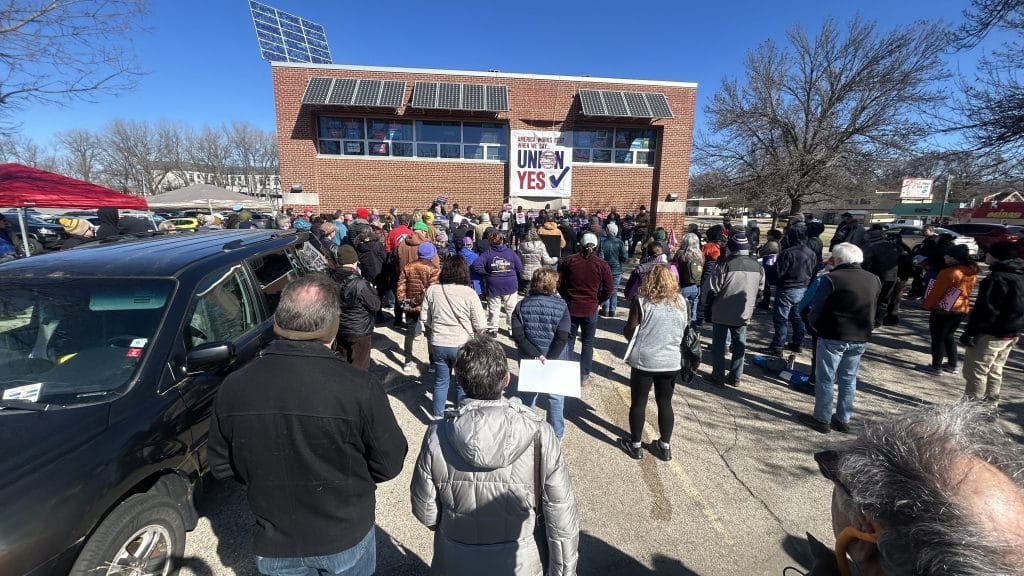
After speeches, those in attendance spread out across Madison to canvas for Judge Susan Crawford, the progressive-backed candidate in the April 1 state Supreme Court election.
With the court narrowly split between liberals and conservative-aligned judges, the winner of the election could very well sway how the current lawsuit challenging Act 10 fares in the appeals process.
“In 2011, workers watched as a billionaire-backed politician attacked the working class of this state,” Gruber told the crowd. He is the president of AFSCME local 1215, representing wardens in the Wisconsin Department of Natural Resources.
“We wondered why,” Gruber continued, with a bit of sly sarcasm. “Now we know, Act 10 was the test run for Project 2025.”
Of course, Gruber and anyone else paying attention in 2011 understood Walker’s motives at the time. But Gruber’s phrasing underscored a reality: the brutal assault on Wisconsin workers of 14 years ago has gone national.
By the tens of thousands, workers are losing their jobs or the workplace protections on which they once counted. Some have had their collective bargaining rights illegally stripped.
The nation’s arbiter of workplace disputes—the National Labor Relations Board (NLRB)—has set a business-friendly course, after a brief revival of pro-worker activity during President Joe Biden’s administration. For a time, Trump rendered it unable to carry out its most basic functions. After Trump fired Democratic board member Gwynn Wilcox, the NLRB did not have the quorum required to adjudicate workplace disputes or certify union elections. A federal circuit court judge restored Wilcox to the board, but on Friday, an appeals court ruled Trump has the power to fire Wilcox.
But Wisconsin offers a model for how to recover: fight back, dream big, and deliver meaningful victories. It’s up to national union and political leaders to learn the lessons of Wisconsin, or suffer the consequences.
The consequences
“This right here says it all,” Rick Roeth said, brandishing a red sign with white letters that read “STOP THE BILLIONAIRE TAKEOVER.”
Roeth spoke a few minutes after Gruber at the March 22 rally. Elon Musk and his Department of Government Efficiency featured as the event’s main antagonists. Musk-linked groups have spent millions of dollars on the state Supreme Court race, backing conservative-aligned Judge Brad Schimel. Musk is also handing out million-dollar bribes to Wisconsin voters who sign a specious “Petition in Opposition to Activist Judges.”
Roeth is a business agent with Teamsters Local 120. The union represents many different groups of workers, including Madison and Janesville public-transit bus drivers. The local boasts itself as the largest Teamsters outpost in the nation.
But even the largest unions have suffered catastrophic damage from Act 10.
“Our area in Wisconsin, before Act 10, had over 6,000 members,” Roeth said in his speech. “Our Wisconsin area now: 3,500, [a] direct result of Act 10.”
Last year, the Teamsters International declined to endorse a candidate in the presidential election despite the Biden-Harris administration saving the union’s pension through a $36 billion cash infusion.
The Teamsters’ president, Sean O’Brien, delivered a speech at last summer’s Republican National Convention in Milwaukee. He called Trump a “tough S-O-B” and praised many individual Republicans. His pleas for Republicans to embrace policies that help working people drew a tepid response.
Teamsters leadership still allowed the union’s individual district councils to endorse candidates. Both of the bodies representing the vast majority of Wisconsin Teamsters, including Local 120, quickly backed former Vice President Kamala Harris. District council leaders at the time told me they recognized that Republicans, for all their bluster, fail to deliver for workers.
The Service Employees International Union (SEIU) has gone through its own political realignment and membership declines in Wisconsin. But where the Teamsters have elected to follow a road that further fractured the labor movement, SEIU has sought to build coalitions.
This past January, SEIU rejoined the AFL-CIO, the nation’s largest labor federation.
In 2022, the AFL-CIO set itself the anemic goal of organizing 1 million more workers across its 63 member unions over the next 10 years. SEIU, by contrast, committed in 2024 to adding 1 million new members itself by 2030. The move would reverse trends in the Badger State.
In the years after Act 10, Wisconsin’s four SEIU locals fused into a single entity covering workers from La Crosse to Milwaukee.
According to SEIU Wisconsin President Pat Raes, membership in the union declined from around 15,000 when Act 10 became law to approximately 5,000. The declines made the merger a necessity.
But SEIU Wisconsin is showing renewed vigor. In response to SEIU’s organizing goal, the local is attempting several large new organizing campaigns, including of nurses at UW Health and a mix of staff at Group Health Cooperative in the Madison area.
The campaigns are some of the most ambitious in the state and could yield real membership gains at a time when the share of jobs represented by unions has only declined nationally.
The lesson from Wisconsin is clear: new organizing has to be far more aggressive in the wake of anti-worker policy. Anything less invites a long slow decline.
New organizing
Despite the wounds Act 10 inflicted, public-sector unions continue to fight for the future of the workers they represent.
Gruber’s union representing DNR wardens has seen explosive growth in the last couple of years. What began as a group of six wardens has surged by 1,500% over the last two years to represent well over 100 people.
“Why did it grow?” Gruber asks the question rhetorically. “Because they told us to sit down and we stood up. Stand up. Force power to respond, and overextend and show their weakness. Plant the seeds of change. A single act of defiance empowers the next. Today’s resistance becomes tomorrow’s movement.”
The union’s work has helped draw attention to workplace issues for women. A November 2023 story in the Milwaukee Journal Sentinel found what one former warden called a “terrible, toxic culture” within the profession. Gruber sees restoring collective bargaining as a way to force systemic change within the DNR.
The Teaching Assistants Association (TAA) on UW-Madison’s campus represents graduate students and has enjoyed remarkable success in its recent organizing campaigns.
After more than a decade of inaction, TAA launched a pressure campaign and petition effort in early 2023 to extend paid parental leave to graduate students. Last spring, the Universities of Wisconsin acquiesced and granted the policy to UW-Madison grad students, while excluding other campuses where grad students had not organized in the same way.
And now TAA is a plaintiff in the lawsuit challenging Act 10. They can count the recent Dane County circuit court decision as another victory. The group’s leaders have begun to plan for a world in which they get a final favorable ruling from the state Supreme Court.
All of this success has come despite the TAA is not a union under Wisconsin law, due to burdensome Act 10 requirements. To once again earn that status, its potential members would need to vote in favor of unionizing. As of now its membership is voluntary.
TAA has asked grad students to sign pledge cards saying that, in the event the relevant parts of Act 10 are struck down, they will commit to taking steps to supporting recertification of the union.
“I think the energy in the union is that we would be very excited to recertify if the future legal landscape looked anything like Judge Frost’s ruling,” says Bennett McIntosh, one of TAA’s co-presidents.
But overturning Act 10 will leave some unions behind, like TAA’s parent organization, AFT Wisconsin. But there are victories to be found even in these longer-term fights.
“Can’t stop”
The American Federation of Teachers (AFT) advocates for the faculty and academic staff on UW campuses. Many of its members—with the notable exception of the grad students represented by TAA—are not included under Act 10. Wisconsin’s State Employment Labor Relations Act of 1965 bestowed the right to unionize on various groups of state workers. UW-Madison faculty and academic staff were excluded. That meanseven if the courts strike down Act 10, many AFT members won’t have the right to collective bargaining.
Instead, AFT Wisconsin is pursuing what labor organizers call a “meet-and-confer” relationship with UW administrators. The process is similar to collective bargaining, but lacks an enforceable contract. Instead, it’s meant to give workers a “seat at the table” with administrators when discussing workplace issues.
Through repeated demonstration and action, AFT’s campaign for meet-and-confer earned the support of Gov. Tony Evers in 2024. But its membership continues to pressure the UW Board of Regents to back the concept.
On the afternoon of Friday, March 14, AFT-Wisconsin President Jon Shelton led members into UW-Madison’s Van Hise Hall, the home of the Board of Regents Offices, to deliver dozens of written requests for meet-and-confer.
Despite the many anti-worker policies of the Trump administration, assaults on higher education and the lack of a potential major victory on the horizon similar to the Act 10 lawsuit, Shelton is feeling more motivated to continue the fight.
“This is really about, frankly, the future of higher education in this state and public higher education in this country,” he says. “For faculty and staff at their workplaces to have a real seat at the table in how resources are being allocated, it’s going to directly determine how successful your kids are when you send them to a UW school.”
His fighting words are a far cry from the “play possum” strategy Democratic strategist James Carville advocated in the face of Trump administration cuts.
SEIU Wisconsin has refused to lay down. Of all the labor organizations I profiled for this story, it may be doing the most to fight back against the attacks on labor rights at both the state and federal level.
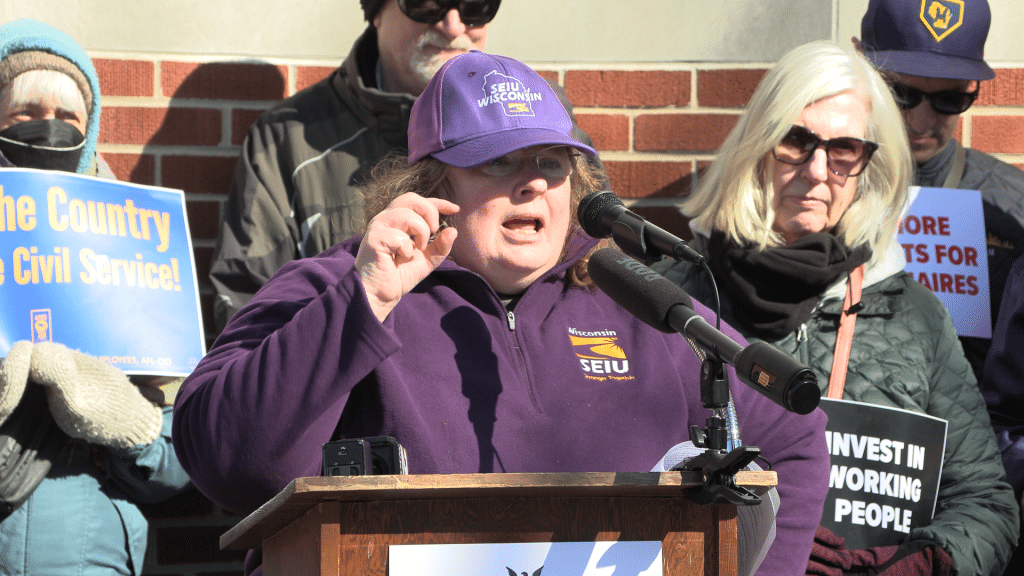
The union has organized many high-profiled demonstrations against Republican policy at multiple levels of governance. The local’s executive director, Louis Davis, told me earlier this year that its members would “knock on hundreds of thousands of doors” for Crawford ahead of the April 1 election. It is a plaintiff in the Act 10 lawsuit, and has another case fighting to represent the UW nurses before the state Supreme Court.
“You can’t stop because if we stopped, [Trump] would win,” SEIU Wisconsin President Pat Raes says. “And we can’t stop fighting for union rights, because if you look at it, it wasn’t a president that brought the unions in. It was the workers fighting for safe working conditions, eight-hour shifts, decent schedules, Kindergarten.”
The fight ahead
The American Federation of Government Employees (AFGE) represents many of the workers facing layoffs and deteriorating working conditions under the Trump administration. Its leaders are promising a fight. What that looks like remains to be seen.
Using Wisconsin as a guide, it needs to be aggressive. Strikes should not be off the table despite laws prohibiting some workers from striking. Continuing to respect rules the administration flouts is asymmetric warfare against a more powerful opponent.
In some cases, the fight could be existential, as it is for the union representing Transportation Security Administration workers. The Trump administration rescinded the union’s contract on March 7 and effectively stripped collective bargaining rights from thousands of people. Multiple outlets have also reported that the administration will no longer collect union dues.
AFGE local 777 represents TSA employees in Wisconsin and Illinois. Its president, Darrel English, helped stage two events this past month in Madison as part of a broader pressure campaign on the Trump administration.
“We’re always going to be fighting with you,” English said to other union members at one event. “And we’re not afraid to stand up, because this is the fight right here. There is no tomorrow if we don’t stand up today.”

The Department of Veterans Affairs (VA) is eyeing massive cuts, aiming to eliminate around 83,000 positions.
William Townsend is president of AFGE local 1732. The union represents Madison VA Hospital workers.
“Now we have an administration out here and a secretary that says ‘Oh, we’re going to cut 83,000 VA jobs,” Townsend says. “I find that a bit ironic considering that for decades, the VA has been undermanned, underfunded, and overworked.”
The response by elected officials at the federal level in response to these cuts and trampled rights has failed to meet the moment.
Sen. Chuck Schumer, the Democratic minority leader, voted along with several of his colleagues to usher through a Republican championed continuing resolution to fund the government. He gained no concessions for federal workers or labor rights in the process.
This came after blustery promises from Schumer to fight. He and other congressional Democrats even staged a press conference during which they chanted “We will win!”
Wisconsin’s Democratic elected representatives are doing better than Schumer, though that’s a low bar to clear. Sen. Tammy Baldwin voted against the continuing resolution.
“In the first few months of the Trump administration, we’ve seen attack after attack on federal employees,” Baldwin said in a statement responding to the TSA contract rescission. “Instead of lowering costs for families across the state, we’re seeing mass firings of public servants who do the unseen work that keeps people safe and makes our community work—all to make room in the budget for tax breaks for billionaires.”
On the Republican side, Rep. Derrick Van Orden, hailing from the 3rd Congressional District along Wisconsin’s western edge, promised personal retaliation against a fired VA worker.
Tony Ruiz, a veteran who was laid off from his job at the VA in Los Angeles in February, reached out to Van Orden through a direct message on LinkedIn because of the congressman’s position on the House Veterans Affairs Committee.
Ruiz shared screenshots of the interaction with me.
Van Orden, apparently unaware that Ruiz had been fired, but able to see his employment history listed on LinkedIn, responded threatening to turn in Ruiz to the Department of Government Efficiency (DOGE).
“I have absolutely no say in the employment status of any individual in the executive branch, however I will be referring you to DOGE as it seems that at 13:46 on a Monday you should have been working for veterans, not posting trash about your boss, President Trump,” Van Orden wrote. “There needs to be accountability.”
NEW: In a Saturday morning message on LinkedIn, WI GOP Rep. Derrick Van Orden threatened retaliation against a former VA employee for messaging the congressman about federal government cuts during normal business hours. pic.twitter.com/HT4uGwMYjG
— JT Cestkowski (@JTCestkowski) March 2, 2025
Rep. Mark Pocan, the Democrat representing Madison and the 2nd Congressional District, has sought to pressure Van Orden. But in doing so he’s had to deal with some heat himself.
At a town hall in Belmont on March 8, Pocan sought to draw attention to Van Orden’s support for the Trump administration. But in doing so, he had to field questions from a packed room that included some progressives dissatisfied with the amount of fight shown thus far by Democratic congressional leaders.

“I think the Democratic response has not been as strong as many people would like to have,” Pocan said in response to a particularly pointed question about the lack of coherent Democratic messaging. The answer drew applause from the room.
In an interview with me after the event, Pocan said Democrats are doing as much as they can given their position in the minority.
Two weeks later, Pocan was speaking at the Madison Labor Temple anti-billionaire rally alongside Gruber, Raes, Townsend, English, and other labor leaders railing against the attacks on federal workers.
“And all of these cuts are about a transfer of wealth, stealing from the middle class and those aspiring to be in the middle class,” Pocan said. “And giving a 4.5 trillion dollar tax cut to Donald Trump and Elon Musk.”
Who has power in Madison,
and what are they doing with it?
Help us create fiercely independent politics coverage that tracks power and policy.
Author

Related Articles

Wisconsin communities face scrutiny over data center secrecy
The town of Beloit is the fifth Wisconsin community with an NDA for a possible data center.
Eyeing voting rights, liberals aim to secure Wisconsin Supreme Court through 2030
In the April election, Wisconsin liberals are hoping to expand their majority on a body that could be a critical backstop for voting rights during the next presidential race.

Police surveillance technology needs proper accountability
Grassroots resistance against Flock cameras are writing the blueprint for comprehensive reform.