
Our attorney and UWPD’s argue about body cams
Sort of, as “Tone Magazine” navigates Wisconsin’s new law hindering access to body-camera footage.

Sort of, as “Tone Magazine” navigates Wisconsin’s new law hindering access to body-camera footage.

This is our newsletter-first column, Microtones. It runs on the site on Fridays, but you can get it in your inbox on Thursdays by signing up for our email newsletter.
Back in June, we reported on a new Wisconsin law, Act 253, that allows police agencies to charge records requesters for the cost of redacting audio and video materials. The UW-Madison Police Department had already begun taking advantage of the law. When Tone Madison filed an open-records request for body camera footage of the May 1 crackdown on the UW-Madison pro-Palestinian encampment, UWPD invoked Act 253 to claim that we’d be liable for redaction fees, and threatened a reporter with a punitive fine of $10,000.
Open-records attorney Tom Kamenick, of the Wisconsin Transparency Project, responded to UWPD on our behalf in a September 11, 2024 legal memo to the department’s records custodians. You can read the whole thing in PDF form here. The 11-page document argues that UWPD’s interpretation of the new law is faulty. More broadly, it details how starkly Act 253 conflicts with the broader body of Wisconsin open-records law. Kamenick’s memo offers the most thorough examination of Act 253 to date. No one has yet considered the law this closely and carefully—especially not the Wisconsin legislators and law-enforcement lobbyists who supported the bill. Plus, Kamenick knows Wisconsin open-records law better than just about anyone.
We aren’t launching into a fully-fledged lawsuit against UWPD at the moment. Our goal is to get UWPD, or really UW-Madison’s Office of Legal Affairs (OLA), to explain in detail how and why it is interpreting this novel and broadly-worded law. So far, we’re not getting anywhere. Kendra Maier, an attorney with OLA, replied to Kamenick on Tuesday with a brief email:
Dear Mr. Kamenick,
The UW-Madison Police Department forwarded your letter regarding Tone Magazine’s [sic] request for body camera footage from two campus locations on May 1, 2024. My office has reviewed the letter and discussed the records with UWPD leadership, who have confirmed based on preliminary review that certain redactions would be necessary to fulfill the request as it was initially made. Our interpretation of the new legislation is that it permits a law enforcement agency to impose a fee for redactions under this circumstance. Accordingly, the UWPD will require a pre-payment of the estimated redaction fees before the records can be released.
I believe at one point in UWPD’s communications with Tone Magazine there was brief discussion about narrowing the scope of the request, which they would be happy to assist with. Alternatively, Tone Magazine may wish to request footage from the permanent university cameras located in the area during the same time frame. UWPD has indicated that it would not charge a redaction fee for those video records.
Sincerely,
Kendra
This tells us that UWPD isn’t changing its stance. But it doesn’t tell us why. It doesn’t address any of the specific points Kamenick made in his initial memo. So, we still have no insight into the actual legal reasoning behind UWPD’s implementation of Act 253. We don’t take issue with the idea of narrowing the request. That’s a pretty routine and reasonable thing that comes up in the back-and-forth of the open-records process. The problem is that, at this point, we’d be moving forward on very uncertain legal ground. Maier’s email also doesn’t explain why UWPD would treat footage from campus surveillance cameras differently than body-cam footage. UWPD controls the cameras installed in various fixed locations around campus; the footage they create would fall under the scope of Act 253 as well.
Non-answers and people calling this publication “Tone Magazine,” two of my favorite things. We’re still figuring out what our next steps should be.
Whatever the end result, we hope that this memo will be useful to anyone else around our state as they deal with other police departments invoking Act 253. Kamenick unpacks a number of issues that would likely come up if a records requester challenged the law in court, either to get an individual Wisconsin police agency to interpret it differently, or—ideally—to get it thrown out entirely. “Any analysis of any portion of [Wisconsin’s] Open Records Law must begin with—and constantly keep in mind—the presumption of access to government records, the command that the law must be construed liberally in favor of access, and the admonition that exceptions to access (including a denial for failure to pay a fee) must be construed narrowly,” Kamenick writes. “Any ambiguities should be resolved in favor of greater access.”
Enacted earlier this year, Wisconsin Act 253 presents many novel and disturbing departures from the accepted norms of open-records laws. When Tone Madison contributor Alice Herman filed an open records request for body camera footage, UWPD’s records custodians told us that we could be charged redaction fees under the new law. They noted that Herman could seek an exemption to the fee by claiming that she wasn’t using the material for “financial gain,” but could face a $10,000 fine if police thought that she was misrepresenting herself in that. Yes, seriously. Here’s how UWPD put it in a June 4 email:
I see that two individuals from Tone Madison are cc’d on this correspondence, so I wanted to clarify if you are affiliated as a contributor with Tone Madison, or if you are just an outside party requesting the footage? If you are an outside party requesting footage, and this will not be used for a story on a media outlet, then under this legislation, we will require you to fill out a form certifying that you would not use this footage for financial gain. By signing this, you agree to use this only for personal use. If you end up sending it to Tone Madison to use on their website or social media platforms, you will be in violation of that certification, in which you may be charged a $10,000 fine.
Anyone with even the dimmest understanding of open-records laws can see the alarming implications here for government transparency and free speech. But this is the reality that Act 253 has created. It invites police to snoop into the identity and purposes of someone requesting records—which shouldn’t matter, because public records belong to everyone, period. It invites police to threaten those people with an exorbitant fine—a punitive element that is basically unprecedented anywhere in state or federal open-records laws in this country—on the basis of “financial gain,” a term that is undefined in the law and ripe for abuse. Seriously, it has shocked every attorney and open-records advocate I’ve talked to, and these are people who have seen a thing or two.
The law is also vaguely worded, which just encourages police to interpret it as capriciously as they like. (The “financial gain” part never stops being funny at a small publication that’s always treading water, in an economically devastated media landscape. Anyways.) It hasn’t been tested in the courts. Wisconsin’s borderline-useless Democratic Attorney General, Josh Kaul, has not issued any guidance on how local governments should interpret and apply the law.
It’s important to seek as many legal guardrails as we can around Act 253, because its use is spreading. Other police agencies enforcing the law, or currently considering it, include the Brookfield Police Department, Menomonie Police Department, Washington County Sheriff Office, Beloit Police Department, Rice Lake Police Department, Wautoma Police Department, and even the La Pointe Police Department on Madeline Island. And that’s just what you can find with some cursory web searches. We haven’t had a chance to thoroughly explore the new law’s implementation around the state. As I reported in June, the Madison Police Department cannot yet enforce Act 253, because a City of Madison ordinance prohibits redaction fees at the local level. MPD Chief Shon Barnes has signaled that he’d like to change that.
We’re able to pursue this thanks to some crucial donations from Tone Madison readers. In late July, we sent out a fundraising appeal to our email list, seeking to raise $500 to pay Kamenick a flat fee for his services. (Not pro bono, but a bargain for the amount of work he’s put in. And worth it to support Kamenick’s dogged efforts to fight for transparency and accountability in general, which benefits Wisconsinites everywhere.) As we explained then, we don’t usually budget money for this sort of thing. Larger news organizations will often sic their lawyers on government agencies in open-records disputes, but we don’t have their resources. Setting aside $500 for an extra expense is something we really have to think carefully about.
Our readers came through swiftly and generously, putting us past our goal in just a few days. A massive thanks to everyone who contributed—we always say we can’t do this without you because we literally can’t. This is a journalist-owned, reader-supported publication. Donations from readers are the main reason we have money in the bank from month to month.
If you want more detail about Tone Madison‘s weird ordeal with UWPD and Act 253 specifically, catch up with the July 15 piece in which Herman and I discuss everything that’s absurd and perverse about the whole situation. For one thing, police around the country asked for body cameras. They’ve drummed up millions in federal, state, and municipal funding to buy cameras and software from companies like Motorola and Axon. (Axon used to be named TASER International, but sometimes you have to rebrand when your namesake product kills people.) Police have claimed over and over again that body cameras would make policing more transparent and accountable. Now that members of the public and media are asking for the resulting footage, cops are pleading poverty. Act 253 attempts to make individual records requestors pay for a problem that police have already spent vast public sums to create.
Getting the footage, with or without fees, is one thing. The bigger issue is finding out whether UWPD, or any other law-enforcement agency in the state, can really back up its interpretation of this new law. Even the Wisconsin Chiefs of Police Association, which lobbied in favor of the bill, notes in a celebratory memo from two of its attorneys that “Act 253 contains several ambiguities.” Good grief—this thing was practically written by and for cops and their lawyers. If it’s ambiguous, it’s either because police want it that way, or because everyone who supported this bill is astoundingly lazy. If they really want to create new barriers to transparency, they’re going to have to work harder than that.
Who has power in Madison,
and what are they doing with it?
Help us create fiercely independent politics coverage that tracks power and policy.
Author

Related Articles
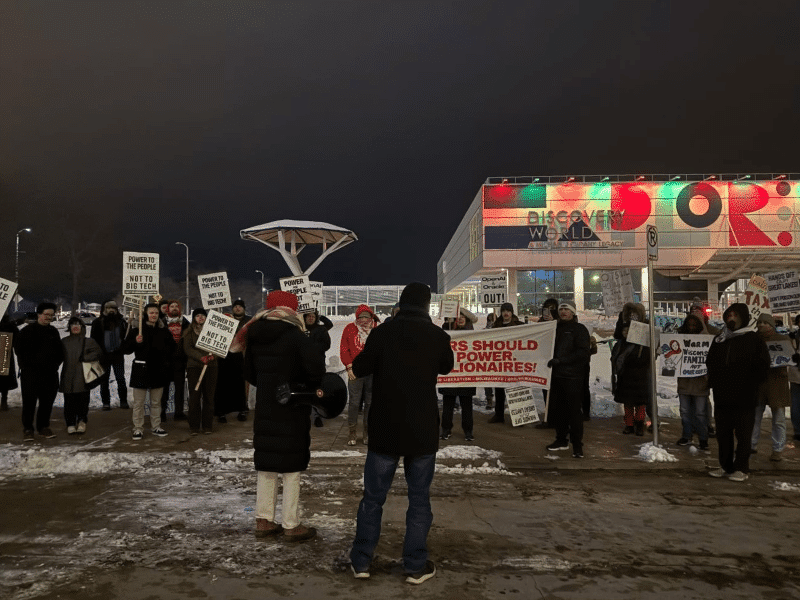
Opting out of the tech-backed AI inevitability narrative
As data centers set their sights on harvesting Wisconsin’s human and natural resources, refusal and resistance starts locally.

Movie tee envy
Pondering a shirt collection, and stumbling upon Cosmic Cabin, which has the goods—at least niche ones for cinephiles.

Tone Madison Presents: MAMA New Artist Listening Room
Join us on Saturday, November 29, at Harmony Bar & Grill for a night of live music from emerging Madison artists.