
Meet the neighbors, greet the worms, and make friends in “Garage Sale”
Developer Amelia Zollner talks with us about her wholesome but unpredictable video game.
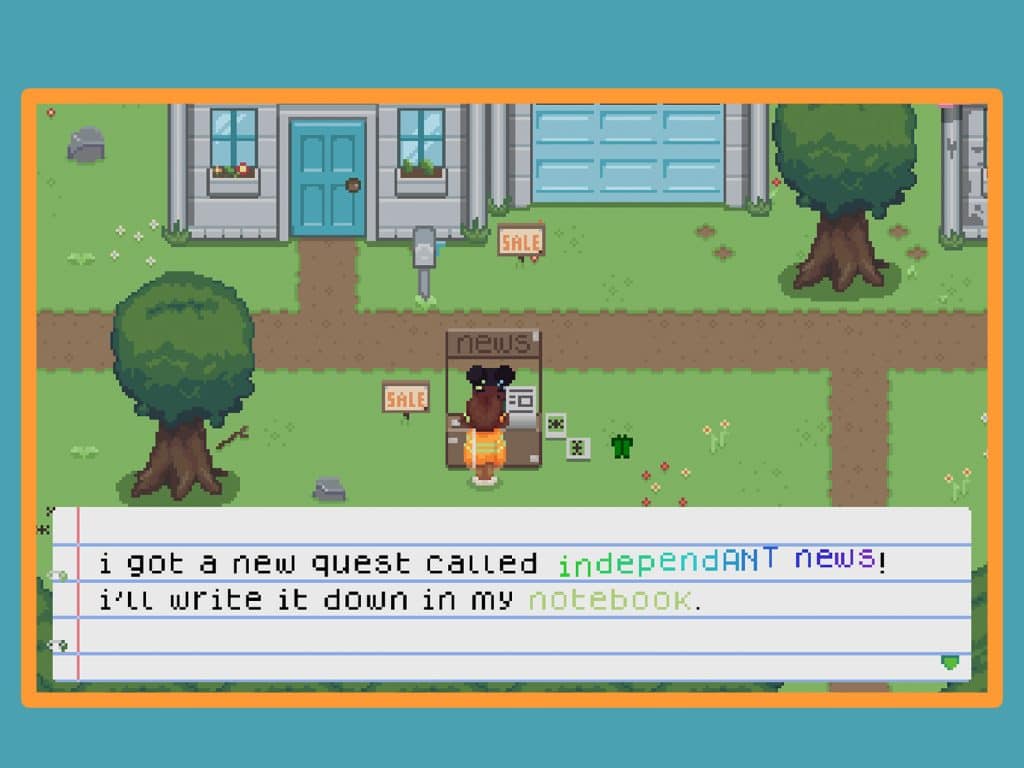
Developer Amelia Zollner talks with us about her wholesome but unpredictable video game.
NOTE: Portions of the interview below contain major plot spoilers for Garage Sale. They are contained in the final section of the interview, which we’ve marked with an additional spoiler warning. If you’d like to avoid spoilers, just stop reading there.
Back in January, Madison-based journalist Amelia Zollner began recruiting people to playtest Garage Sale, her debut as a video game developer. Zollner writes about video games and music for Polygon, Rock Paper Shotgun, and a few other publications—including Tone Madison, where she’s covered the musical history of Nottingham Co-Op and a local musician’s love of video-game scores. So I was curious and volunteered. Zollner met me one Saturday at a local library branch, fired up the game on her laptop, and watched me try to figure it out. The test version of the game at that point didn’t have music or sound yet. What it did have was a richly developed story about a young girl, Juniper, navigating the small town of Lettuce Village. The short, charmingly pixelated 2D game follows Juniper as she takes on a task that’s daunting for people at any age: Go out into the world on your own, and make some friends.
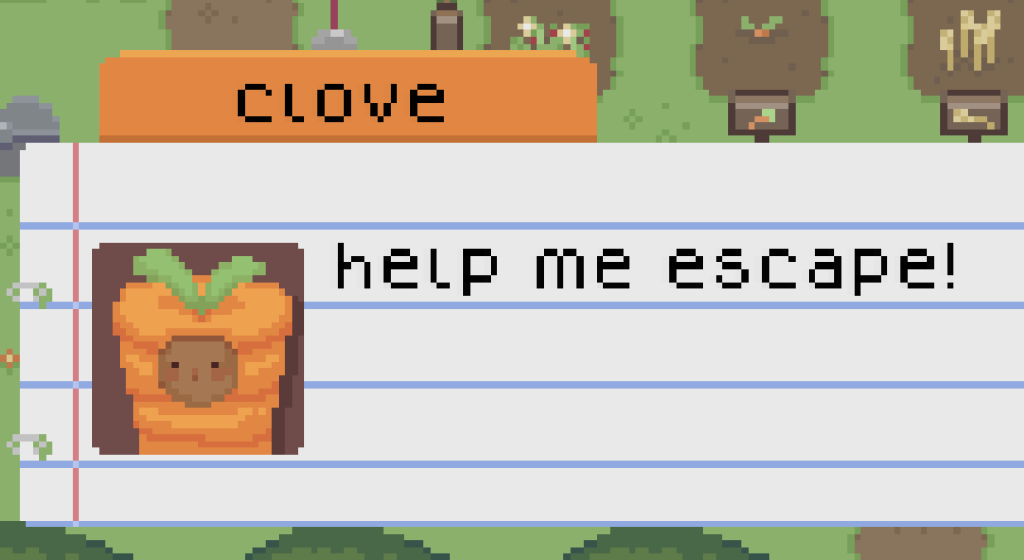
Juniper has an excuse to visit just about every house in town and meet all of her neighbors, because it’s Lettuce Village’s one big local holiday: Garage Sale Day. While most of the adults in town host garage sales, the children take center stage. Early on in the game, Juniper agrees to help another kid, Nadia, finish the latest edition of her self-published newspaper. She meets a little boy who is very unhappy about having to run his parents’ farm stand, and especially, extremely unhappy about having to wear a carrot costume while he works. As Juniper keeps exploring, she keeps picking up new quests and getting embroiled in the townsfolk’s niche interests, hopes, dreams, and low-level crises (one of which also involves carrots).
If this all sounds like the setup for a very wholesome, short role-playing game, well, that’s what Zollner was planning from the start. But Garage Sale doesn’t smother the player with wholesomeness. It finds plenty of breathing space for the personality and texture one wants in a good RPG, along with some dramatic payoff. It actually helps that most of the characters are children—the writing uses their lack of filter to create dialogue that’s as brash and opinionated as it is cute. Garage Sale has no voice acting, but uses animated text—capitals and punctuation or lack thereof, but also the pacing of lines unscrolling across the screen, and the occasional word that turns into a wiggling rainbow—to give players a strong sense of how these characters talk. That’s one of many similarities Garage Sale shares with the 2019 indie gem A Short Hike, which Zollner cites as a large influence.
Even the adult characters have shades of vulnerability and doubt that end up playing a crucial role in developing the game’s themes of community and care. In one quest, Juniper has to settle an argument between an adult couple who bicker, albeit lovingly, about the recipe for the town’s signature dish, Lettuce Village Linguine. Throughout the day, Juniper meets visitors from the sprawling metropolis of Salad City, who often tell her about their longing for a tighter-knit, less alienated community. It turns out that the various non-sentient critters and inanimate objects of Lettuce Village have a lot to say as well. (Pro tip: talk to the worms! At every opportunity!)
Zollner began planning for Garage Sale before she began studying journalism at UW-Madison, where she is currently a senior. But work on the game got going in earnest once Zollner got to campus and connected with a bunch of willing collaborators, who developed and published the game under the name Bug Burrow: Rishit Khare (lead programmer, lead composer, artist, writer), Jennifer Kim (programmer, artist), Josie Ronk (artist, writer), and Allie Carlson (writer). Caleb Haynes, of the Montana indie-pop band Hey, Ily!, contributed additional music. While Zollner is credited as the game’s director (she also contributed writing, art, and programming), she’s emphatic that this was a deeply collaborative effort. Each member of the team shows up in Lettuce Village as an NPC.
The game was released on Steam in June, for Windows PC and Mac. (It also plays pretty well on Steam Deck, the platform’s handheld gaming PC, which is what I mostly used when playing the released version of the game for this story.) Garage Sale has attracted some notice from game streamers and reviewers on Twitch and YouTube. In the local press, The Daily Cardinal, The Cap Times, and the Wisconsin State Journal have all dug thoughtfully into Garage Sale‘s creation and influences. In August, the online gaming community Wholesome Games included Garage Sale in a special discount sale. Zollner declines to share specific sales numbers, but says that “the game has sold way more copies than I expected,” and notes that the Wholesome Games sale doubled the number of people who bought it or added it to their Steam wishlists.
Zollner sat down with Tone Madison in August for a longer conversation about Garage Sale‘s themes and gameplay.
Tone Madison: To go back to a very basic point, what made you want to tell this particular story in the first place?
Amelia Zollner: It’s kind of a weird story. The summer before I went to college, I was kind of worried about going to college in general. I was also really bored, so I wanted to start a project, and I learned about this engine that runs in your browser called Bitsy. And so I was like, “Oh, I’ll just teach myself how to make a game in Bitsy and have that be my little summer project.” It was going to be about loneliness and moving to a new place and not really feeling comfortable in this new place. The garage sale event that’s taking place throughout the game was going to be the last part of the town that you see before you move away. It was going to be about, also, saying goodbye to a town.
Once I got to college, I met all these people who wanted to work on the game with me. And then, just because I felt such a strong sense of community there, the entire point of the game changed. It was shaped by the circumstances in which I made the game. It’s kind of nostalgic for me, almost, just because [when] I grew up,my family would have garage sales a lot, and I grew up loving going to thrift stores and finding little items and stuff. I wanted to make something that’s more of a celebration of community than a sad little project.
Tone Madison: When you were growing up, were you in a small town like this?
Amelia Zollner: No, I wasn’t. I grew up in the Chicago suburbs… I felt almost disconnected from my community [because] my parents are also divorced, like [Juniper’s parents]. Between the two towns I lived in, they were both very car-centric. It wasn’t really a town where I could just leave and walk around when I was 10 years old. It was more like I had to ask my parents for rides or whatever. That almost shaped it a little too, because I wanted to imagine a town that’s very walkable and has a sense of community.
Tone Madison: There’s a running theme in some of the dialogue with characters who are visiting from Salad City, and they talk about wanting something different from the disconnected, sprawl-y environment they’re used to.
Amelia Zollner: Yeah.
Tone Madison: Animated text plays a big role in this game. There’s no voice acting, so dialogue text will light up or shimmer or wiggle around to give the speaker some extra personality. How did that come about?
Amelia Zollner: I don’t know if I have a good answer for this, because it was one of the first things that we added to the game. I believe it’s just something that’s pretty much built-in with the engine—the way it displays text, it automatically has [a simple markup programming language called] BBCode, where you put these little tags around it. But I think we knew that was something we wanted from our engine. Our engine is called Godot, by the way. Our lead programmer, when we started working on the game, he showed me those effects, and I was like, “We need to have rainbow text in there. We need it to be, like, waving around and stuff.” And I’ve noticed now, the engine we used wasn’t very popular. Are you familiar with Unity and everything that went down with Unity [in late 2023 and early 2024]?
Long story short, Unity sucks now and nobody likes it, so everybody’s making the switch over to Godot, which is what we used. Now I’ve seen so many games on Twitter where people are posting little snippets, and they’re using the same text effects. And I can tell that it’s made with Godot because of the text effects.
Tone Madison: Aside from bug fixes and things like that, what kinds of things did you end up changing or thinking about after doing those rounds of playtesting?
Amelia Zollner: The hardest parts were restructuring a lot of quests to make sure that everything was clear to the player. When I would add quests, I would have hints that were kind of vague, and they made sense to me, because I designed it. But then when I watched people play the game, they would get very stuck and [say], “What does this even mean?” A big chunk of it was just going back and doing iterations on testing. I think when you tested it, [it was] closer to the end of that initial round. I think you probably played a version that was a little bit clearer. I can’t remember if you really ran into issues with quests or not.
We did a second round after that in March that was just online, and we sent out a bunch of Steam Keys and had people play the game. A lot of people during that round had a lot more specific things where they would [say], “This specific line of dialogue reads weirdly.” A lot of people thought that the [initial character design for the] doctor’s wife, Althea, [looked] like the Mind Flayer from Dungeons And Dragons [and] Baldur’s Gate 3. That was a big thing that many people said. So we had to fix that. It was a lot of little fixes like that.

Tone Madison: That was interesting to me, because I’d never gotten to playtest a game before. Since you come from this whole background of knowing a lot about video games and writing about them, I was kind of wondering what sorts of games influenced the experience that you wanted to give people in Garage Sale—even if they’re not the obvious points of reference that some people might reach for. You told me previously that A Short Hike was a big influence, and obviously people have compared Garage Sale to Stardew Valley. But were there things that influenced this that maybe weren’t what people would expect at first?
Amelia Zollner: I will say that everyone on the team had their own influences, since we all contributed to the writing and especially the art. I didn’t do a lot of the art, but I feel like we did share a lot of things, like you said, like A Short Hike [and] Stardew Valley, for sure. Personally, when I was doing the art, I didn’t really think about Stardew Valley. I think it just kind of lent itself to that style, since it’s an outdoors-y game. But I guess for me, my biggest influence was probably Undertale, which is a little bit weird because it’s not really similar in terms of gameplay or anything. I played it very late, not when the game was popular or anything like that. This was probably like five years after it came out, and it really stuck with me. I think that also kind of lent itself to Garage Sale‘s theme of community, just because that was what stuck with me from Undertale.
Also, there’s this game called Boku No Natsuyasumi, which was never published or released in English. So you have to watch these weird playthroughs that have really bad subtitles on YouTube if you want to really experience it and understand it, but it’s about this kid who’s just experiencing summer in the Japanese countryside. It’s a lot of… finding bugs, jumping across the river. None of it is serious at all, and there’s not really a goal to it. It’s just hanging out and experiencing summer. And I kind of wanted the gameplay to feel like that. Although Garage Sale did end up having more linear quests, I guess.
I did think a lot about all of the walking simulators. I know that used to be such a derogatory term in gaming, where people would call a game they hated a “walking simulator,” but I think it can be a positive term. What Remains Of Edith Finch is super cool. The gameplay is literally just walking. I guess Firewatch is kind of one of those too.
Right at the very beginning, when Garage Sale was a prototype in Bitsy, [one of my big influences was] one of the older Animal Crossing games, Wild World. There was this mechanic where they would have a flea market day, and you could just go into your villagers’ houses and just take their furniture, [and] they wouldn’t really care about it or anything. It always made me kind of sad. I was like, “I feel bad taking your furniture like you’re not attached to it or anything.” Growing up, I played this game a lot, and I always thought about, what if their furniture had a backstory? What if they’re attached to it and they don’t want to let go of it? Or what if they’re getting rid of it because they don’t want it in their house anymore because it’s attached to bad memories or whatever? I always thought it would be interesting to flesh that out more. That was the main inspiration. I just don’t think about that as much now, because I feel like it shifted into something different.
Tone Madison: Garage Sale isn’t a long RPG with sprawling dialogue trees, but it seems like in the writing, it was important to get a sense of every character having a story and opinions about things. It has the texture and little hints of character building that people seek out in an RPG. Was it a challenge to strike that balance within the framework of a shorter game?
Amelia Zollner: The biggest challenge with that was giving personalities to the NPCs who aren’t necessarily involved in quests, or just play a very small step where you just talk to them once. Because then they don’t have a character arc. A lot of those characters, I think, during playtesting, especially, people were like, “They’re boring.” [The playtesters] just didn’t like them at all. After playtests, we would go back and revisit certain characters and think, “What kind of quirks can we give them?” I do feel like it might have made the game feel a little repetitive to a point where everybody has some really intense interest—people are just very passionate about things. But also, I feel like what we wanted to go for, in the sense that Lettuce Village is a very supportive town and everyone can do the things they care about and no one’s really going to judge them for it. Maybe a few people will be a little judge-y, but not in a serious way. It felt more natural to do that [character development] through quests, because you would naturally learn about the characters’ struggles, since you’re just helping your neighbors with things in pretty much all of the quests.
Tone Madison: One of the very first quests in the game is to go and make some friends. Whether you’re a kid or an adult, trying to make new friends in a new place or new situation can be daunting, even though the game is also very sweet about it. That’s a huge hurdle to deal with.
Amelia Zollner: Something funny that also happened during a lot of the playtests was that people would read that and be like, “Damn it, I don’t want to make friends.” People would get so mad about that. But I don’t know. It had to be a part of the game, so we couldn’t get rid of it.
Tone Madison: And Garage Sale doesn’t give you the option to play in an evil mode, or make choices that might alienate people, which you can do in a lot of RPGs.
Amelia Zollner: “Make three enemies,” right? Yeah, that’s basically what Undertale is. You’re either evil or good. That’s the whole point. So we couldn’t also do that.
Tone Madison: The way that you are portraying childhood in this game feels like a very important thing. I’m not sure exactly how old Juniper is supposed to be, but it is very true to childhood, in that the kids in the game are very wrapped up in their own concerns. But they’re also aware of these adult things around them that they shouldn’t necessarily have to think about, whether it’s your parents being divorced or just, “Oh, I’m not supposed to go to the woods.” And that’s kind of scary. I was wondering about the thought process that went into creating a compelling story around mostly child characters.
Amelia Zollner: I think just wanting to create a more wholesome story naturally lent itself to having child characters. First of all, kids are not scared to say anything, ever. I used to work at —or work-slash-volunteer, it was a weird situation—I was working-ish at a preschool for a while, and I used to babysit a lot when I was younger. I feel like I’ve just been around kids who are so unintentionally mean. They will just say anything, which is so fun. [That is] part of Garage Sale. Clove and Clementine, the farmers’ kids, are so mean to each other, but they still love each other. Kids are quirky. Kids are weird. It’s fun to write quirky dialogue from their point of view.
The wholesome narrative wouldn’t work as well if it was some adult who had more of a backstory. Juniper is younger, and she’s more of a blank slate that the player can project their identity onto, because she’s kind of shy. She doesn’t have a lot of friends in town yet, even though she’s been living there. That’s another thing that would have been hard to do with an adult cast of main characters.
Tone Madison: What has it been like dealing with the online reaction to the game? I saw that there were people on Twitch who were streaming it. There was some press coverage for it locally, too. [Editor’s note: Yes, we’re a bit behind on this, aren’t we!] There were also some shitty comments that you fielded.
game development WIN! pic.twitter.com/fVnGXDuly1
— amelia! 🧙🏼 garage sale is out on steam!!! (@ameliazollner) July 7, 2024
treating this like a kickstarter. 5 more negative reviews and i'll make ms. darby teach CRT at the lettuce village school come on guys we can do it 🤗
— amelia! 🧙🏼 garage sale is out on steam!!! (@ameliazollner) July 7, 2024
Amelia Zollner: It’s been super cool. That one review that I was posting about is actually our only negative review that we’ve gotten so far. [Editor’s note: This interview took place in early August.] And to me, it’s like a positive review. I want people like that to hate this game. That’s good, to me. But yeah, it’s been super cool to see people posting guides about it on Steam, or popping into the Discord to [say] “Hey, I just played this game and I liked it.”
Tone Madison: That one negative review you’re talking about was complaining about the queer-normativeness of the game. Your response was basically that you wanted to make it more queer.
Amelia Zollner: I was joking. Every time someone is mean to the lesbian couple, turn another character gay or something.
Tone Madison: In the story that Rob Thomas wrote about Garage Sale for The Cap Times, you also mentioned that it was important to you that the game include queer characters. It’s something the game handles in a very intentional way.
Amelia Zollner: That was definitely super important to us when we were making the game. All of us come from totally different backgrounds. Our development team is a lot of people of color, a lot of queer people, people coming from all different family structures and stuff. We definitely drew on a lot of our own experiences and tried to make it as authentically diverse as we possibly could. So I’m kind of glad that that guy was mad, because that means we did our job.
Spoiler alert: The section below includes potential spoilers about the game, one of them being a very big spoiler.
Tone Madison: One thing that I ran into in my playthrough of the released version was a mystery quest I couldn’t manage to complete. Basically, you try to go into an area and some unseen character tells you to stop and says that you can’t enter until you’ve “convened with my brethren,” or something like that. I tried to figure it out and failed. I was so curious about that, because you have to almost completely stumble upon the quest by accident. Even though I didn’t manage to complete it, that added another layer of dimension to the game.
Amelia Zollner: Do you want me to just tell you what it is?
Tone Madison: Sure, yeah.
Amelia Zollner: I swore you figured this out during your playtest. For some reason I [thought so] because I knew it was there when you playtested. But anyway, the brethren are the worms hidden throughout the town, and so you have to talk to 10 worms. And then once you do, they let you into the room, and there’s—I don’t know if I want to spoil the inside of the room for you.
Tone Madison: I will totally play through it again and do that! I thought I had talked to a lot of worms in the game, but clearly it wasn’t enough.
Amelia Zollner: There are, like, two [quests] that I think a lot of people have had trouble finding. I think that’s the thing that most people have asked for help with, which is interesting. I’m not sure if I made it too hard, or if I like that there’s a little challenge in a game that’s [otherwise] pretty easy.
Tone Madison: There’s a point that I really responded to during the playtest, towards the end, when Juniper meets the founder of Lettuce Village. It takes this total atmospheric shift where I almost thought it was going to get spooky all of a sudden. And it is kind of spooky, but it ends up being mostly sweet. It’s such a dramatic payoff.
Amelia Zollner: That was super hard to do, because I didn’t necessarily want people to think the game was going to become a horror game in that moment. We wanted to portray the idea that since you’re not supposed to go into that forest, it’s especially scary for this little kid to go in on her own without knowing what’s necessarily ahead. We had to fine-tune the way the environment looked. It used to be darker, and there were weirder noises in there. I know this was after you [playtested], because you played without sound, and people were really worried that it was going to do a whole 180 and just segue into horror-game territory.
The same thing happened at the ending. This is such a random tangent, but [in some earlier versions of the game] the mom used to just pop up and be like “Juniper, come over here.” And people were like, “My mom is gonna kill me at the end of Garage Sale!” Oh, my God. No, that’s not what we’re going for! So yeah, we had to make a lot of changes. But hopefully the end result is this feeling that you’re going into a new territory that you’ve never done before, and you’re a little bit worried about it, but you can tell that it’s not going to be scary.
Tone Madison: I liked that the Founder part had me guessing for a moment. The interaction that you end up having with him is really sweet. But it is still a little bit eerie in that he’s been dead for however long and says he’s been watching Juniper all day. It doesn’t upset the balance of the game, though. I could see how it would take a lot of work to get that shift right.
Amelia Zollner: I know we had to fine-tune his dialogue specifically. This is the stupidest anecdote, but I think in the first draft, I wanted to strike this balance between [an] awkward dad, almost like Juniper’s Dad, [and an] old guy. He ended up saying a lot of stuff that was very self-aware. And then a lot of the people on our team read it once, and they described it as Marvel dialogue, which was the worst thing ever, but it was kind of true.
Tone Madison: What is next for you and the others on the Garage Sale team, as far as making games?
Amelia Zollner: Oh my god, I think up next for a lot of us is taking a break. In the end, we definitely were in crunch mode, which is something we tried to avoid as much as possible. But the way it ended up working out was [that] we pulled a few all-nighters toward the end of the process, and in March before we were getting the beta done. I think everyone is a little bit—I don’t want to say burnt out, because that’s kind of extreme—but we need a break. I would love to work with everyone again, though.
I definitely think something for me is that I want to try to do something completely on my own with a lot smaller of a scope. I never knew how to program before Garage Sale. I’d love to try to do my own little project. I’ve always said I wanted to make a fishing game. So I don’t know. I honestly don’t have a good answer. I think everyone’s still gonna hopefully make games, and hopefully we’ll get to do something again together, but I don’t think we’re going to start work on another project right away, necessarily.
We can publish more
“only on Tone Madison” stories —
but only with your support.
Author

Related Articles

Small Bites: How much garlic is too much garlic?
With “double the garlic” dominating social media, it’s time to reevaluate your recipes.
Fear and queer hunger in the Northwoods of Melissa Faliveno’s “Hemlock”
The new novel from the author of the “Tomboyland” essay collection finds its footing in the dark corners of Wisconsin’s forests.
Madison Alternative Comics Fest showcases a rising art form through diverse voices
Madison’s answer to the alternative comic festival circuit debuts at Aubergine on December 13.