
Small Bites: I studied the blade
Prep your kitchen for fresh spring produce by getting your gear in tip-top shape.
Prep your kitchen for fresh spring produce by getting your gear in tip-top shape.

This is our newsletter-first column, Microtones. It runs on the site on Fridays, but you can get it in your inbox on Thursdays by signing up for our email newsletter.
“Small Bites” is a column about exploring the broader world of food and drink in Madison through approachable and specific experiences.
When the doldrums of winter give way to the mud-luscious world e.e. cummings wrote about, I am wary of going outside. Give me snow, give me cold: great. I can tromp through a frozen forest any day with a smile creeping up between my rosy, wind-bitten cheeks. But the dull-brown muck world of pre-Spring? Pass. It’ll dry out if you give it a week or so, and then the trees will start budding, and then, by god, it’ll be time to raid the farmer’s market for asparagus and peas.
It’s during these few weeks that I start to think about my own version of Spring cleaning: the baseboards can get washed when I get around to it, but a dull knife clomping its way through an onion as I prep a bright and green Spring vegetable risotto? Unacceptable. Pre-Spring is for knife sharpening (and oiling your cutting boards, if you have nice wooden cutting boards).
When you’re not sure if you need to sharpen your knives, Michelle Dietz of Wisconsin Cutlery & Kitchen Supply on Madison’s west side has this advice: “Listen to your tomatoes: if you can’t cut a tomato without stabbing or squishing, it’s time to sharpen.” Even if I can pass the tomato test after some light edge honing, however, I still like to sharpen my knives every time March pops up on the calendar. Out comes the whetstone, out comes the ceramic honing rod.
If you’ve made it this far and are thinking, oh no, I don’t trust myself to sharpen my own knives, don’t worry. Wisconsin Cutlery & Kitchen Supply will do it for you. They offer while-you-wait sharpening for extremely reasonable prices. I’ve had a few of my knives sharpened there over the last few years and they do fantastic work. I’m a big, big fan of outsourcing finicky jobs to experts.
But I’m also someone who tends to overcomplicate things and obsess over process. It was one of the traits that helped me become a professional kitchen gear reviewer as a previous career. And with that in mind, let’s talk about the chemical composition of steel. No, I’m not joking: the type of steel your knife is made from likely has a huge impact on how you would approach sharpening it.
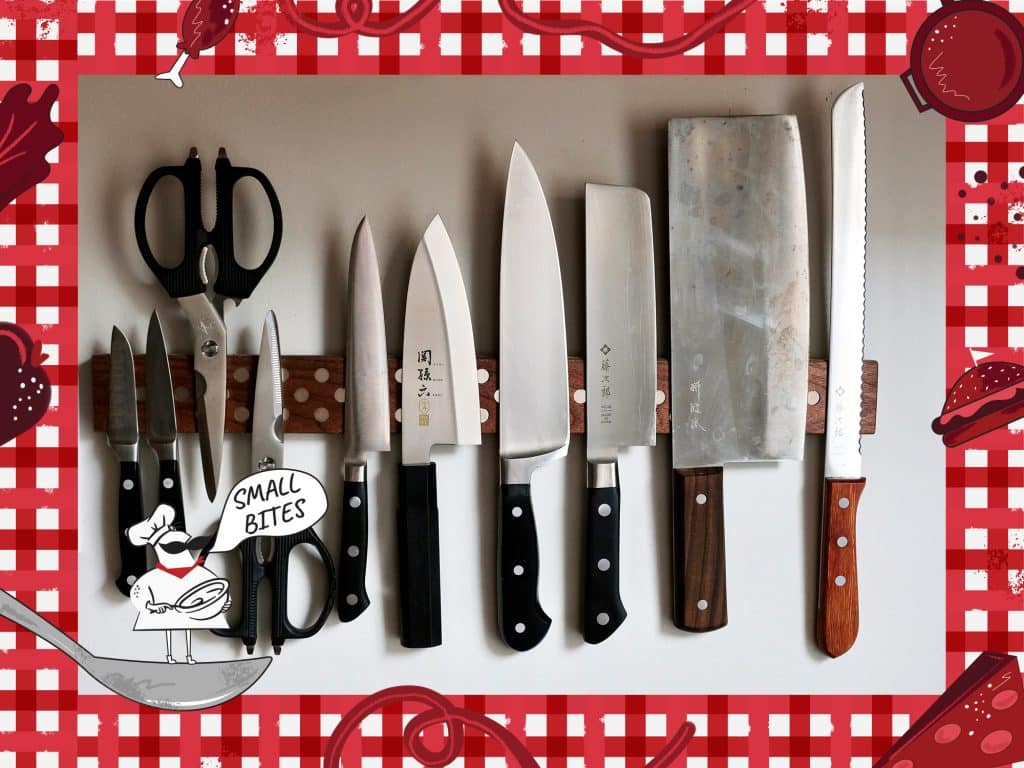
At home, I mostly use four different knives: a Tojiro DP petty knife for detail work, a Tojiro DP nakiri knife for vegetable prep, a Wüsthof Classic chef’s knife for all-around utility, and a Togiharu Chinese cleaver for mincing, and breaking down larger produce. Both Tojiro knives are made from san-mai construction, which means that they have a very high-carbon stainless steel core that’s sandwiched between two layers of corrosion-resistant stainless steel. The Wüsthof is made from high-carbon stainless steel, and the Togiharu is made entirely from carbon steel. But what does that all mean?
According to the World Steel Association, “Steel is an alloy of iron and carbon containing less than 2% carbon and 1% manganese and small amounts of silicon, phosphorus, sulphur [or sulfur for my fellow Americans] and oxygen.” Iron itself is a raw element that can be mined from the earth, and as a metal, it’s fairly soft. That means that iron is more likely to bend rather than break if you whack at it with a hammer. The introduction of carbon turns iron into steel, and as an alloy, steel can be hardened. Hardened steel is more brittle (meaning it can snap if you whack it with a hammer), but it’s also much better at holding a sharpened edge over time. What starts to get tricky, however, is the fact that steel is an alloy, and there are countless ways to formulate steel to customize just how hard you want it to actually be. Slightly higher carbon content in steel makes it harder and easier to hold a sharpened edge, but iron and carbon are not very rust-resistant. Enter: stainless steels, which contain at least 10.5% chromium to form a barrier that resists rust and other corrosion.
The higher the chromium content, the softer the steel will be when hardened, but the more corrosion resistance it will have. Cheaper knives available at big box stores are usually made of corrosion-resistant stainless steel and come with all sorts of usability claims, though they tend to be bad investments. “Avoid lower quality knives with bolsters on chef and santoku knives: these are often hollow, which means they can’t be reduced, which means the knives can never be sharpened correctly, and the effective life cycle is VERY SHORT,” Dietz says. “If something says it never needs to be sharpened, has a built-in sharpener, or says it’s fine in the dishwasher, know they’re lying to you, and you deserve better.”
High-end knives (especially traditional Japanese knives) are usually made from carbon steel, which has higher carbon content and fewer corrosion-resistant minerals than stainless steel knives. The benefit of a carbon steel knife is that it’s easier to grind a razor-sharp edge into the metal, and the metal is more likely to stay sharp after cutting with it. The downside of carbon steel is that it’s very brittle and the edge can chip (avoid trying to cut through bone), and it’s also susceptible to corrosion and rust (meaning: you have to wipe it completely dry and apply a protective oil coating every time you use it).
High-end knife brands, like Wüsthof of Germany, are often as well-known for their custom steel formulas as they are for manufacturing. By tinkering with the chemical makeup and tweaking their balance of iron, carbon, chromium, and sometimes other minerals like molybdenum, these manufacturers created a category known as “high-carbon stainless steel.” These steels are able to hold a sharp edge better than traditional stainless steel while maintaining a strong level of rust and corrosion resistance. They’re also pretty forgiving and don’t chip as readily as carbon steel knives do, making them great options for a workhorse kitchen knife.
If you’re shopping for a nice kitchen knife and don’t know what to choose, Dietz recommends: “Ask questions about steel hardness, and determine where you fall on the edge retention/brittleness continuum. Get a feel for different handle types, weights, and blade profiles. Listen to your inner voice regarding your preferences, and don’t be afraid to hear feedback on how to hold the blade, and how to care for it—even if that’s different than what you’ve done in the past.”
When it comes to my core four knives, their steel makeup greatly affects how I approach sharpening them. My two Tojiro knives have a VG-10 high-carbon stainless steel that’s fairly hard and is easier to sharpen to a great cutting edge on a whetstone. But whetstone sharpening isn’t for everybody. “Sharpening on a whetstone is a great move for a home cook who understands blade geometry, or is willing to work towards understanding blade geometry (both the angles of the bevel and the profile of the blade),” Dietz says. I’ve owned my Wüsthof chef’s knife for 15 years and struggled with finding the right blade geometry at first, which is why I brought it to Wisconsin Cutlery & Kitchen Supply to have it professionally sharpened two years ago. It’s also made from a less-hard high-carbon stainless steel, and I’ve struggled getting the edge to set as sharp as I’d like it to be on my whetstone.
The Togiharu cleaver, on the other hand, is made from virgin carbon steel. While it’s prone to water spots and rust and is a pain to take care of, it nearly slices straight through tomatoes and I haven’t actually had to sharpen it yet. It’s held its edge really well, and I’ve been able to maintain that edge by honing it regularly on a ceramic rod (which I recently picked up from Wisconsin Cutlery & Kitchen Supply).
Whetstone sharpening, to be honest, is really more of a hobby and a way to keep me from going stir-crazy when I’m trying to avoid having to scrape mud off my boots. But if you, like me, feel overconfident in your blade-handling skills and want to give it a shot, you can buy everything you need to sharpen your own knives at Wisconsin Cutlery & Kitchen Supply, too.
“A professional can give you valuable feedback on your techniques and options, and guide you on your path to home sharpening, if that’s what you prefer,” says Dietz. “A professional can also correct mistakes, and tackle trickier jobs, and do a better job in less time, for less money, in most cases.”
Either way, you’re going to be grateful to have sharp knives when you’re dicing onions for meal prep every day this Spring. Just don’t think you can avoid knife-sharpening by buying knife sets with micro-serration. Dietz warns: “Cutting onions with a serrated knife will have you in tears in no time!”
We can publish more
“only on Tone Madison” stories —
but only with your support.
Author

Related Articles

Small Bites: How I would fix Madison dining
Going out on Sundays and other thoughts on building a more sustainable food city.
Small Bites: How I make bread
Meditating on the process, flour, flavor, time, and place.
Small Bites: The moral cost of meat
How a bad dream prompted more intentional eating in the new year.