
“Pictures Of Ghosts” invokes the city of Recife’s historical memory through haunting memoir
Brazilian writer and director Kleber Mendonça Filho’s sterling essay film premieres in Madison at UW Cinematheque on February 23.

Brazilian writer and director Kleber Mendonça Filho’s sterling essay film premieres in Madison at UW Cinematheque on February 23.
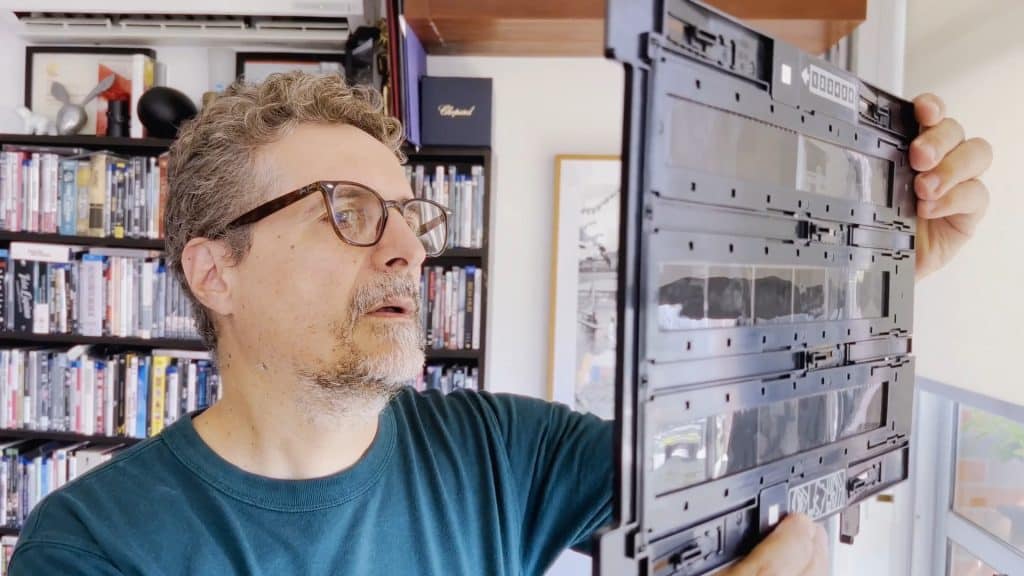
In the middle of Kleber Mendonça Filho’s latest documentary and essay film, Pictures Of Ghosts [Retratos fantasmas] (2023), the filmmaker drolly inserts his own hushed voiceover into a freeze-frame from Leonardo Lacca and Raul Luna e Tião’s 2006 short, Eisenstein: “Fiction films are the best documentaries.” The quote, both self-referential and slightly self-deprecating, recalls a famous one from the late Jean-Luc Godard in the medium’s history. Unlike Godard’s one-line commentary, this simple assertion is not trying to impart advice, but rather reflect a vision of the world through cinema and associated acts of recording. It’s an intensely contemplative concept that Filho communicates through a myriad of photographic and video sources from the last century, professional and amateur, jointly with the deft editorial hand of Matheus Farias.
A true hybrid work, Pictures Of Ghosts—premiering locally at UW Cinematheque on Friday, February 23, at 7 p.m.—fuses the personal and historical to examine the role of filmmaking in one’s life. And, at the same time, it examines movie presentation as a cultural institution in Filho’s seaside hometown of Recife in Brazil. In the film’s first part, “The Setúbal Apartment,” Filho gets at the heart of the aforementioned quote and the title of the work itself. He achieves this by offering a hauntological post-credits footnote to his 2012 feature, Neighboring Sounds. Two years after its release, Filho and wife Emilie Lesclaux returned home one night to hear distinctive yowling and barking of the deceased neighbors’ hounddog Nico—sounds filtered through open windows and summoned through Filho’s own film as it played on a national network on multiple neighbors’ televisions.
This indelible moment, recollected once more, fluidly prefaces the bulk of Filho’s fixations in the latter two-thirds of his film. Filho further traces his own identity as a cinephile but also the time-lapsed meaning of these Recifian “temples” (the cinemas of Art-Palácio, Trianon, Moderno, São Luiz), as they are preserved in photographs, on celluloid, or in digital data of films themselves. (“Marquees are timekeepers,” Filho attests, as he examines images of the Moderno moviehouse’s exterior.)
Lacca and Tião’s 20-minute Eisenstein contains the last-surviving images of the print distribution center that supplied cinemas in Brazil’s North and Northeast before it relocated to São Paulo; and André Antônio’s dystopian sci-fi feature The Cult (2015), also contains the only surviving images of the traditional Marist School that was torn apart and renovated (or gentrified) as a shopping mall. While the title “Pictures Of Ghosts” is meant to conjure presence of the living, as it does in its former part with dog Nico and Filho’s long-passed mother, historian Joselice Juca, Filho soon moves into public territory, creating a sort of séance of cinema secrets hiding in plain sight—a more creatively cogent, stimulating scrutiny of ideas that Kim’s Video (2023) introduced recently.
All this perhaps begs the microcosmic question about films famously shot in Madison (or in any smaller city or more uncommon spot for film production). If we were to revisit Michael Mann’s Public Enemies (2009) or Alan Metter’s Back To School (1986), for instance, what might we observe on location? How would the present tense’s relationship to their framing of landscapes and landmarks alter our perspective of them and of Madison? (In reassessing Jim Horwitz’s innovative 2003 graduate-school feature Grodmin three years ago, it was certainly a point of interest.)
To invert Filho’s own insertion and refer back to the omnipresent Godard, the best documentaries often start with fiction films, and inspire a deeper appreciation of their subject matter beyond the boundaries of selective presentation. Pictures Of Ghosts is explicitly geared towards people who’ve been bitten by the cinema bug, so to speak, and who may sit down to craft stray notes into coherent reviews (hopefully, much like this one). Filho’s is a dense work integral to those involved in the medium’s preservation, locally in the American Midwest at the Wisconsin Center for Film and Theater Research. But at a swift 90 minutes, his film patently offers an olive branch to more general moviegoers of any generation who want to better connect with their community and any work of art’s place of origin, which is irrevocably bound up in its memory.
We can publish more
“only on Tone Madison” stories —
but only with your support.
Author

Related Articles
“Limerent Pittsburgh” intricately constructs a folkloric affection of place
Artist Anne Ciecko’s 2025 videopoem is a highlight among the 30 selections of this year’s Midwest Video Poetry Fest at ALL on April 4.
Lea Jacobs sheds new light on an old master in “John Ford At Work”
The UW Professor Emeritus’ new book on the storied American director coincides with a five-film UW Cinematheque series this spring.
Inspiriting radical communal aspirations: an interview with Ben Balcom on “The Phalanx”
The Milwaukee filmmaker’s latest experimental short premieres locally at the Chazen Museum during the 2026 Wisconsin Film Festival on April 12.