
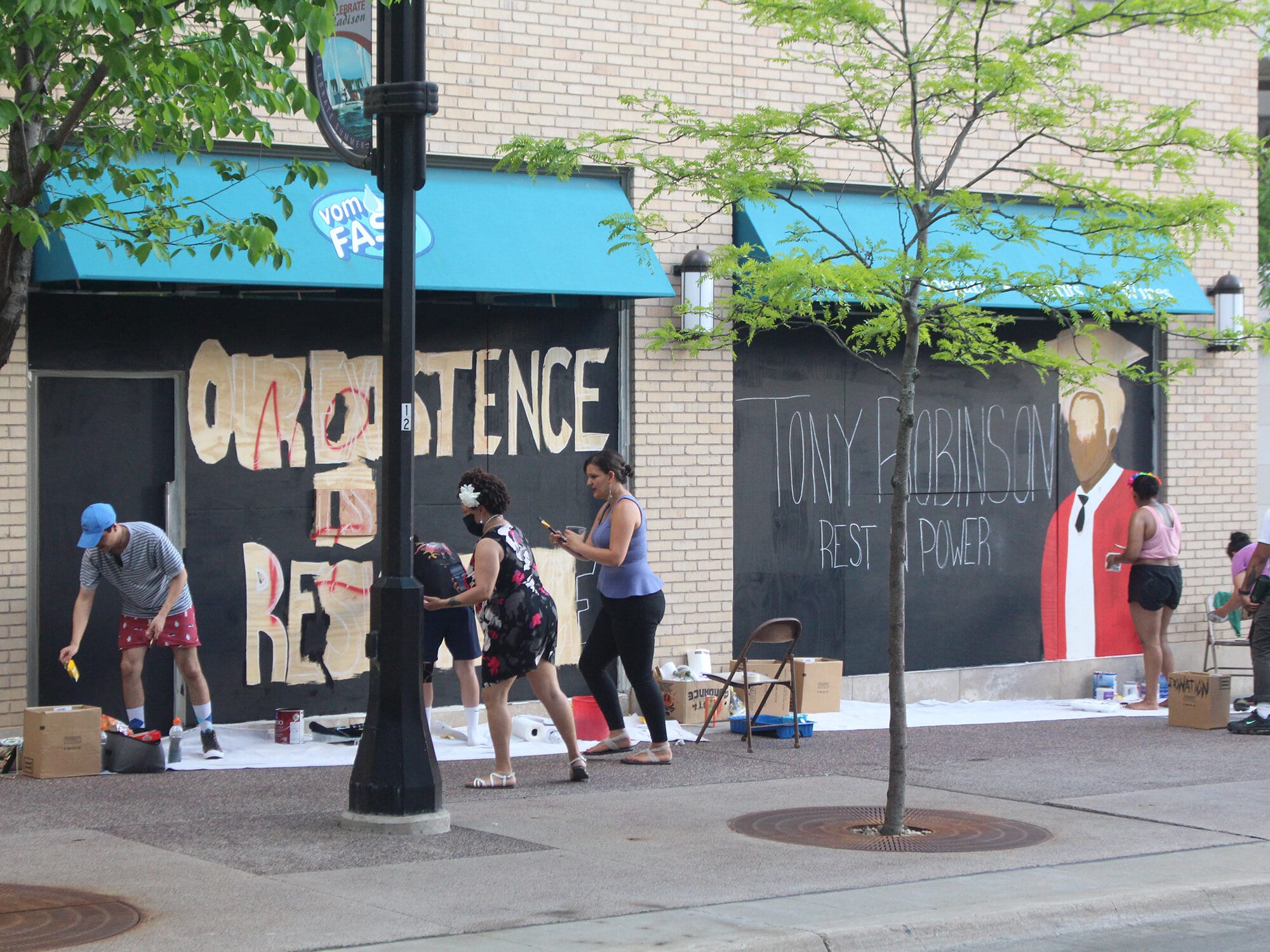
Public art in the State Street area elevates POC voices, but business and political priorities could easily co-opt it.
Note: An earlier version of this essay was originally published on the author’s website.
In the weeks following Black Lives Matter protests, murals have popped up all over the country. In particular, murals have appeared on boarded up windows in business districts, like Madison’s State Street, in the aftermath of riots and damage done to businesses. The murals vary in topic from positive messages to solidarity with Black Lives.
As beautiful as I think the downtown murals are and as glad as I am that there’s a big presence of POC artists, there’s a lot about this whole initiative that makes me uncomfortable and nervous.
First, that it takes less than 48 hours for the city to direct resources to help a luxury business district* board up its broken windows and hire artists to paint over them. This is in addition to the fact that State Street already had an outpouring of volunteer cleanup crews, had a successful crowdfunding campaign that raised $200,000 of disaster relief in 24 hours, and received the city Finance Committee’s approval of up to $25,000 grants per business to cover their repair costs and insurance deductibles. Meanwhile, there are other communities with blight and rundown buildings that have never received adequate resources, and maybe if they had, we wouldn’t have gotten to this point of crisis to begin with.
Second, that the city stepping in and hiring artists of color is a bit of a catch-22. If they hadn’t done it, most of those businesses would have individually approached mostly white artists to do free/cheap/self-promotional murals to cover up evidence of the protests with positive messages. Because the city stepped in, there are lots of murals specifically about Black Lives Matter that give voice to the movement and claim space for it, instead of covering the whole issue up. But…had this not happened, would the city or any of these businesses have worked with these POC artists? Will they work with them again? Will these small businesses that benefited from the murals call POC when there isn’t a crisis that affects white people? Were there any POC hired to help lead and organize this initiative?
Third, most of the artists commissioned by the City of Madison received a payment of $250 each. Others volunteered their time. Let’s not get too excited when we call this project an art commission. It’s mostly charity.
Fourth, there’s talk now about preserving these murals at nonprofits and state agencies like the Wisconsin Historical Society. Okay, so who owns them? Nonprofit institutions, with predominantly white boards, white patrons, and white audiences? Are they going to buy them from the artists? Are they going to let the artists keep their copyright and IP? Because let’s be clear that a “commission” of $250 or any preliminary fee should not also be the purchasing price of the artwork. You paid to have it created, not to own it.
Fifth, if we’re so eager to preserve these murals as a part of our history, let’s again remember that this project was created for a predominantly white-owned business district that serves predominantly white clientele. We’re going to preserve the history of what happened to an upscale business district during Black Lives Matter protests. Will we also preserve the history of what’s happening in neighborhoods that aren’t gentrified at this same moment? All of this is to say, whose history are we centering in what we choose to preserve?
I have many questions about how this is all going to be handled, by the nonprofit institutions that are stepping in, by the BID, by the city. There is a just way to handle this, that is fair to a diverse history and to the labor and intellectual property of these artists. But that counts on the people at all these institutions leading and organizing the charge to recognize the pitfalls of even their best intentions.
As a final note, there will be a few people who react negatively to this article and jump to the defense of struggling businesses during a pandemic. Some people will bring up the mom-and-pop shops and POC-owned businesses on State Street, who certainly have a presence downtown, (whether we center POC-owned businesses in the narrative aside from when it is opportune is another debate). As a small business owner myself, I get it. It’s hard running a small business, and it’s scary during a pandemic. But let’s not gaslight the issue. Suffering doesn’t excuse anyone from addressing their privilege. It didn’t before the pandemic, and it doesn’t now. It is a privilege to even be able to pursue one’s own business, even a mom-and-pop one, especially in an expensive area like State Street. So let’s not center the suffering of businesses in a story about BIPOC art.
Instead, let’s keep our focus on Black Lives Matter, the murals, and the future stewardship of BIPOC stories. These murals represent the voices of the BIPOC artists who created them. They claimed space for Black Lives in a contentious arena, and turned plywood boards into valuable works of art that institutions now wish to collect and own. If we don’t address these questions now, we risk misusing this moment and the artwork that emerged from activism. That is exactly why we need to have this debate, and do the necessary work that follows.