
Testimony on the Legislature’s anti-trans sports bills brought out courageous opposition and a lot of political cowardice.
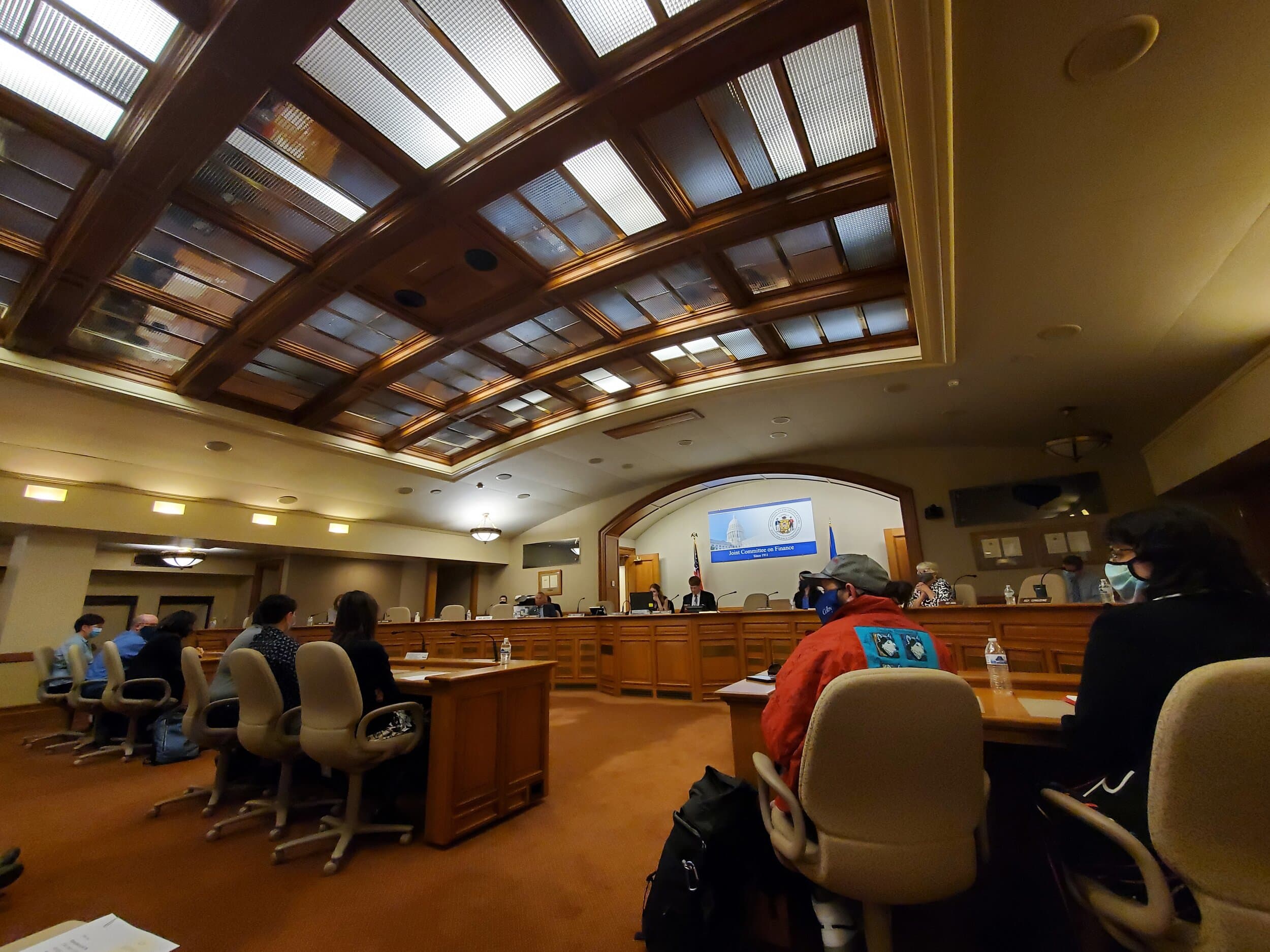
It was four hours into a five-hour-long hearing when the first transgender person took the stand to testify against two bills that would ban transgender children from playing sports in Wisconsin schools. Rachel Crowl of Appleton, who says she had to give up a successful acting career for 12 years after finally coming out and transitioning as an adult, addressed the members of the Assembly Committee on Education. It was one of three separate committee hearings held on May 26 to consider the legislation.
“When the world tells you you don’t belong, it sticks,” Crowl said during the hearing. “The legislation you’re considering will only further complicate (trans youth) lives when they’re already so very complicated. Life’s already hard. Why make it harder?”
The two bills would require transgender athletes play on sports teams that align with their sex assigned at birth by a physician, as opposed to their actual gender. As written, neither bill says who exactly would be responsible for making those decisions or how exactly challenges would be allowed to be made against individual children.
It’s unusual for both the Assembly and Senate versions of a bill to have overlapping hearing times, but the tactic seemed aimed at spreading out the overwhelming opposition and to front-load testimony in favor of the legislation. Testimony against the bills outweighed that in favor by more than two to one. (Full disclosure: I also testified against the bills.)
It wasn’t until the final 20 minutes of the five-hour hearing that testimony came from transgender and nonbinary youth themselves, several of whom only made it to the stand when an adult ally gave up their spot. At that point, many of the committee members and much of the press had already left the room. It didn’t stop these young Wisconsinites from giving some of the most compelling and emotional testimony of the day.
One 12-year-old, who testified last, recounted a period of bullying and self-harm after they began using they/them pronouns and identifying as nonbinary. They said that joining the track team and finding friends and community had really helped them.
“I haven’t self-harmed since,” they said.
A 15-year-old cisgender girl who also testified near the end of the proceeding railed against the bills, saying she was glad to play sports alongside transgender and nonbinary teammates and that the proposed bills were cruel and unnecessary.
Rep. Sondy Pope (D-Mt. Horeb), one of the committee’s ranking members, stayed until the end and commended the students for their bravery. Pope was the most outspoken in her criticisms of the proposed bills, frequently fact-checking proponents and other members of the committee.
“You call this the ‘Protect Women in Sports Act?’” she said at one point early on. “Transgender women are women. You are singling out which women you want to protect, which I find confusing.”
No organizations in Wisconsin have signed on to support the bills. Some 30 groups have come out publicly against them, including the Wisconsin Interscholastic Athletic Association, which regulates high school sports, the University of Wisconsin-Madison, the statewide teachers union, the ACLU, the State Bar of Wisconsin’s civil rights and liberties section, the LGBTQ advocacy group Fair Wisconsin, GSAFE, Planned Parenthood, and the Wisconsin Coalition Against Sexual Assault.
The WIAA sent its testimony in writing, since the committee hearings were scheduled for the same day as the group’s annual meeting.
In addition to barring trans athletes from sports teams that align with their correct gender, the bill language also suggests that schools create “co-ed” teams for transgender students to join instead.
Hope Owens-Wilson, the Youth Organizer for the ACLU of Wisconsin, made the connection between what the bills attempted to do and civil rights battles of the past. “This bill and the language around it conforms with the antiquated logic of ‘separate but equal.’ It tries to solve a problem where one does not exist.”
Transphobia on display
Testifying in favor of the bills were a string of adult cisgender women who are part of the “Save Women’s Sports” lobbying group that’s part of the push behind similar legislation in states across the country. Currently, Legislatures in 30 other states, most of them Republican-controlled, have considered banning trans youth from the correct sports teams. Twenty have weighed bans on gender-confirming medical care for transgender minors as well. Several have now passed into law, teeing up what’s likely to become a major legal battle nationally.
Leia Schneeberger, a competitive mountain bike racer and Madison West High School graduate, testified that she’d recently lost two races to a transgender woman and that it “was the most demoralizing experience of my life.” Schneeberger has also won several recent races, and finished behind several cisgender women athletes as well. Neither bill would impact Schneeberger’s sport, because the bills apply specifically to public schools, voucher-funded private schools, the UW System, and state technical colleges.
That kind of cherry-picking of results an individual competitor does or doesn’t like is also at play in the court case cited most often by the Wisconsin bill’s proponents as an example of why they feel such legislation is needed.
The case, in Connecticut, targets two transgender high school track athletes. Chelsea Mitchell, the plaintiff in that case (with the backing of the Alliance Defending Freedom, classified as a hate group by the SPLC), went on to twice win against one of the girls she complains about in the lawsuit. She also won a scholarship and is currently competing at a D1 college, whereas both of the runners in question—Terry Miller or Andraya Yearwood—have opted not to continue to compete at all.
The adult women testifying in favor of the bills last week also included longtime Madison anti-trans activist and musician Thistle Petterson, along with Miriam Ben-Shalom, a former military drill segreant who successfully challenged her discharge for homosexuality in 1976 but has gone on to become a prominent voice in trans-exclusionary radical “feminist” circles (aka TERFs).
Petterson cited a formative childhood experience on a girl’s gymnastics team that she says provided her with a sense of friendship and camaraderie she wasn’t getting at school. However, she doesn’t think transgender girls should enjoy the same opportunities, and she used plainly transphobic language to make her point.
“Had a boy, deluded into believing he was a girl, been allowed to join our team, it would have forced the girls on the team to buy into his delusions,” Petterson said. “There is no such thing as a boy who is a girl.”
Ben-Shalom took the accusations a step further, claiming that “biology is biology and there are only two sexes.” She briefly acknolwedged that intersex people do exist, however.
The bill’s co-authors, Rep. Barabara Dittrich (R-Oconomowoc) and Rep. Janel Brandtjen (R-Menomonie), meanwhile opened the public testimony period with a series of accusations and unfounded claims.
“This is not a matter of transphobia, hate, or any of the false pejoratives thrown at women who wish to stand up for women in sports,” Dittrich said. “Despite the fact that I have transgender acquaintances that I love, that does not give them the right to steal my accomplishments.”
Dittrich again leveled accusations of being “anti-women” at Democratic Gov. Tony Evers, and lashed out at “the power brokers of sports” that are against the anti-trans legislation.
Pushback on several fronts
Rep. Don Vruwink (D-Milton), one of the committee members, noted early in the hearing that he failed to see why the bills were necessary. He highlighted that a real problem in girl’s and women’s sports was a lack of investment.
“I’ve spent 40 years coaching girl’s teams, 45 years around sports,” Vruwink said. “I haven’t seen the problem you’re bringing forward. In all the years I coached I never saw the things you’re describing. I personally think the biggest threat to girl’s sports is finding people to umpire and officiate them.”
There were also questions about the constitutionality of the bills. Ray Hacke, an attorney with the right-wing Pacific Justice Institute, claimed that the legislation would stand up to legal scrutiny. “Girls will be reduced to spectators and cheerleaders in their sports if we don’t act,” Hacke added in his testimony.
However, attorneys from the Freedom From Religion Foundation and Wisconsin Education Association Council both said that a recent U.S. Supreme Court ruling on Title VII held that “discrimination on the basis of sex” does cover transgender people. Legislative Council for the committee meeting noted that the issue wasn’t entirely settled but was likely to be in the near future, with a federal circuit court poised to take up a case to determine whether similar language in Title IX also includes transgender people.
In addition to the legal arguments, Rep. Donna Rozar (R-Marshfield) brought up support for the exclusion of transgender girls in sports by gay tennis player Martina Navratilova and transgender former Olympic swimmer and current candidate for California governor, Caitlyn Jenner.
“Why, with their outspoken lifestyles, would they likely come out in support of bills like these?” Rozar asked of GSAFE Co-Executive Director Brian Juchems after his testimony in opposition.
“A year ago, Caitlyn Jenner spoke in support of transgender athletes and has since flip-flopped, so I can’t say I know her motivation for that,” Juchems replied. “I do know that Caitlyn currently competes in a women’s golf tournament so there might be some hypocrisy on her part. She also doesn’t speak for all trans girls or athletes. She’s just one person with a microphone.”
Andi Janeway, a Madison-based arts educator, summed up the frustrations of many in the packed hearing room with their pointed testimony.
“There are children here in Wisconsin…who are asking you to allow them to live,” Janeway said. “They are not asking for preferential treatment. In fact, they are asking you to treat them as you treat their peers. This is not a difficult task. I am speaking from experience as a transgender individual as well as an educator who works with transgender and nonbinary youth when I tell you that affirming transgender and nonbinary youth is not a difficult task, and it starts with letting this bill die.”
The battle continues
Assembly Speaker Robin Vos has stated that he wants to move these bills quickly to a floor vote this June (coincidentally also LGBTQ Pride month). Each committee will need to meet again to vote on whether to pass the bills on to the full Legislature, though it’s unlikely they will take further public comment.
“Trans kids deserve our love and respect and support just like any other kid,” Gov. Tony Evers tweeted during the hearings. “I stand with them.”
Despite the fact that Evers will likely veto both bills if and when they come before him, simply having these public debates in the first place can do untold harm and help sow confusion and hatred toward an already vulnerable community.
“It’s great we have more knowledge about things happening against us and how to advocate for ourselves,” Ollie Heide told me. Ollie is a nonbinary 14-year-old who is finishing up the 8th grade and took the day off to testify against the bills. “But it’s also hard for lots of trans kids to know that so many adults are working against us like this. It adds so much anxiety.”