
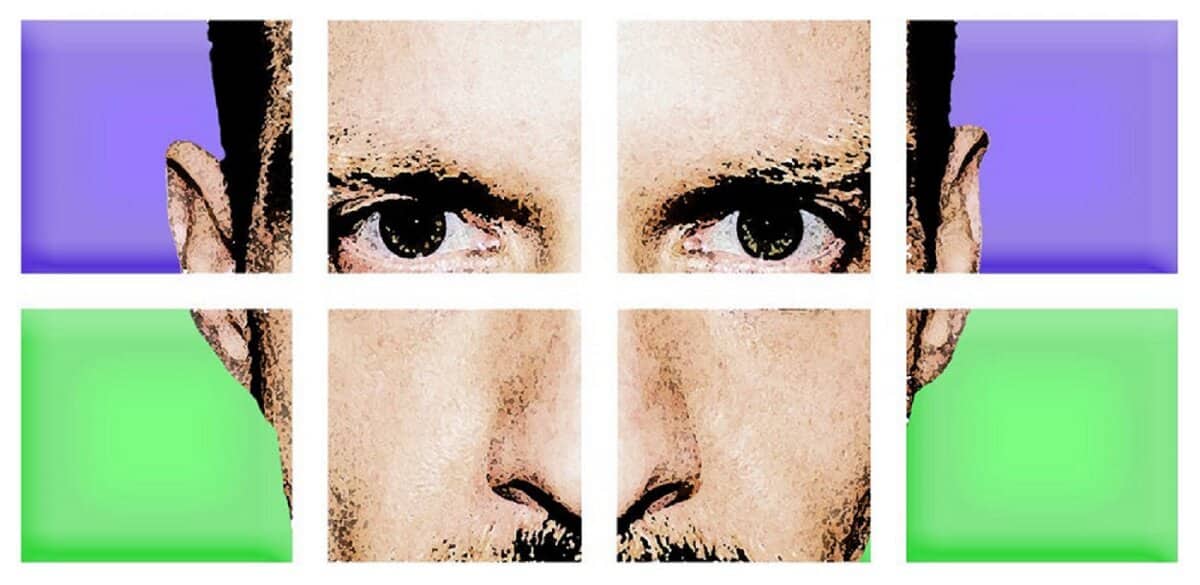
The Madison-based rap producer opens up about his formative years and his new instrumental record.
The proverb “patience is a virtue” is one that Brent Schultz, the Madison-based music producer known as B-Luv, seems to ponder on his instrumental saga Defective Portraits. Easygoing and meticulously hatched, the twinkling melodies throughout denote the tonic feeling of a mantra. Each song adds a foundational brick to the emotionally towering high-rise that Schultz now sits on after over a decade’s worth of trial and error. Within its warm walls you’ll find reflections of an artist who is now ready to stand before his art truthfully—a sound that’s reborn, but never too distanced from its roots—in all its vulnerable glory. The record is both passive and bursting with contemplative glee, a pointedly introspective set of hip-hop instrumentals that’s best enjoyed in the morning, when new opportunities are at their brightest.
The record took shape during a period in which Schultz found the supportive environment he needed to grow as an artist in the form of the Willy Street area. Similar to most coming of age stories, his start involved a push in the right direction. Living next to his best friend Tamir Smith (known to many as King Kronos), was that push. “If I hadn’t moved to the Willy Street area when I was ten and met Tamir, my life would have been totally different,” Schultz says.
The pair’s 2014 song “A Dead End Called Merry St” referenced the splinter just off of the Yahara River that served as the grounds for their musical awakening. It was here where they’d pass each other their favorite forms of music and share the spotlight during cypher sessions with a group of friends—who would go on to become the group Synchronized Mindz—over industry beats they’d find on the internet.
A Dead End Called Merry St by K.I.N.G Kronos
While the ciphers and voices on a clean hip-hop track proved to be vital in cultivating Schultz’s taste in the long run—an affinity for the verbal dexterity of CunninLynguists and Wu-Tang Clan ultimately steered him away from Will Smith CDs, which seemed to be the only rap his mother approved of—he credits his goldfish memory for convincing him to find a home away from the mic. “Even if a song’s lyrics are so-so, it’s the beats that I hear first. If the beats are great then I could listen to a track over-and-over again,” Schultz says. “Which made me think, well, maybe I should try my hand at producing music and see how it goes.”
And it went about as well as one could expect, at first. “It all sucked,” he says. “I was never happy with anything I was making. I didn’t know anything about sampling. I was trying to make things strictly off of my keyboard without much know-how.” The gap between what Schultz knew and what he was looking to accomplish wasn’t simple. Being the dedicated artist that he is, he set his sights on studying the artists who persuaded him to dig into that side of artistry: The Alchemist, RZA, KNO, Ant, and a handful of others.
The many years that followed his initial plunge into the production realm were typical of a struggle-rap producer attempting to carve his name into a small scene: congested creativity, mismatched audio mixes that would confuse both him and his emcees, little to no exposure, and “DJing” sets around Madison (including the “Rhyme Room” sessions at the now defunct Mr. Roberts Bar & Grill on Atwood Avenue), some of which found him simply standing behind an emcee and hitting the next button on a laptop. It was all worth it in the long run for Schultz’s confidence, but in the moment it began to feel very stagnant, and boredom began to sit in.
Navigating the Madison DJ circuit for five years was enough experience for Schultz to gain some strong footing with his craft and within the Midwest scene. He amassed a collection of experiences that would prove formative, including losing two beat battles and picking up a foundational piece of advice from producer-turned-cryptocurrency tycoon !llmind: “Build from the ground up; work with what’s around you.” Schultz took the words to heart.
“I know I’m good enough to work with larger artists,” Schultz says, “but we have so much amazing talent here in Madison, it was really easy for me to forget the big time and be passionate about what I have around me.” The Madison hip-hop scene gifted Schultz in many ways, a momentous one being his relationship with a network of Madison-bred hip-hop producers and emcees. Collectively, Schultz and this group would become Outside Voices.
Before the pandemic, the crew would record and polish entire projects in a single weekend while hanging out in a Northwoods cabin owned by Zach Salvat, a Madison DJ/producer/digital artist who works under the name Evaridae. Schultz and Salvat would pair up under the name CliqDark.
“Before I met Zach I never really had a personal mentor,” Schultz says. “He’s kind of like the RZA for Outside Voices. With him being someone who went to the [now-closed] Madison Media Institute, it was really interesting to see how he did things. I’m very grateful to have met him.”
The soft, meditative approach that Schultz takes on Defective Portraits seems to be undergirded by the fondness and gratitude he has for his come up, archetypal of a hip-hop producer who enjoys the peace of making music in the deep woods of Wisconsin. The record’s final track, “Fearless,” was Defective Portraits’ seedling and focused his efforts on crafting the gently crackling sonic palette he’d use across the record.
“It might be the winters we have here. Something about them really makes people want to enjoy the emotional vibe that comes with cold days,” Schultz says. Always soft, with airy, brisk rhythms that heighten the record’s unabating enthusiasm for ambient noise, it’s perfect thinking music. Listeners may catch their next best idea by simply staying indoors and following along to the rounded, mellow zeniths found on “Dreaming Out Loud” or by putting their legs up next to an opened notebook, waiting for their next big idea to be coaxed out by the gentle release of “Sun Beams.”
In true testament to his own musical upbringing and fascination with establishing accessibility within the Midwest hip-hop community, Schultz set out on making Defective Portraits his version of a creative co-op. In an intentional decision to make the record free, Schultz stayed true to his community-bolstering vision. In an Instagram post earlier this year, he encouraged artists to enjoy the record and do with it what they pleased. “Bargazing” was built with this collaborative spirit in mind, with its spatially aware rhythms and melodic frames ready for any type of voice or rhyme scheme to accentuate it, no matter the artist’s background or experience.
“I’ve had some people hit me up before saying how badly they want to work with me but don’t really have the money or resources to do it. And I don’t want any of that to be a factor anymore. I want to spark creativity in people. If that spark happens then I want artists to be able to express and access that creativity as quickly as possible,” Schultz says.
Caring, introspective, soft-spoken; the music you hear on Defective Portraits truly is a piece of both Brent Schultz and B-Luv, who are not too far off personality-wise. The allure of the alter-ego has always been of interest to Schultz, being a fanatic of the WWE wrestler Bret “The Hitman” Hart due to Hart’s commitment of injecting extravaganza with realism. In the same truthful-and-performative vein, Schultz finds a way to be who he truly is as a person and as a performer by way of a morning routine that’s as warm and mellow as his music. “What I love is waking up, having my coffee, maybe having a little herb, and making music. Some people like making music at night, but there’s something about being in the morning, when your brain is fresh; it’s the optimal time to create for me,” Schultz says.
“I’ve made about 90 percent of my music while high,” he continues. “I really fall into a groove when I combine the two. There was a time in my life when I was concerned that maybe I couldn’t work without it, so I had to test myself on that by letting up for a bit. But the only thing that proved was how my sound came from within me all along and from nothing else.”
Method To The Madness(Instrumentals) by B-Luv
“Many Faces” opens Defective Portraits with grating plucks alongside a sample of Game Of Thrones’ Arya Stark describing how difficult it is to be forced within a false reality: “Neither of us got to be the other person, did we? But I can now. With the faces, I can choose.” “I think—in a musical sense—I put on a different mask for each situation,” Schultz says. “I’ll always stay within my realm, but I am a different variation of myself depending on the desired sound, morphing myself into a way that works. I am attracted to popular things, sounds, ideas, but I want to make sure I actually like it for what it is and not because someone told me I should.”
This diligent pursuit in honoring the face value of each song’s title is one of the record’s defining qualities. The melody withering within the song “The Sweet Collapse” is consistently bent, evoking a prepossessing tower in mid-collapse. “Hollow Intentions” produces a melodramatic soreness that rings in the ears, as if begging for forgiveness. And the shadow that lingers behind the bright textures in “Silhouettes” plays on contrasts to mesmeric effect.
“For a while I kind of gave up on labeling songs,” Schultz says. “It was hard for me to come up with them. Whenever I’d send beats out to rappers they’d get mad at me because they’d never know which one I was referring to. They’d be like ‘which beat is the one you want me on, 4:20 or 4:21?.’ And I came to find out that a lot of them really benefited by having a place to jump from.”
And if there were a beat to designate as a final jumping point for our defective 2020, it might as well be the melancholic-yet-euphoric vista of rapturous triumph, “Bye To Yesterday.” “With everything that’s happened this past year, I think we are on the come up as a society” Schultz says. “I think people will start enjoying the little things a bit more: being able to hang out with friends, going out on the town… geez, even being able to hug people, for God’s sake.”
For him, there’s no such thing as losses, only lessons. And Defective Portraits is the tasteful result of the many lessons Schultz has managed to compile during his lifespan as a DIY producer. If the human condition is anything but permanent—in ways that forces us to paint how we want to see ourselves portrayed in place of accepting the beauty that already stares back at us in a natural reflection—Schultz is opting to alleviate the toxic fumes of societal perfectionism with some therapeutic resonance.
As optimistic as it all may seem, it may also be a good thing, sometimes, to reflect and blow down the cobwebs. “As we know, there are a lot of issues with this country that need to be faced head-on,” Schultz says. “And I feel like we’ve done a lot of that this year. Our eyes have been opened. I think we needed to break it all down before we could build back up.”