
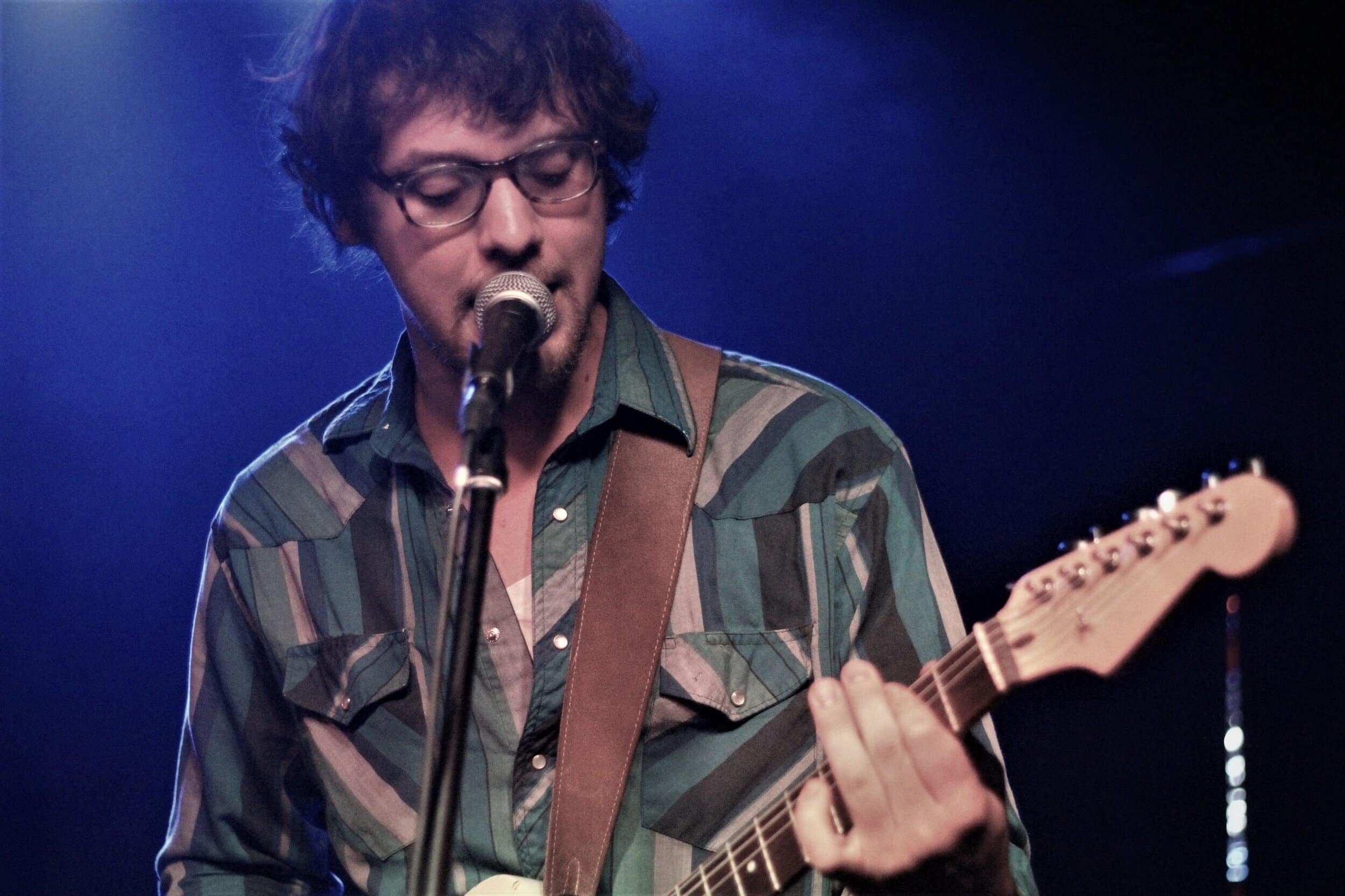
The Madison-based songwriter discusses his new solo album, out February 26.
For years, Graham Hunt’s been turning heads with impressive runs at several different flavors of punk. Whether that be through the undeniably catchy, grit-bitten power-pop of Midnight Reruns, the swoon-worthy dream punk of Sundial Mottos, or Midwives’ blistering hardcore, it’s clear that Hunt’s made an impression over the last decade, spending years as an active member in Milwaukee’s music scene and moving to Chicago for a year before relocating to Madison in 2018. Hunt’s solo work continues to be an oddball amalgam of the best traits of his other projects: Midwives’ exacting focus, Reruns’ strong songwriting structures, and Sundial Mottos’ winsome, relaxed aesthetic all are apparent throughout the excellent new solo album Painting Over Mold. Even the distinct imprints of Dusk and Mike Krol, both acts Hunt has appeared with as a touring member, find cohesion across the record.
Despite slowing many other musicians and artists down, the COVID pandemic seems to have ultimately accelerated Hunt’s output. Painting Over Mold arrives hot on the heels of former Hussy drummer Heather Sawyer’s galvanizing debut album as Heather The Jerk, Cable Access TV, which Hunt recorded and produced. Hunt also has a few other projects in the works that he’s not quite ready to discuss in detail. He’s also a visual artist and has been posting new paintings lately on his Instagram.
A strong group of collaborators from across different corners of Wisconsin music contributed to Painting Over Mold, including Amos Pitsch, Disq’s Shannon Connor and Isaac de Broux-Slone, Tollboth’s Sheridan Connor, Daydream Retrievers’ Ian Olvera, Sahan Jayasuriya (aka Cold Lunch), and Proud Parents’ Claire Nelson-Lifson.
“Scraping The Road” gave listeners a promising first look at Painting Over Mold, which stands tall as one of the most memorable entries in Hunt’s superlative discography. While Hunt’s lyrics have impressed in the past, they hit a new high watermark with Painting Over Mold. Throughout the record—Hunt wouldn’t commit to characterizing it as an EP or full-length—there’s an incredible amount of conviction, even as the various protagonists in Painting Over Mold’s narratives waver in confidence.
On “Change Their Mind,” which first appeared as a single in 2019 (and has a music video premiering below), Hunt uses first-person to assuage doubts about the shifting nature of personality, hammering home an incredibly effective chorus of “Anyone can change their mind at any time for any reason.” “Paul The Cat,” a song inspired by a cat who used to live across from Mickey’s Tavern, finds Hunt extending a watchful eye outward, noting the cat’s hesitant movements and overall comfort. “Dinerland” opens with the words “Now what instinct do I trust?” and later follows up with “Homesick for another world / When you’re not sure you’re a girl / How can you visit if you’ve never been there?”—contrasting the complex realities of gender identity exploration with the escapist impulses that have been heightened by quarantine, providing both angles with empathy and understanding.
On the breathtaking “Lighter Touch,” which includes the line that gives Painting Over Mold its title, Hunt positions himself as the narrator again, returning to the body dysmorphia that populated Midnight Reruns’ Force Of Nurture: “I can feel my teeth are clenching and my neck is stiff / When I’m watering all the plants, I forget that I need air, and then I catch my breath / When I start to brush my teeth, there’s a motor in my arm that’s going way too fast / Then I’ll spit and then I bleed and I wonder why I know I’m doing it / I can not stop, waiting for the shoe to drop / You’re always saying ‘Can you not?’ and you’re telling me that I need a lighter touch.”
Hunt finds grace in the margins on Painting Over Mold, celebrating the minuscule and the mundane, knowing that life’s more fulfilling to navigate if the journey’s treated with the same respect as the destination. He spoke with Tone Madison ahead of the album’s February 26 release.
Tone Madison: Last time we saw each other, you mentioned that it was hard for you to listen to the Midnight Reruns records because you feel like a different person. Is that potential outcome something you’re more conscious of now when you’re writing new material, or do you see it as inevitable?
Graham Hunt: I don’t worry about it as much now. I just worry less in general about what the reaction to whatever I’m making is going to be. Especially since such a small amount of people hear it anyway. I guess it’s just a more realistic approach that way. I don’t really feel like I have a choice. I don’t know if that sounds pretentious or whatever, but I’ve just come to terms with that aspect of myself where it’s like, I have to make this stuff. I tried to stop for a little while and I just can’t. It just has to come out. So it doesn’t really matter.
Obviously it’s cool if people hear it, but I’m going to do it regardless and I guess part of the person I feel like I was when I was doing Midnight Reruns was a person that really cared about that, and I really wanted a lot of people to hear it and I really cared about what people thought and I was kind of a more insecure person, so I don’t know. Maybe this stuff will age better to me because maybe I’m not subconsciously thinking about all that stuff, about particular audiences. I don’t even know if I thought about that back then. I thought about it afterwards. Maybe I didn’t think about it when I was making it, but I’m not really sure.
Tone Madison: Right, and I think that also kind of speaks to the common experience of a lot of songwriters who dig out their old high-school notebooks and find old lyrics, only to feel deeply embarrassed because it’s still something tied, in some way, to an identity that they’d rather not remember.
Graham Hunt: I don’t know, there’s no reason to feel bad about that stuff, everyone does it. Maybe in my early 20’s or something that’s something that I would feel embarrassed or bad about, where I’m a little more at peace with my cringe-iness now. Some stuff I write and do is going to be cringe and some stuff that I write and do is not going to be. That’s just part of making things.
Tone Madison: A lot of Painting Over Mold interrogates the uneasy connections between uncertainty and confidence. Was there anything in particular that drove you to exploring those themes?
Graham Hunt: That’s kind of just part of being an artist. I’ve seen memes about this, where it’s like you’re always trying to find that balance between thinking you’re total garbage and thinking you’re amazing. And I don’t think I’m amazing or anything special but you need to feel like that in the moment while you’re doing it to get it done. So you feel amazing in the moment while you’re doing it, and then when you’re done with it, you can step back and be like, “This is a cool thing I did.”
Sometimes it’s easy to completely get snapped back in the other direction, where you make something and you’re just like, “I spent so much time on this and I thought it was so cool when I was doing it and it sucks and I feel like an idiot for thinking I was a genius the whole time I was doing it’ but then a lot of times with that too, you get some space from it, you spend some time apart from it and come back to it and go ‘this is fine. It’s fine. I don’t hate it.” So maybe subconsciously I was writing about the creative process in some of the songs. I don’t know. I’m not really sure.
Tone Madison: I’m fairly certain that “Change Their Mind,” which came out as a single in 2019 and reappears as the second track of Painting Over Mold, came from a different session than the rest of the album. What was the timeline for this record like?
Graham Hunt: Yeah, it did. That one I was in LA, rehearsing with the [Mike] Krol band but I had a friend, Matt Gorski, who’s from Milwaukee that lives out there and I had that song and I’d just finished it right before I left, so I was like “alright.” I had a couple days and I know he’s great at recording and has a setup in his house and it’d be an excuse to hang out with him too, so I did that there with him. Sahan [Jayasuriya] was there too, because that’s when he still lived out there. So that one, I’d just finished the song so it was fresh and I was kind of excited about it so I was like “let’s just do it,” and it was kind of spur-of-the-moment but it turned out really cool, I thought.
A couple of the songs I had around that time period, I was writing around the end of 2018, like “Lighter Touch.” The first song on the record I wrote on one of those breaks in LA in between Mike Krol tours. I was in an Airbnb and there was a piano in it, and that’s where I wrote half of that song. That was probably in 2019. It’s a weird thing, a lot of these songs like [“Change Their Mind],” the first song (“Anything to Make It Better”), and “Lighter Touch,” I wrote half of them, what feels like a long time ago and I wrote the other half of them after a year or something had passed. That happens to me a lot, where I’m like, “Well, I got this thing and I don’t really know how to resolve it or finish it.” And then way later, it’ll just kind of pop up in your head.
A bunch of the songs were kind of written in one big burst right before the pandemic happened, early 2020. I just wanted to record some music and I hit up Amos [Pitsch] because I wanted to do it at Crutch of Memory [Pitsch’s home studio in Appleton] and we were going to do it in March. And I was like “oh shit, I set this deadline for myself, I should probably have some songs,” so a lot of the rest of them I feel like were really quickly put together in the span of a couple of months, just figuring out all the parts. Then the day or week we’d arranged to do that was right after the shit had just hit the fan, so we were like, “We probably shouldn’t do this.” So then I was like “Well, do you just want to play drums on some of the songs? I can send you demos and then you can just do it from your house,” and he did that, so that’s cool.
Tone Madison: A number of guests appear across Painting Over Mold. How much did their contributions shape the record’s sound?
Painting Over Mold by Graham Hunt
Graham Hunt: A decent amount, I would say. It would certainly be a different record if I had played all the instruments myself. For “Scraping The Road,” Isaac has this lap steel that he has modded with a whammy bar on it so you can bend the strings like if it was a pedal steel but without the pedals and he was like, “Well, I’ve been itching to use this for something and this is kind of a country song so let’s just lean into that,” so he played that lap-steel solo and Shannon came up with the bass line for that—I didn’t come up with that bass line. Amos, that was kind of a push and pull with half kind of his ideas and half of me being like, “I want it kind of like this,” so definitely there was some cool stuff that I wouldn’t have thought of because of that on there for sure.
Tone Madison: In the event we get live music back to a place where shows can safely resume, have you considered putting a full band together to play this material out?
Graham Hunt: I don’t know. I would prefer not to play solo. I don’t really like it, being up there by myself. I feel like a lot of my songs, to me, don’t really hold up as just acoustic guitar and guy singing. It’s a lot of the extra stuff on the recordings that makes it interesting to me that you can’t really do with just one person. I was doing stuff with a drum machine, backing tracks for a while, but I was more just doing that because I had opportunities to play shows where maybe a band wasn’t available to me at the moment and I just wanted to play or I needed money or something.
I have two friends in Milwaukee that play with me for the solo stuff sometimes, but if they can’t do it, something comes up, then I’ll figure something out. I just don’t like it. To play with people is much more fun. Getting energy from other people on stage, playing off of them, you share the responsibility of how terrifying it is to be up there, it’s just a lot more fun. So maybe I’ll use the same guys, maybe I’ll add some people to the band. I don’t even know if I’m gonna play shows with this stuff, I have no idea. I just made this—I don’t even know if it’s an album—just this collection of songs.
I miss shows in general, playing them, but I especially miss doing the small towns around Wisconsin. There’s just something about it that speaks to my soul—I don’t know what it is.