
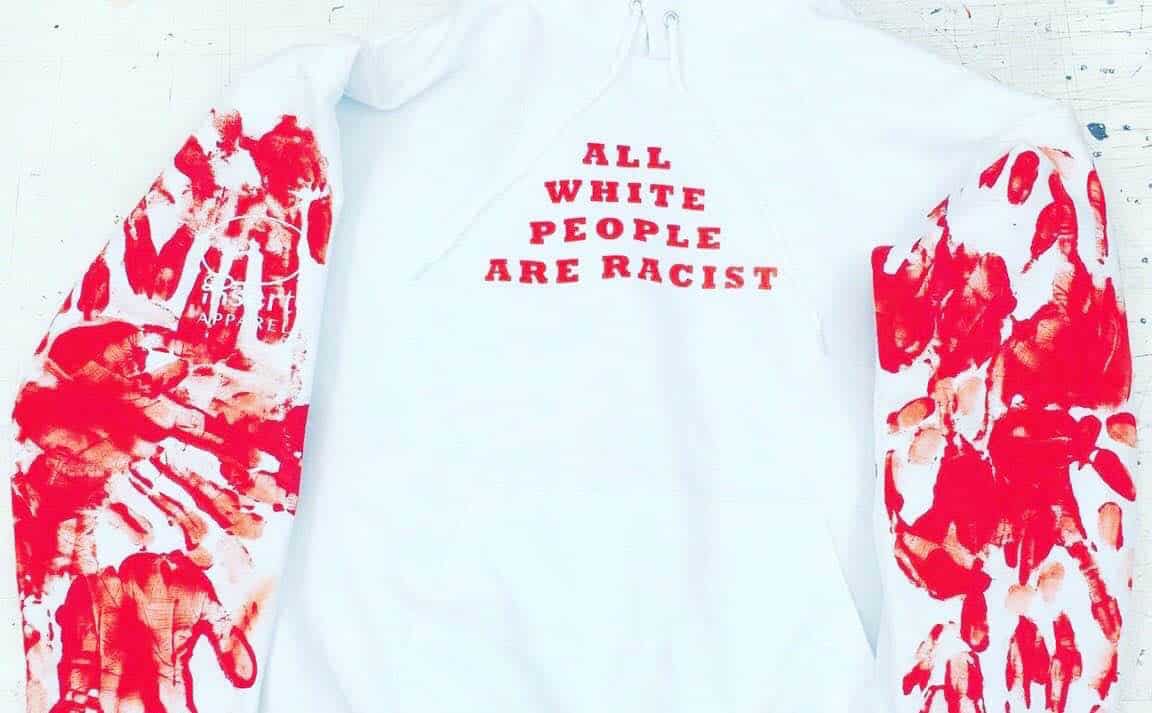
Are we missing the bigger picture around a UW student’s “All White People Are Racist” hoodie?

UW-Madison student (and my fellow First Waver) Eneale Pickett is the head of Insert Apparel, a clothing brand that features language intended to empower students of marginalized identities and critique the oppressive systems at work on our campuses and in our country. Insert is an expression born from oppression; Eneale created it in response to an incident in the Spring 2016 semester in which Synovia Knox, a Black woman, was harassed and spit on by another student in the comfort of her dorm floor. Her attacker received little punishment from UW-Madison officials. Knox, Pickett, and several other UW-Madison students of color were heavy contributors to the resurfacing of #TheRealUW, leading to a Chazen exhibition last April called “Unhood Yourself”—a direct response to the wave of bias incidents and the generally hostile climate surrounding students of marginalized identities at UW-Madison.
Pickett recently came under fire when his “All White People Are Racist” hoodie went viral. It featured the phrase in white letters on a Badger Red background, as well as an inverse edition with handprints coined “Blood on the Sleeves.” He’s received death threats, slurs from anonymous accounts, and undoubtedly shifted the conversation at UW-Madison from a simple hoodie. As he told WKOW:
“A lot of people want to talk about race in this very nice way. So, if you need this conversation to be comfortable, that’s a problem. Because, that’s not actually a conversation. I’m really just consoling you.”
Is this nothing but another tired foray into familiar territory? Marginalized body shouts aloud in protest, amplifies its pain to the world, only to be met with fire upon revelation of the obvious? I ask myself this because I remember my unofficial fifth year in Madison, sitting right on the peripheral of an unrelenting sense of chaos as my friends and their friends weathered the hatred as they saw fit. Sexual assault reports, swastika graffiti tagged downtown, death threats slid under dorm doors over a Bucky logo with a Ku Klux Klan hood, complete with a burning torch.
Despite the unsettling feeling that I’ve seen this film before—my final spring semester was punctuated by the murder of Tony Robinson in 2015—the oppressive phenomena surrounding the events of last spring felt familiar, yet on a fever pitch. I’d recall how it tired us, but even that feels tired to say by now.
Eneale was one of the first individuals I saw wear a “Kluxy” t-shirt in the open. Admittedly, I found it very easy to lose in translation: a statement piece that read easier to familiar eyes, the sets of eyes knowing where intention lies in extreme, but a piece where the intended demographic may feel less inclined to pry past the imagery to find the importance in the message. A Klan hood, next to a Dixie flag and swastika, is one of the many crown jewels of white-supremacist ideology; placing it on the head of a beloved mascot is not only sensible, but accurate given the Klan’s former ties to UW-Madison fraternities. Still, I found it jarring and I love extreme shit.
White supremacy dominates our country, leaking into our campus cultures, but the white kids we go to class with aren’t pillaging the Red Gym to hunt brown kids down en masse.
Isn’t it a bit much?
The extremity of Insert Apparel is essential to the point Eneale is making: comfort is a luxury the subjugated can no longer afford. Eneale dropped a sweatshirt and got a swift digital kick from the racist bowels of the Internet. All things considered, he seems unfazed and prepared to keep it pushin’. He’s dropping a new shirt whose front declares “All Men Are Sexist,” and whose rear breaks the fourth wall with: “Now here come the problematic rebuttals.” Eneale’s work—challenging whiteness, brutality, homophobia, gender bias—suggests the external product is a result of internal work, an ongoing dialogue with his own identity through scathing critique of how that identity interacts with the world abroad.
Unfortunately, the response Insert has drawn on a local and national scale is suggestive of the tired film we’ve seen before: people are threatening Eneale’s life, questioning his character, and reeling in defensiveness of an identity crafted to hold them dear, unchallenged in the working order of our world. If Insert is a step in playing “the game”—of life, of dismantling oppression, of working for a better world—the response to the brand is merely interested in “practice”—dialogue with no action, threatening life and limb instead of confronting an uncomfortable truth.
Indeed, all white people benefit from racism by default, giving a person’s sole existence—should their body be coded as white by our society—an infinite line of credit in all active and passive forms of practicing racism. Ergo, all white people are racist through what they’ve done with that credit, how their experiences are processed through a pantheon of pale skin, the conscious and unconscious biases that can go unchecked and unamended for decades, lifetimes, centuries on end.
Sweeping as its statement may be, Eneale’s “All White People Are Racist” hoodie is… right. Birthed from the fire of true subjugation, a cloth of protest will never match a bullet or a lashing to the body that wears it to assert oneself as human. Such provocation of a discussion is practice for a game that plenty of bodies are uninterested in attending. In the same fashion of many white folks outright rejecting the obvious—mistaking a scream in rebellion for a war cry—many men won’t show up to throw the patriarchy overboard. Many activists believe in valuing Black lives, but treat straightness as the key to protecting the nuclear family. Memes and threads aside, Insert Apparel is neither first nor last in leading the practice squad, so who’s prepared to fight damn hard for the victory in the game of life?
As of now, Insert’s Etsy storefront is gone. I hope this isn’t permanent. I’ve been scared before, and even the qualms embedded in my feelings are up for sacrifice. We are past the time to dispose of our reservations if truth is truly where we want to stand.